As the Korean Medical Association (KMA) has declared a nationwide medical sector protest against the government, there is an analysis that if even local clinics collectively go on strike, they could be punished under the Fair Trade Act, Medical Service Act, and other laws. If punished, there is a possibility that doctors' licenses could be revoked under the strengthened laws.
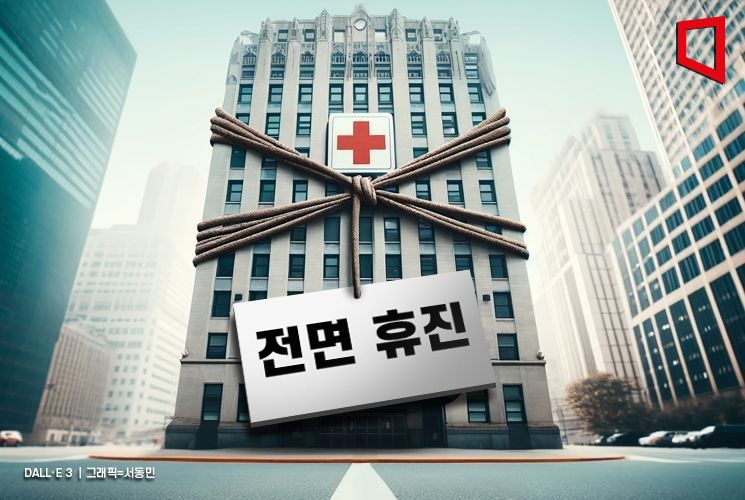
According to the government and medical circles on the 9th, the KMA held a nationwide doctors' representatives meeting in the afternoon and declared a full strike and a general rally to be held on the 18th.
According to the KMA, in a collective action approval vote conducted from the 4th to the 7th of this month targeting all members, out of 111,861 eligible voters, 70,800 participated, recording a turnout rate of 63.3%.
In the vote, 90.6% agreed with the question, "Do you support the KMA's strong struggle to stop the government's medical and educational manipulation?" and 73.5% agreed with the question, "Will you participate in the collective action, including the planned strike in June by the KMA?"
With a high approval rate for participation in collective action in this vote and the National Emergency Committee of Medical School Professors (Jeon-ui-bi), which includes 20 universities, also announcing a solidarity policy, the possibility of a collective strike has increased.
The government has declared that it will respond according to the law if even private practitioners go on strike.
Jeon Byeong-wang, Director of the Health and Medical Policy Office at the Ministry of Health and Welfare, emphasized, "Collective action is neither desirable nor will it bring any changes," adding, "If private practitioners engage in illegal collective action, the government will take necessary measures under the Medical Service Act and other laws to respond."
When the government pushed for an increase in medical school admissions in 2020, anticipating that a significant number of local clinics nationwide would close, it issued guidelines to local governments to issue a 'Medical Service Commencement Order' if the rate of clinic closures in the area exceeded 30%. Later, the guideline was strengthened by lowering the threshold for the commencement order to 15% depending on the strike situation.
The government can issue a commencement order again this time. If private practitioners do not comply, they may face not only suspension of their qualifications for up to one year but also imprisonment for up to three years.
In particular, the revised Medical Service Act allows for the revocation of a doctor's license if they are sentenced to imprisonment without prison labor or higher, probation, or suspended sentence for any crime. Violating the commencement order may lead to license revocation under the Medical Service Act.
In addition to the Medical Service Act, doctors' licenses can also be revoked under the Emergency Medical Service Act, Fair Trade Act, and Criminal Act (for obstruction of business).
The 'Emergency Medical Service Act' allows the head of a medical institution to issue work orders to staff to maintain an emergency medical system. If violated and causing significant disadvantage to patients, license suspension or revocation within six months is possible.
The 'Fair Trade Act' prohibits business associations from unfairly restricting competition or limiting the activities of individual businesses.
If such prohibited acts occur, the business association (doctor's association) may be fined up to 1 billion KRW, and individuals such as association heads may face imprisonment of up to three years or fines up to 200 million KRW.
In fact, during the collective strike by the KMA in 2000 opposing the separation of drug prescribing and dispensing, the then KMA president was convicted for violating the Fair Trade Act and Medical Service Act and had his license revoked.
According to precedent, "Since collective strikes occurred for reasons not based on individual business decisions and caused significant disruption to the public's use of medical institutions, it cannot be seen as an act of fair and free competition among doctors."
© The Asia Business Daily(www.asiae.co.kr). All rights reserved.
![Clutching a Stolen Dior Bag, Saying "I Hate Being Poor but Real"... The Grotesque Con of a "Human Knockoff" [Slate]](https://cwcontent.asiae.co.kr/asiaresize/183/2026021902243444107_1771435474.jpg)















