Yoon Sang-hyun "Government Should Form TF Team to Prepare"
Jung Cheong-rae "Yeongilman Temptation Is Important, But..."
Amid active debates between the ruling and opposition parties over the possibility of oil and gas deposits in Yeongil Bay, Pohang, Gyeongbuk, announced by the government, some voices are calling for attention to be paid to the 7th Block, where the agreement with Japan is about to expire.
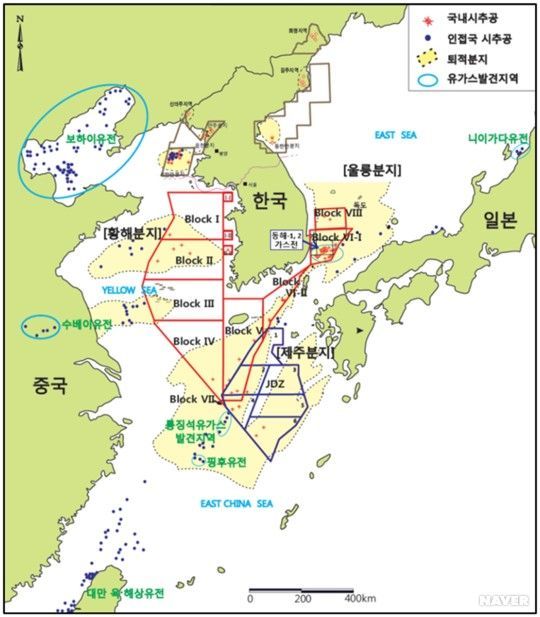
Why is the 7th Block so important... Will Japan take it away?
The 7th Block overlaps with the Korea-Japan Joint Development Zone (JDZ) and is a continental shelf located about 200 km south of Jeju Island. The 7th Block was first revealed in a 1969 report by the United Nations (UN) Economic Commission for Asia and the Far East. The report stated that "the continental shelves of Korea's West Sea and the East China Sea may contain the world's largest oil deposits." A 2004 report by the U.S. international policy research institute, the Woodrow Wilson Center, provided a specific estimate that the natural gas reserves in the East China Sea could be ten times that of Saudi Arabia. In response, Korea and Japan signed the Korea-Japan Continental Shelf Joint Development Agreement in 1974 and began joint development.
The agreement is set to expire in June 2028, but if either Korea or Japan notifies termination three years prior, in June next year, the agreement will end. Korea has so far requested joint development from Japan, but Japan has responded passively, citing economic infeasibility. Korea has been unable to develop independently because the agreement stipulates that "both countries must jointly carry out development."
Another reason for Japan's passive stance is the 1982 UN Convention on the Law of the Sea, which was adopted in a way favorable to Japan. This law follows a method that defines an exclusive economic zone (EEZ) up to 200 nautical miles, rather than the previous method of determining which country the continental shelf is connected to. Simply put, if the negotiations end as they are, most of the 7th Block is likely to belong to Japan, so Japan sees no need for joint development.
Ruling and Opposition Parties: "Prepare for Japan's Exclusive Control of the 7th Block"
On the 7th, Yoon Sang-hyun, a member of the People Power Party, said on his social media, "We should not harbor false hopes of becoming an oil-producing country overnight, but even with uncertainties, we must challenge ourselves with a persistent attitude to discover economically viable oil fields." He advised, "Since the agreement could be unilaterally terminated in June next year, the government should form a task force (TF) to take preemptive measures and prepare for this issue." He added, "Above all, if the agreement ends, Japan will take most of the 7th Block, and China may intervene to claim the rest." He emphasized, "China has claimed that a significant part of the 7th Block in the East China Sea is its own continental shelf extending from the Chinese mainland." While attention is focused on the Yeongil Bay oil field news, the government must also prepare for the development of the 7th Block, where the agreement is about to expire, by mounting a full diplomatic effort.
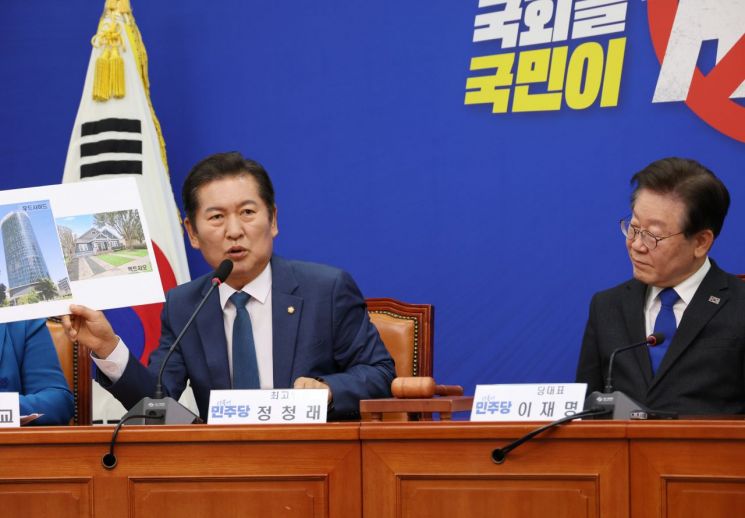
On the same day, the Democratic Party also raised the need to pay attention to the 7th Block. Jung Cheong-rae, a senior member of the Democratic Party, said at a meeting, "There is a song called '7th Block' that was wildly popular in the 1980s." He added, "Since 1980, Korea and Japan have experimentally drilled seven test wells, and although the quantities were small, oil and gas were discovered in three of these wells." He continued, "In 1986, Japan declared a halt to development, citing economic infeasibility, and according to Japan's ulterior motives, it might notify termination of the agreement in June next year." He urged, "While the Yoon Seok-yeol administration should focus on the allure of Yeongil Bay, it should also pay attention to any possible infringement of Korea's interests in the 7th Block."
© The Asia Business Daily(www.asiae.co.kr). All rights reserved.
![Clutching a Stolen Dior Bag, Saying "I Hate Being Poor but Real"... The Grotesque Con of a "Human Knockoff" [Slate]](https://cwcontent.asiae.co.kr/asiaresize/183/2026021902243444107_1771435474.jpg)
















