ECB and Bank of Canada Cut Key Interest Rates
"Fed Expected to Cut Twice More This Year Starting September"
Inflation Trends Remain a Variable
Following Canada and Europe lowering their benchmark interest rates, a global 'pivot' movement is spreading, drawing attention to the timing of the US rate cuts. As recent signals of cooling in the US labor market continue to be detected and concerns about economic slowdown intensify due to weak consumption and manufacturing indicators, Wall Street expects the Fed to begin cutting rates in September and join the pivot.
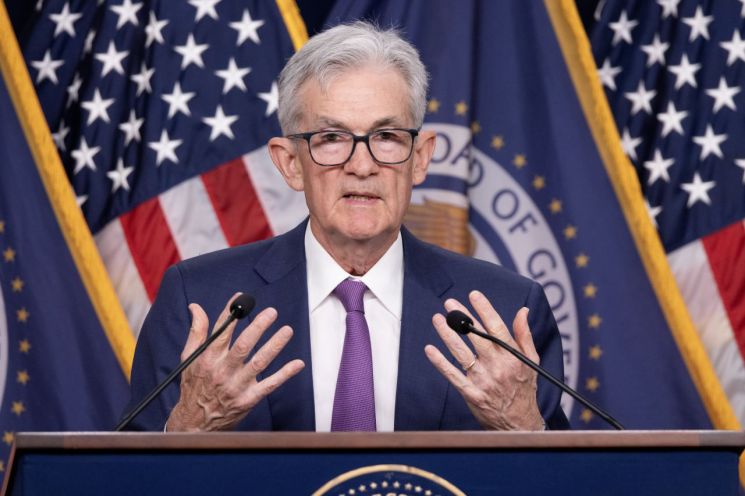
According to the Chicago Mercantile Exchange (CME) FedWatch on the 6th (local time), the federal funds futures market on that day reflected nearly a 70% chance that the Fed will cut rates by at least 0.25 percentage points at the September Federal Open Market Committee (FOMC) meeting. This is a sharp rise of about 20 percentage points from the 50% level at the end of last month.
The heightened expectations for a Fed rate cut in September come as recent data show persistent signs of a slowdown in the US labor market and contraction in both consumption and manufacturing sectors. According to ADP, a US private labor market research firm, private sector new job creation in May was 152,000, significantly below market expectations (173,000) and the previous month's level (188,000). The US Department of Labor reported that the number of job openings in April was 8.059 million, below both the expected 8.37 million and the previous month's 8.355 million, marking the lowest level in over three years since February 2021. The newly released data for the week of May 26 to June 1 showed initial claims for US unemployment benefits at 229,000, exceeding both market expectations (220,000) and the previous week's 221,000. Since overheating in employment has been considered a factor pushing up US inflation, the recent labor market slowdown supports expectations for the Fed to lower benchmark interest rates. The downward revision of the US first-quarter GDP growth rate from an annualized 1.6% to 1.3%, due to a slowdown in consumer spending?which accounts for two-thirds of the US economy?also raises concerns about a more pronounced economic downturn.
Experts also expect the Fed to start cutting rates in September, with the highest forecast being two cuts within the year. According to a Reuters poll conducted from May 31 to June 5 among 116 economists, 64% (74 respondents) predicted the Fed would cut rates by 0.25 percentage points in September. Additionally, 59% (68 respondents) expected the Fed to reduce rates by a total of 0.5 percentage points in two cuts this year. Only 28% (33 respondents) anticipated the Fed would cut rates once or not at all this year.
Oscar Munoz, TD Securities' US Chief Macroeconomic Strategist, said, "The Fed is in a good position in terms of monetary policy currently constraining the economy," forecasting two rate cuts in September and December. He explained, "The Fed does not want to over-restrict. If the economy holds up and inflation continues to decline, it will begin monetary easing."
However, inflation is expected to remain a key variable in the Fed's rate path going forward. Bank of America (BoA) anticipates that the Fed will raise its inflation forecast at the June FOMC meeting. The Fed releases a Summary of Economic Projections (SEP) quarterly, and in March, it raised the core Personal Consumption Expenditures (PCE) price index growth forecast for this year by 0.2 percentage points to 2.8%. Neel Kashkari, President of the Minneapolis Federal Reserve Bank, recently stated in an interview with foreign media that Americans would rather endure a recession than inflation and argued that the current rate level should be maintained longer.
© The Asia Business Daily(www.asiae.co.kr). All rights reserved.
![Clutching a Stolen Dior Bag, Saying "I Hate Being Poor but Real"... The Grotesque Con of a "Human Knockoff" [Slate]](https://cwcontent.asiae.co.kr/asiaresize/183/2026021902243444107_1771435474.jpg)















