63.4% Support 'Hardline Struggle Including Clinic Closures'
Bundang Seoul National University Hospital, Boramae Hospital, Gangnam Center Also Participate
Essential Departments Such as Emergency Room and ICU Excluded
Professors at Seoul National University Hospital announced that if the resident doctor situation is not resolved, they will begin a complete strike from the 17th, excluding some essential departments such as the emergency room and intensive care unit.
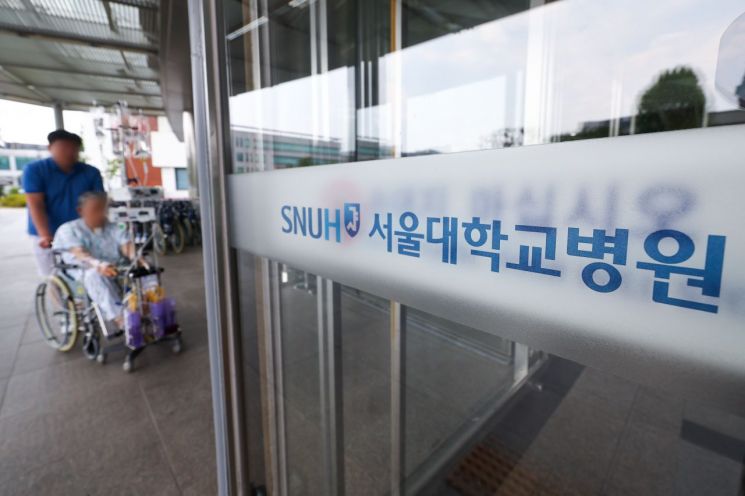
The Emergency Response Committee of Professors at Seoul National University College of Medicine and Seoul National University Hospital (ERC) announced on the 6th that, based on a survey conducted among all professors at four hospitals?Seoul National University Hospital, Bundang Seoul National University Hospital, Seoul Metropolitan Boramae Hospital, and Gangnam Center?they have resolved to initiate a full strike from the 17th, excluding essential departments such as the emergency room and intensive care unit.
In the first survey conducted from the 3rd to the 6th regarding the "professors' course of action related to the advance notice of administrative measures against resident doctors," 63.4% of the 939 respondents supported "strong resistance including a strike." In the second survey conducted from the 5th to the 6th asking about agreement on the strike method, 68.4% of the 750 respondents stated they would participate in a full strike excluding essential departments such as the emergency room and intensive care unit.
The ERC stated, "The full strike will continue until the government completely cancels the medical service maintenance order and work commencement order for all resident doctors, acknowledges responsibility for worsening the current situation by attempting to deprive their right to self-determination, and takes visible measures." They added, "We ask patients to postpone their treatment at our hospitals until the government's unjust actions are revoked," emphasizing, "Please understand that whether the strike continues depends on the government."
Earlier, on the 4th, the government withdrew various orders issued to resident doctors and their affiliated training hospitals, including the medical service maintenance order, work commencement order, and prohibition on accepting resignation letters, and decided to suspend the administrative disciplinary procedures for license suspension, requesting hospitals to persuade resident doctors to return. However, professors at Seoul National University College of Medicine view the government's announcement of "suspending administrative disciplinary procedures" as implying that the government can resume these procedures at any time, and they are demanding the complete cancellation of the administrative measures.
On this day, the ERC pointed out, "The government withdrew the order prohibiting acceptance of resignation letters issued to hospital directors on June 4 and the medical service maintenance and work commencement orders imposed on resident doctors, and stated that if they return, the license suspension will be 'suspended' until training is completed," adding, "This means that the order prohibiting acceptance of resignation letters, which restricts the freedom to choose one's occupation, is still considered lawful."
The ERC argued, "Is it acceptable in a liberal democratic government for individuals to be punished simply for refusing forced labor orders? Although the license suspension is 'suspended,' the fact that they did not work after submitting resignation letters until June 3 still remains their 'illegal act.'"
The ERC stated, "The so-called 'doctor collective action' triggered by the government's announcement to increase medical school quotas is an explosion of accumulated problems in the formulation and operation of Korea's medical policies reaching a critical point," lamenting, "The policies painstakingly announced by the government are often perceived as shackles by the medical community." They further criticized, "Before doctors even began collective action, the government issued bans on collective leave and medical service maintenance orders, reflecting an impure intention to politically exploit medical policies, which has intertwined with distrust and communication failures between the medical community and the government."
© The Asia Business Daily(www.asiae.co.kr). All rights reserved.
![Clutching a Stolen Dior Bag, Saying "I Hate Being Poor but Real"... The Grotesque Con of a "Human Knockoff" [Slate]](https://cwcontent.asiae.co.kr/asiaresize/183/2026021902243444107_1771435474.jpg)















