North Korean MZ Who Spent Childhood During the Arduous March
"Acquired Market Economy... Increased Access to External Culture Through IT Technology"
In response to North Korea's provocations involving filth-filled balloons, our government has indicated a tough stance by loosening legal restrictions on resuming loudspeaker broadcasts toward the North. There is a possibility that criticisms of the North Korean regime and K-pop will be transmitted via these loudspeakers. Additionally, since domestic private defector groups have sent balloons carrying USBs containing Korean cultural content, it is expected that psychological unrest among young North Korean soldiers and residents near the border will be significant.
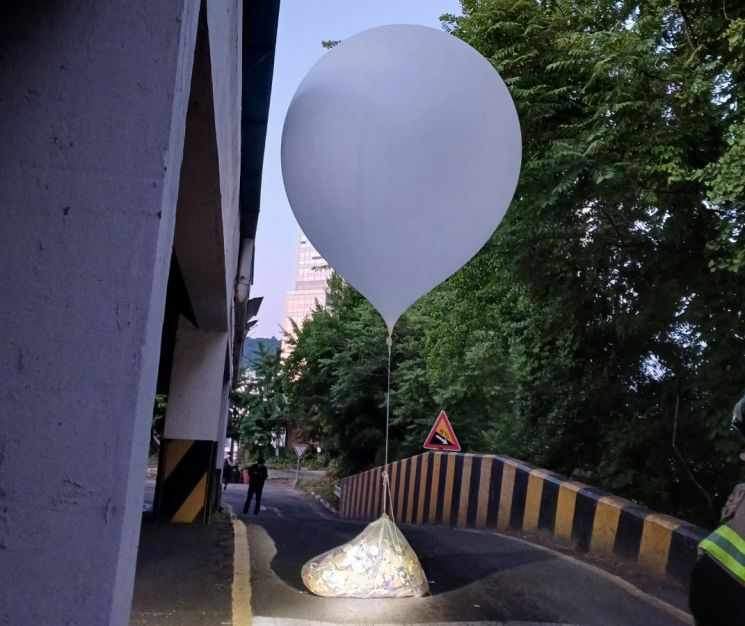 North Korean anti-South Korea trash balloons have fallen on the road in Yonghyeon-dong, Michuhol-gu, Incheon. Photo by Yonhap News
Recently, the defector group Free Joseon Movement sent materials desired by North Korea's MZ generation via balloons carrying USB flash drives to the North in response to the Southward filth balloon dispersal. Earlier, on the 3rd, Park Sang-hak, the head of the Free Joseon Movement, stated in a press release that starting from the 6th, they would release 200,000 leaflets and 2,000 USBs containing videos such as Korean dramas and trot songs by Lim Young-woong via balloons, saying, "Kim Jong-un sent filth and garbage to the people of the Republic of Korea, but defectors will send truth and love to 20 million North Korean compatriots."
This measure aims to induce unrest among young North Korean soldiers. During major provocations by North Korea, our government has used loudspeakers as a pressure card; in January 2016, former President Park Geun-hye actively utilized loudspeakers, calling them "the most certain and effective psychological warfare against North Korea." North Korea reacted sensitively. In July of the same year, North Korea harshly criticized our government, calling the Demilitarized Zone along the Military Demarcation Line "a fuse line for a new northern invasion war" and accusing the South Korean authorities of malicious intent.
In the current phase of North Korea's 'filth balloon provocation,' the government's decision to lift restrictions on resuming loudspeaker broadcasts and the defector groups' leaflet dispersal to the North are in this context. Especially since changes in regime perception among North Korea's MZ generation, known as the Jangmadang generation, are becoming prominent, the psychological warfare effect is expected to be greater.
'North Korean MZ' Jangmadang Generation... Signs of Regime Unrest Emerging
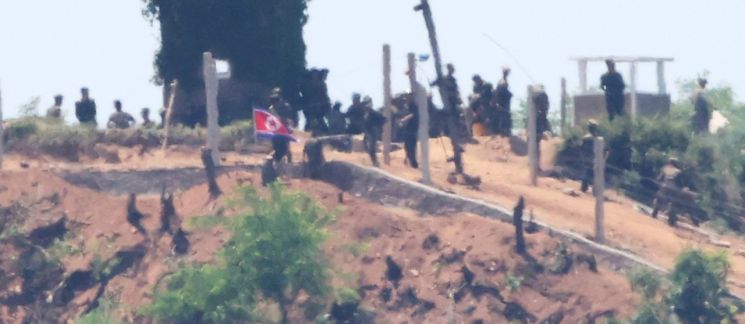 On the 4th, when the proposal to suspend the entire effect of the September 19 inter-Korean military agreement passed the State Council meeting, North Korean soldiers were conducting fortification work at a North Korean outpost viewed from the border area in Paju, Gyeonggi Province. Photo by Yonhap News Agency
The Jangmadang generation is a neologism referring to North Korea's youth born after the 1980s. As of 2022 estimates, they number about 3.5 million, accounting for approximately 14% of North Korea's estimated population of 25 million. According to the KB Financial Group Management Research Institute's report titled "North Korea's MZ Generation: Characteristics and Trends of the Jangmadang Generation," the Jangmadang generation currently works as laborers, market merchants, and trade workers inside North Korea or abroad, actively generating real income within the North Korean economy. Because they were born around the same time and lead income and consumption, they can be compared to South Korea's MZ generation (Millennials + Generation Z). They also share tendencies such as valuing 'self/individual' over 'group/organization,' unlike older generations.
The report analyzes, "Teenagers in the Jangmadang generation who earn money in the markets purchase the latest mobile phones as a form of conspicuous consumption, and they value quickly accessing and knowing more about external cultures by watching videos or listening to music from South Korea, China, and other countries."
North Korean authorities expect conformity to the regime and call them the "new generation," but outwardly conforming, they tend to emphasize 'self-reliance,' taking responsibility for their own survival. This tendency was influenced by the 'Arduous March' of the 1990s, during which the Jangmadang generation experienced childhood and adolescence. Unlike older generations, they survived extreme hardship through market activities rather than state rationing, thereby internalizing market economy practices. According to a recent report on the perception of North Korea's economic and social realities released by the Ministry of Unification, although a very small minority of about 1%, cases have been confirmed where people in their 20s to 40s, including the Jangmadang generation, opened proxy accounts at Chinese banks to store surplus funds.
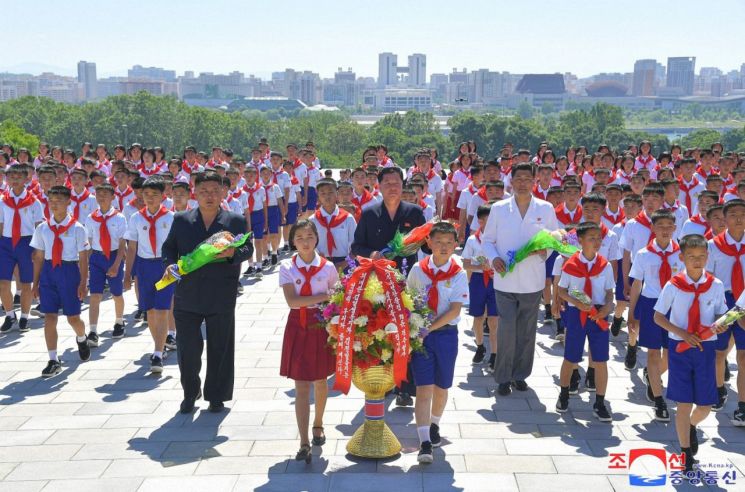 On the 3rd, participants of the 78th anniversary celebration of the founding of the North Korean Boy Scouts (June 6) laid flower baskets at the statues of President Kim Il-sung and National Defense Commission Chairman Kim Jong-il, according to a report by the Korean Central News Agency on the 4th. Photo by Yonhap News Agency
North Korea has been strengthening ideological control by enacting laws such as the 2020 Anti-Reactionary Thought and Culture Rejection Law, the 2021 Youth Education Guarantee Law, and the 2023 Pyongyang Cultural Language Protection Law, but signs of unrest among North Korean residents are increasingly detected. Recently, the North Korea-focused media Daily NK reported that word of mouth about the South Korean film "Pawn" is rapidly spreading among residents near the North Korean border, indicating a surge in the inflow of K-content.
The report diagnoses, "The Jangmadang generation is actively accessing external culture using IT technology. While it is uncertain whether the Jangmadang generation can change the North Korean regime, those who have internalized the market economy, unlike older generations, desire change and self-reliance rather than conformity to the North Korean regime."
© The Asia Business Daily(www.asiae.co.kr). All rights reserved.
![Clutching a Stolen Dior Bag, Saying "I Hate Being Poor but Real"... The Grotesque Con of a "Human Knockoff" [Slate]](https://cwcontent.asiae.co.kr/asiaresize/183/2026021902243444107_1771435474.jpg)

















