Final Approval of 1.0814 Trillion Won 'Myeonmok Line Light Rail' Feasibility Study
Mayor Oh Strongly Committed to Project Promotion... Efforts to Improve Feasibility
Connected with Lines 1, 6, 7, Gyeongui-Jungang, Gyeongchun, GTX B/C... Key Transportation Hub
The Seoul City Myeonmok Line light rail project passed the final review of the preliminary feasibility study by the 4th Fiscal Project Evaluation Committee of the Ministry of Economy and Finance on the 5th. The line connects Cheongnyangni Station (Line 1) in Dongdaemun-gu to Sinnnae Station (Line 6) in Jungnang-gu, and upon completion, it is expected to serve as a key transportation hub in the northeastern area.
The 'Myeonmok Line Light Rail,' with a total project cost of 1.0814 trillion KRW, spans 9.147 km and consists of 12 stations. It was selected as a preliminary feasibility study target project in August 2021, and since October of the same year, the Ministry of Economy and Finance and the Korea Development Institute (KDI PIMAC) have been conducting the study.
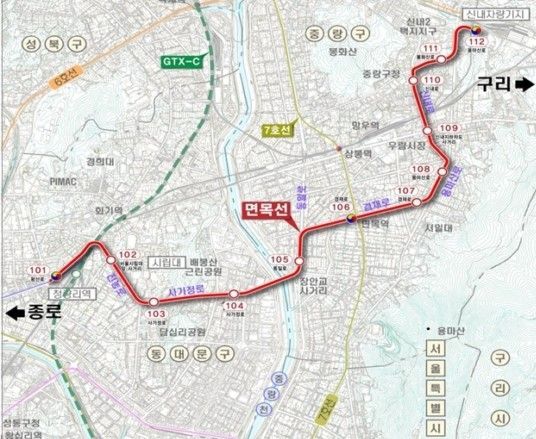
The project has also seen strong determination from Seoul Mayor Oh Se-hoon, local members of the National Assembly, and residents. Seoul City systematically prepared the comprehensive evaluation of the preliminary feasibility study by highlighting the transportation inconvenience and regional balanced development effects. In particular, Seoul City devised various measures to enhance project feasibility, including one change in the project plan, and conducted close consultations with related agencies.
Recently, the city presented to the government strategies to improve ridership and benefits by updating future development plans around the Myeonmok Line and changing the vehicle type (from rubber-tired vehicles to steel-wheeled vehicles), as well as optimizing train operation plans and station construction costs to reduce total project expenses.
Seoul City expects that with the final approval of the preliminary feasibility study, the convenience of residents in areas that have experienced difficulties accessing the city center due to insufficient transportation infrastructure will greatly improve. Furthermore, the connectivity with GTX and Seoul subway lines will be enhanced, enabling the line to properly fulfill its role as a key route to achieve the national goal of balanced development. Seoul City plans to promptly proceed with subsequent steps such as basic planning and detailed design to ensure early opening.
However, the 'Gangbuk Transversal Line,' which was reviewed on the same day, did not pass the preliminary feasibility study despite various efforts to increase benefits and reduce costs. Seoul City stated that the Gangbuk Transversal Line is also a crucial route necessary for regional balanced development and will be resubmitted soon after route adjustments and feasibility improvements. It is analyzed that the line’s economic feasibility was rated low because, although it requires relatively high costs due to passing through mountainous areas, the demand is predicted to be low.
Mayor Oh said, "The Myeonmok Line will connect seven lines including Lines 1, 6, 7, Gyeongui-Jungang, Gyeongchun, and GTX B/C, and upon completion, it will serve as a transportation hub in the northeastern area." He added, "The Myeonmok Line, connecting northeastern Seoul and the city center, is a major route for public welfare and a core facility for the grand transformation of the Gangbuk area and the Gangbuk Renaissance era. We will do our utmost to complete the urban railway network and promote regional development through this project."
© The Asia Business Daily(www.asiae.co.kr). All rights reserved.
![Clutching a Stolen Dior Bag, Saying "I Hate Being Poor but Real"... The Grotesque Con of a "Human Knockoff" [Slate]](https://cwcontent.asiae.co.kr/asiaresize/183/2026021902243444107_1771435474.jpg)















