Last Year, South Korea's Per Capita GNI Was $36,194, Ranking 6th Worldwide
Japan Ranked 7th with $35,841
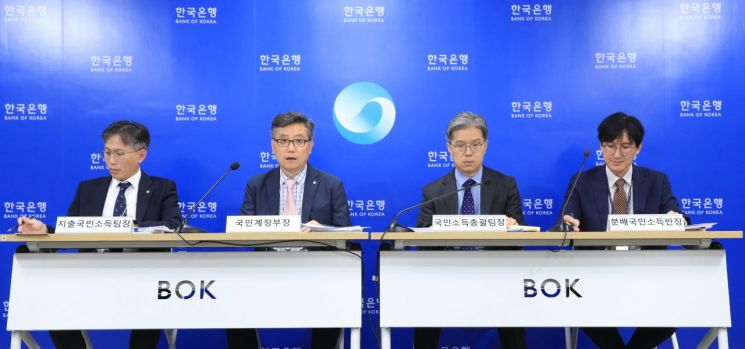 On the 5th, a briefing session was held at the Bank of Korea in Jung-gu, Seoul, on the provisional results of the 1st quarter 2024 national income and the first revision of the national accounts based on the 2020 standard year.
 From the left in the photo: In-gyu Lee, Head of the National Income Expenditure Team; Jeong-tae Choi, Head of the National Accounts Department, Economic Statistics Bureau; Chang-gu Kang, Head of the National Income General Team; Eun-jong Jang, Head of the National Income Distribution Team. (Photo by Bank of Korea)
Last year, South Korea's per capita national income surpassed Japan's for the first time.
According to the Bank of Korea on the 5th, South Korea's per capita Gross National Income (GNI) last year was recorded at $36,194. This ranks 6th among countries with populations over 50 million, following the United States, Germany, the United Kingdom, France, and Italy. Japan ranked 7th, just behind South Korea.
Choi Jung-tae, Director of the Bank of Korea's National Accounts Department, stated, "Last year, South Korea's per capita GNI was lower than Italy's but higher than Japan's and Taiwan's," adding, "This is the first time South Korea has surpassed Japan."
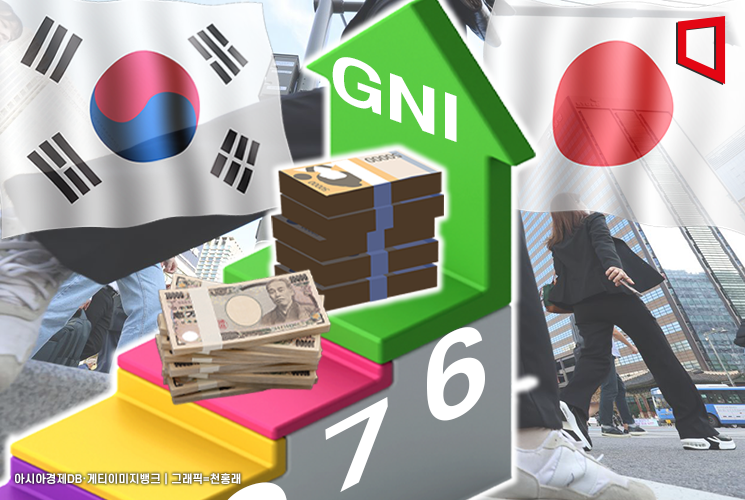
Japan's per capita GNI last year was estimated at $35,841. Director Choi explained, "Japan was significantly affected by the weak yen phenomenon."
He also predicted that achieving a per capita GNI of $40,000 could be possible within a few years. Director Choi said, "If the current trend continues and assuming exchange rates stabilize, reaching a per capita national income of $40,000 within a few years is expected."
According to the Bank of Korea, South Korea's real GNI in the first quarter of this year rose by 2.4% compared to the previous quarter. This is the largest increase in eight years since a 2.8% rise in the first quarter of 2016. This figure exceeds the first quarter's real Gross Domestic Product (GDP) growth rate of 1.3%.
GNI is calculated by adding the income earned by nationals abroad to GDP and subtracting the income earned domestically by foreigners. It is an indicator developed to more accurately measure national income.
The Bank of Korea explained that GNI improved in the first quarter due to a significant increase in exports while imports decreased. Director Choi said, "In the first quarter of this year, prices of IT export products such as semiconductors rose compared to the previous quarter, while prices of imported goods like crude oil fell, leading to a larger increase in GNI."
The reason this year's GNI growth rate is higher than in other years is due to a significant improvement in semiconductor exports. Director Choi explained, "South Korea's export terms of trade are heavily influenced by semiconductors, accounting for about 70%. This reflects the substantial improvement in the semiconductor industry."
The GDP deflator, an index representing the overall domestic price level, rose by 3.9% in the first quarter compared to the same period last year. This is the highest in nine quarters since it recorded 4.4% in the fourth quarter of 2021. The export deflator rose due to increases in semiconductor prices, while the import deflator fell due to lower prices of crude oil and natural gas.
© The Asia Business Daily(www.asiae.co.kr). All rights reserved.
![Clutching a Stolen Dior Bag, Saying "I Hate Being Poor but Real"... The Grotesque Con of a "Human Knockoff" [Slate]](https://cwcontent.asiae.co.kr/asiaresize/183/2026021902243444107_1771435474.jpg)
















