UN Conference on Trade and Development's 'The World of Debt' Report
US Tops with $33 Trillion, Developing Countries at $29 Trillion
Geopolitical Crises and Unequal Global Economic Outcomes Identified as Causes
Last year, global public debt reached a record high of 13 quadrillion won. It was found that one-third of this debt belongs to developing countries. There are concerns that the sharp increase in interest burdens could weaken the provision of basic government services such as healthcare, education, and the environment in these countries.
According to the "A World of Debt" report released on the 4th (local time) by the United Nations Conference on Trade and Development (UNCTAD), the global public debt in 2023 was estimated at $97 trillion (approximately 13 quadrillion 3,400 trillion won), a 5.7% increase compared to 2022.
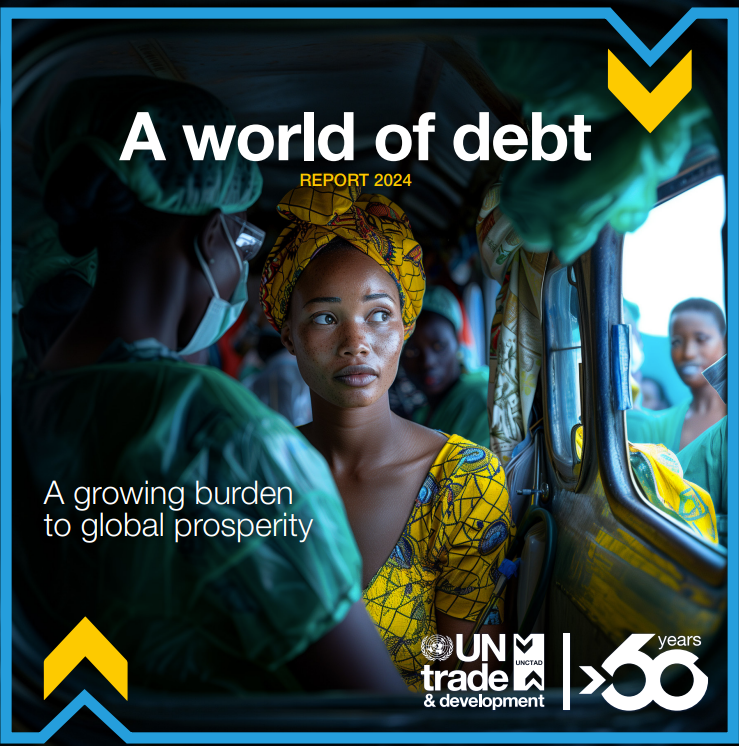 Cover of the report "A World of Debt" released on the 4th (local time) by the United Nations Conference on Trade and Development (UNCTAD) [Image source=United Nations Conference on Trade and Development]
By country, the United States had the largest debt at $33 trillion (4 quadrillion 5,400 trillion won), followed by China (about $15 trillion) and Japan ($10.6 trillion). In particular, the public debt of developing countries such as India, Egypt, Mexico, and Brazil reached $29 trillion (about 4 quadrillion won), accounting for about 30% of the total global debt.
UNCTAD stated, "The 'cascading crises' in the international community and the sluggish and uneven performance of the global economy have supported the rapid increase in global public debt," diagnosing that "debt is increasing at twice the rate in developing countries compared to wealthy countries." It also emphasized, "With the global interest rate hike trend last year, borrowing costs increased, and interest on public debt approached $847 billion, a 26% increase compared to two years ago."

UNCTAD particularly noted that the proportion of debt held by developing countries in the total debt increased from 16% in 2010 to 30%. There are concerns that to repay the rapidly growing debt and interest, funds that should be invested in healthcare, welfare, and education will inevitably decrease.
The Associated Press also pointed out, "Among the 3.3 billion people living in developing countries, one-third spend more money on paying interest than on 'critical areas for human development' such as healthcare, education, and climate."
In the report, UNCTAD stressed, "Developing countries should not be forced to choose between repaying debt and serving their people," and urged, "To ensure a future where both people and the planet prosper, the international financial structure must change."
© The Asia Business Daily(www.asiae.co.kr). All rights reserved.
![Clutching a Stolen Dior Bag, Saying "I Hate Being Poor but Real"... The Grotesque Con of a "Human Knockoff" [Slate]](https://cwcontent.asiae.co.kr/asiaresize/183/2026021902243444107_1771435474.jpg)
















