India's stock market is experiencing a sharp decline of around 5% in the early stages of vote counting on the 4th (local time). This is a reaction to the unexpectedly close race confirmed in the early counting, contrary to the exit polls that had predicted a landslide victory for Prime Minister Narendra Modi's side. The rupee and bonds are also showing weakness.
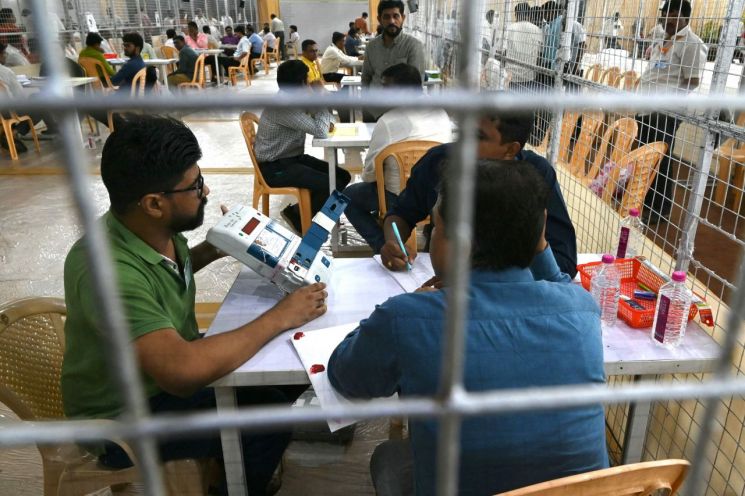
As of 11 a.m. local time (3 p.m. KST) on the same day, the benchmark Sensex index in the Indian stock market is trading about 4.85% lower than the previous close. The Nifty 50 index has also fallen about 5% compared to the previous session. Earlier, major Indian stock indices had reached record highs the day before after exit polls released over the weekend predicted a landslide victory for the Bharatiya Janata Party (BJP) led by Modi, but with the start of vote counting, they are collectively giving back their gains.
The Sensex and Nifty indices, which both recorded gains of over 3% the previous day, started trading down more than 2% this morning. Currently, among the 50 major companies included in the Nifty 50 index, 44 are showing declining stock prices. Adani Ports, considered one of the so-called 'Modi stocks,' is experiencing a drop of around 20%. The market capitalization of the Adani Group shrank by $36 billion compared to the previous close as of 11:30 a.m. Mumbai time. This far exceeds the $20 billion added during the previous day's rally.
In the bond market, the 10-year Indian government bond yield rose more than 10 basis points to around 7.04% as of 10 a.m. The rise in bond yields indicates a drop in bond prices. The rupee fell more than 0.3% against the dollar, giving up most of the previous day's gains. The Indian volatility index surged more than 26% intraday, reaching its highest level since June 2022. This index had fallen more than 15% on Monday, after the exit polls were released, marking a two-week low.
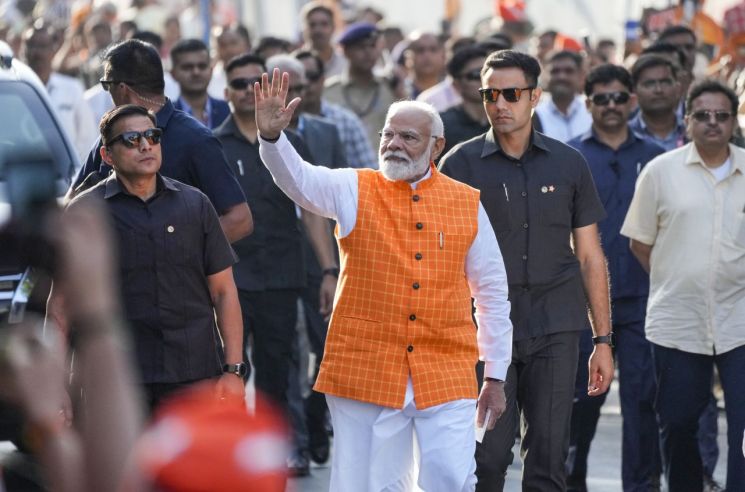
This market sentiment is due to the unexpectedly close contest between the ruling coalition led by Modi and the opposition coalition confirmed during the vote counting process. Bloomberg reported, "At this point, the likelihood of Prime Minister Modi securing the ambitious 400 seats seems low. This is very different from the exit polls released on the 1st," adding, "The Indian stock market has turned downward, and with waning expectations from the exit polls, the rupee and bonds are also showing weakness." Additionally, profit-taking selling appears to have poured in following the record-high market session the previous day. Major foreign media outlets, including The New York Times (NYT), described the competition as "more intense than expected," analyzing that "the exit polls may have been overly optimistic."
Currently, candidates from the National Democratic Alliance (NDA), the ruling coalition led by the BJP, are leading in 285 out of 543 constituencies about three hours into the vote counting. The BJP alone is leading in 236 constituencies. While securing the majority threshold of 272 seats seems achievable, it is far from the initial target of 400 seats. Exit polls released over the weekend had predicted that the BJP-led coalition would secure between 353 and 401 seats in the lower house of parliament.
© The Asia Business Daily(www.asiae.co.kr). All rights reserved.
![Clutching a Stolen Dior Bag, Saying "I Hate Being Poor but Real"... The Grotesque Con of a "Human Knockoff" [Slate]](https://cwcontent.asiae.co.kr/asiaresize/183/2026021902243444107_1771435474.jpg)
















