Meeting Held Aiming for Approval by Emergency Committee on 13th
Discussion on Public Opinion Reflection Ratio and Anti-Backdoor Voting Clause
Leadership System Transition Amendment Expected to Take Time
The People Power Party's Special Committee on Amendments to the Party Constitution and Rules announced on the 4th that it plans to complete discussions on amendments by the 12th.
On the same day, after the first meeting at the party headquarters, Special Committee Chairperson Yeo Sang-gyu told reporters, "The opinions presented by the party will be from today (the 4th) until the 12th," adding, "We are conducting meetings with the goal of finishing by the 12th."
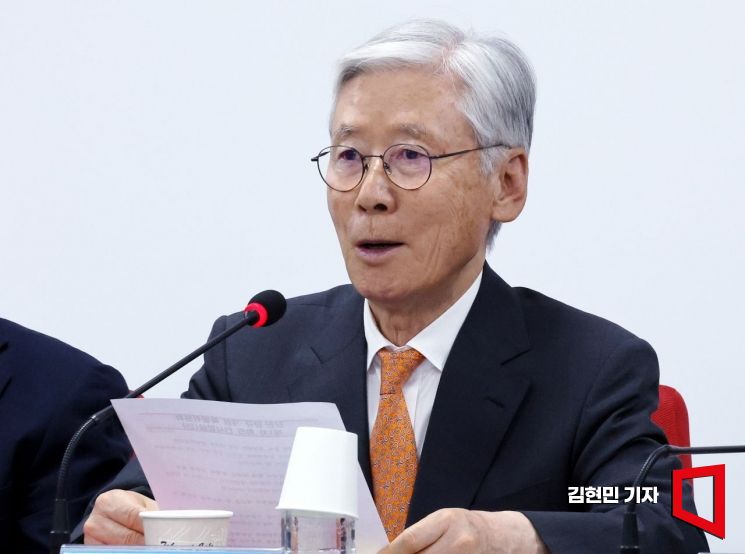 Yeosangyu, Special Committee Chairman for the Revision of the Party Constitution and Rules of the People Power Party, is speaking at the first meeting of the Special Committee for the Revision of the Party Constitution and Rules held at the party headquarters in Yeouido, Seoul, on the 4th. Photo by Hyunmin Kim kimhyun81@
The special committee aims to submit the amendment proposals as an agenda item to the Emergency Response Committee meeting scheduled for the 13th and have them approved. The agenda includes ▲ the proportion of public opinion reflection ▲ transition of leadership system ▲ separation of party leadership and presidential candidacy ▲ provisions to prevent reverse selection. Chairperson Yeo said, "I expect that issues like the runoff voting system and preparations for party leadership and presidential candidacy could be concluded within a day or two of discussion."
The variable is the transition of the leadership system. Currently, the People Power Party adopts a single leadership system where the party leader and supreme council members are elected separately. The proposed collective leadership system involves electing the party leader and supreme council members together, with the runner-up in the party leader election appointed as a supreme council member. The single leadership system has the advantage of clear accountability and unified leadership, while the collective leadership system allows relatively prominent figures to be positioned in the leadership. Chairperson Yeo predicted, "Discussions on the leadership system issue may continue until next week."
© The Asia Business Daily(www.asiae.co.kr). All rights reserved.

















