EBS "Easier than last year's CSAT"
Some academies say "More difficult questions"
'Discriminative questions' Common subjects No. 15 and 22
EBS analyzed that the mathematics section of the June mock test for the 2025 College Scholastic Ability Test (CSAT) was somewhat easier than last year's CSAT. Opinions on the difficulty level were divided within the admissions industry.
At 12:10 PM on the 4th, the second session of the mathematics section of the 2025 CSAT June mock test, administered by the Korea Institute for Curriculum and Evaluation, concluded. On the same day, the Educational Broadcasting System (EBS) provided an analysis of the test trends, including difficulty by session, together with its affiliated teachers.
Teacher Shim Juseok from Incheon Haneul High School analyzed, "The mathematics section appears to have been set at an easier level compared to the 2024 CSAT," adding, "Although there were no so-called 'killer questions' (ultra-high difficulty questions), the test included questions capable of differentiating top-tier students."
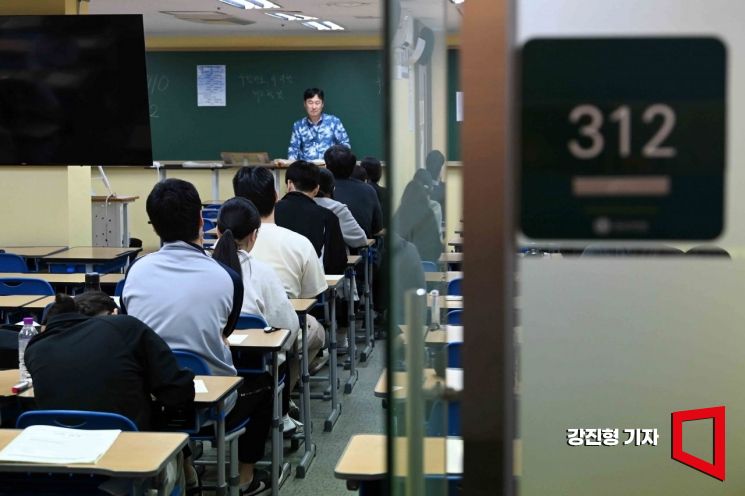 After the announcement of the admission guidelines reflecting the increase in medical school quotas for the 2025 academic year, repeat students are taking the mock CSAT on the 4th at the Jongno Academy Mokdong main branch in Yangcheon-gu, Seoul. Photo by Jinhyung Kang aymsdream@
Compared to the September mock test last year, when the 'killer question exclusion policy' was first applied, EBS analyzed this test as somewhat more difficult. Teacher Shim said, "From the perspective of perfect scorers, this test was indeed harder than the September mock test," and added, "For other grade ranges, the difficulty is similar to or slightly harder than the September mock test."
EBS-linked questions accounted for 15 out of 30 questions, with a linkage rate of 50%. Teacher Shim explained, "12 questions were linked in the common subjects, and 3 questions each were evenly linked in the elective subjects."
In the common subjects, Mathematics I had a total of 11 questions: 4 questions on exponential and logarithmic functions, 3 questions on trigonometric functions, and 4 questions on sequences. Mathematics II included 2 questions on limits and continuity of functions, 5 questions on differentiation of polynomial functions, and 4 questions on integration of polynomial functions. For the elective subjects, Probability and Statistics included 4 questions on combinations and permutations and 4 questions on probability. Calculus had 3 questions on limits of sequences and 5 questions on differentiation. Geometry included 4 questions on conic sections and 4 questions on plane vectors.
Questions with high discriminative power commonly included question 22 in the common subjects (Mathematics I), question 15 (Mathematics II), question 30 in Probability and Statistics, question 30 in Calculus, and question 30 in Geometry. In particular, question 22, which was mainly from Mathematics II, was interpreted as possibly unfamiliar to students. Megastudy stated, "(Question 22) requires checking each case using the 15th term to find the first term, involving verification of 14 terms, and the unfamiliarity with the position of the number likely increases the perceived difficulty."
Opinions on the overall difficulty of the mathematics section were divided among academies. Jongro Academy stated in a press release, "There were no questions that could be specifically identified as killer questions," and added, "The test was set with discriminative power at a level similar to last year." Daesung Academy interpreted, "The difficulty was slightly lower than the 2024 CSAT. The difficulty of 3-point and 4-point questions generally seems to have decreased." On the other hand, Megastudy evaluated, "Overall, the test was set slightly harder than last year's CSAT."
Daesung Academy recommended, "Since common subject questions have recently been mainly difficult, the study proportion for common subjects should be increased," and added, "Especially for students choosing Probability and Statistics over Calculus or Geometry, it is necessary to increase the study proportion of common subjects even more."
© The Asia Business Daily(www.asiae.co.kr). All rights reserved.
![Clutching a Stolen Dior Bag, Saying "I Hate Being Poor but Real"... The Grotesque Con of a "Human Knockoff" [Slate]](https://cwcontent.asiae.co.kr/asiaresize/183/2026021902243444107_1771435474.jpg)















