May S&P Global and ISM PMI Release
US Labor Department to Publish May Employment Report on 7th
The three major indices of the U.S. New York stock market showed an upward trend in the early trading session on the 3rd (local time), the first trading day of this month. AI leader Nvidia surged nearly 4% after announcing its next-generation AI chip 'Rubin.' Amid signs of economic contraction due to a slowdown in U.S. consumption, the market is expected to focus on employment and manufacturing indicators this week.
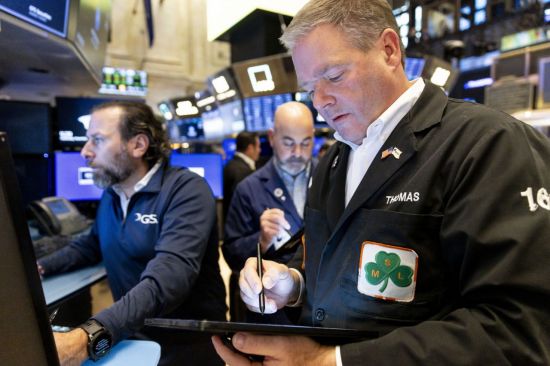
As of 9:32 a.m. at the New York Stock Exchange (NYSE) on the day, the Dow Jones Industrial Average was up 0.06% from the previous close, standing at 38,707.89. The S&P 500, centered on large-cap stocks, rose 0.35% to 5,296.11, and the tech-heavy Nasdaq index was trading up 0.73% at 16,857.62.
By stock, Nvidia jumped 3.8%. Nvidia CEO Jensen Huang unveiled the next-generation AI graphics processing unit (GPU) 'Rubin' on the 2nd, attracting strong buying interest. The Rubin GPU adopts the 6th generation high-bandwidth memory (HBM) called 'HBM4.' GameStop surged 64.43% after Keith Gill, famous as 'Roaring Kitty,' a U.S. retail investor who led the meme stock craze, posted content showing he holds a large amount of GameStop stock and options. Paramount's shares rose 8.32% following news that the U.S. film production company Skydance and Paramount agreed on merger terms.
Last week, the April core Personal Consumption Expenditures (PCE) price index rose 2.8% year-on-year. This matched market expectations and was unchanged from the previous month. The core PCE price index, the inflation gauge most closely watched by the U.S. Federal Reserve (Fed), declined, leading to a general drop in U.S. Treasury yields.
However, real personal income and real personal consumption, adjusted for inflation, each fell by 0.1% from the previous month, indicating signs of consumption slowdown. Consumption accounts for two-thirds of the U.S. economy and serves as an economic barometer. The consumption weakness was also confirmed in the revised U.S. first-quarter Gross Domestic Product (GDP) growth rate released on the 30th of last month. The first-quarter GDP growth rate was revised down from the preliminary annualized rate of 1.6% to 1.3%, with the slowdown in consumer spending being the main cause.
With rising market caution due to signs of consumption slowdown, investors are focusing on manufacturing and employment data to be released this week.
On the 3rd, the May S&P Global Manufacturing Purchasing Managers' Index (PMI) and the Institute for Supply Management (ISM) Manufacturing PMI will be announced. On the 5th, the May S&P Global Services PMI and ISM Services PMI will be released.
Employment data will also be released consecutively. On the 5th, ADP's May private employment report will be published, and on the 7th, the Department of Labor's May nonfarm payroll report will be released. May nonfarm payrolls are expected to increase by 185,000 from the previous month. In April, the increase was 175,000, below the forecast of 243,000. If the overheated labor market cools down, the consumption slowdown and inflation decline could accelerate.
JP Morgan strategist Mislav Matejka analyzed, "We are seeing limited summer gains due to a mismatch between the demand for disinflation, a no-hard-landing scenario, and confidence in earnings acceleration."
U.S. Treasury yields are declining. The U.S. 10-year Treasury yield, a global bond yield benchmark, is trading at around 4.47%, down 4 basis points (1bp = 0.01 percentage points) from the previous trading day. The 2-year Treasury yield, sensitive to monetary policy, is moving around 4.87%, down 2 basis points from the previous day.
International oil prices are falling despite news of an extension of production cuts by the Organization of the Petroleum Exporting Countries Plus (OPEC+). West Texas Intermediate (WTI) crude oil fell $0.66 (0.86%) to $76.33 per barrel, and Brent crude, the global oil price benchmark, dropped $0.58 (0.72%) to $80.53 per barrel.
© The Asia Business Daily(www.asiae.co.kr). All rights reserved.
![Clutching a Stolen Dior Bag, Saying "I Hate Being Poor but Real"... The Grotesque Con of a "Human Knockoff" [Slate]](https://cwcontent.asiae.co.kr/asiaresize/183/2026021902243444107_1771435474.jpg)















