Compensation and Property Division Reach Record Highs
"'Special Property' Will Be Harder to Prove in Ordinary Civil Cases"
"2 Billion Won Compensation Is Unusual... Issues of Equity with Industrial Accident and Other Civil Cases"
Recently, the appellate court ruling in the divorce lawsuit between Choi Tae-won, chairman of SK Group, and Noh So-young, director of Art Center Nabi, resulted in the largest amount of alimony and property division in history, drawing attention to how this high-profile divorce case might influence general divorce lawsuits.
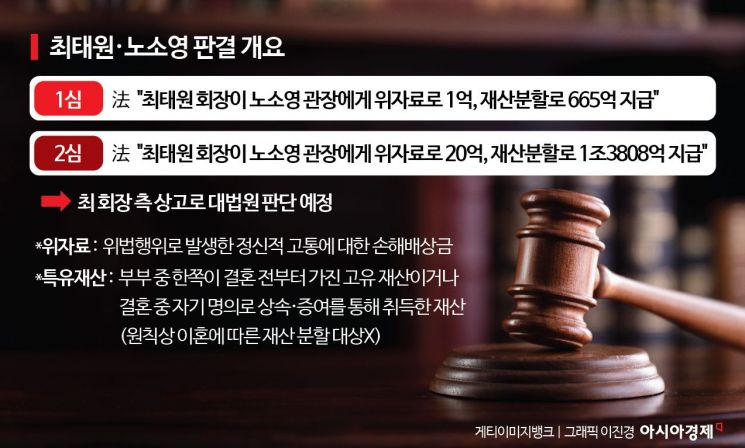
According to the legal community on the 4th, Choi's side filed an appeal to the Supreme Court after the Family Division 2 of the Seoul High Court (Presiding Judges Kim Si-cheol, Kim Ok-gon, and Lee Dong-hyun) ruled on the 30th of last month that "Chairman Choi must pay Noh 1.3808 trillion won in property division and 2 billion won in alimony."
This appellate ruling increased the alimony and property division amounts that Choi must pay by 20 times compared to the first trial. The alimony recognized in the previous first trial was 100 million won, and the property division was 66.5 billion won. The legal community acknowledged that "the amounts recognized by the court are indeed exceptional," but also stated, "the impact of a chaebol family's divorce lawsuit on other general divorce cases should be examined separately depending on the circumstances."
First, the key issue in property division was the 'separate property' portion. Separate property refers to assets that one spouse owned before marriage or assets acquired in their name during the marriage, which are generally not subject to division. Until now, Choi's side argued that the SK shares originated as separate property gifted or inherited from the late Choi Jong-hyun, the former SK chairman, but Noh's side countered that "slush funds from Noh's father, the late former President Roh Tae-woo, were transferred to SK." Unlike the first trial, the appellate court sided with Noh's claim.
Oh Yong-gyu, a partner lawyer at Dongin Law Firm and former presiding judge, explained, "For separate property to be recognized as subject to division, it must be acknowledged that 'there was help in maintaining that separate property.' In this ruling, it was judged that Noh did not just provide simple assistance but made 'significant contributions' during the increase in stock and its value after marriage."
Choi Ji-soo, a lawyer at Lynn Wells & Management Law Firm, predicted, "The argument that separate property should be included in property division could become much stronger in general divorce lawsuits." She added, "Before the first trial ruling in this 2022 case, the scope of recognizing contributions to 'formation and maintenance of property' was broader, but recently, there has been a practical increase in demands to substantiate the formation and maintenance process of separate property. This ruling will intensify disputes over separate property, and the evidence for it will need to be presented more concretely."
Regarding alimony, it was viewed as unlikely to have an immediate impact. Since numerous divorce precedents have recognized alimony at levels of 30 million or 50 million won, it is difficult for precedents recognizing alimony amounts in the hundreds of millions of won to be established quickly. Alimony refers to damages for mental suffering caused by illegal acts.
Lawyer Choi said, "Even in other damage compensation cases unrelated to divorce, it is difficult for alimony to move beyond the standard of 100 million won when a person dies. While there is sympathy for increasing alimony for the breakdown of marital life, it is hard for that to differ significantly from the amount of damages in civil lawsuits, including industrial accidents."
He continued, "The standards for alimony in civil lawsuits must first be discussed for changes to occur that increase alimony in divorce lawsuits. This ruling may influence the beginning of a related consensus, but considering fairness with other civil cases, more time will be needed, and ultimately, the prediction that 'alimony in divorce lawsuits will immediately increase' is premature."
However, it remains uncertain whether the ruling between Chairman Choi and Director Noh will be upheld as is by the Supreme Court. The legal community forecasts a 'prolonged trial,' denying the possibility of a summary dismissal by the Supreme Court. Summary dismissal is a system where the Supreme Court dismisses an appeal without substantive review if there is no significant legal violation in the lower court's ruling. Lawyer Oh said, "It will take quite some time for the Supreme Court's decision. The amount is large, and the case has significant public interest. The Supreme Court will review the issues raised in the appellate court, and the case will be prolonged."
© The Asia Business Daily(www.asiae.co.kr). All rights reserved.

















