Discovery of Offshore Oil in Guyana, Falkland Islands
Boosted Economic Growth but Also Posed Security Threats
Exploration, Drilling, and Development Take Decades
It has been suggested that there may be oil and gas reserves amounting to 14 billion barrels in the waters off Yeongilman Bay, Pohang, Gyeongbuk. If this observation is confirmed through exploratory drilling, South Korea could become an oil-producing country capable of extracting a significant amount of crude oil and gas. Could an unexpected 'windfall' moment come to resource-poor South Korea? For now, it remains only a possibility. We looked into what happened to countries that accidentally discovered oil in their offshore waters in the 21st century.
There Was Oil Offshore... Countries That Unexpectedly Hit the Jackpot
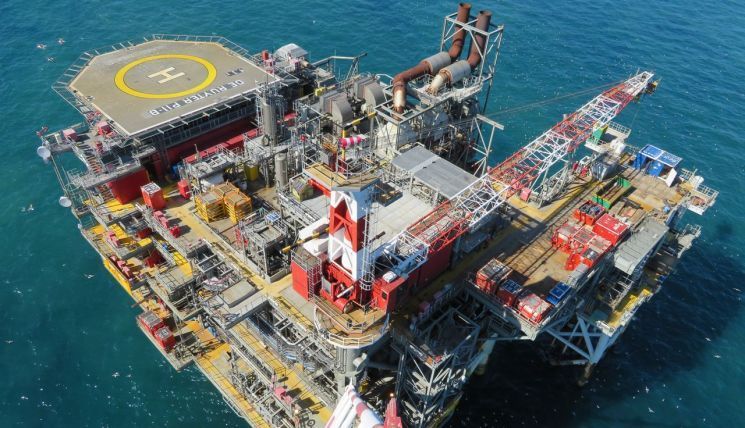 'Dana Petroleum,' a subsidiary of Korea National Oil Corporation, operates the 'Drauter' offshore oil field in the North Sea. The photo is not related to any specific expression in the article. [Image source=Dana Petroleum website]
Guyana, a small country located in the northern part of the South American continent, was extremely poor even in the 2010s. It was always ranked among the top three poorest countries in South America. However, the situation changed in 2016 when reports emerged that vast oil resources might be buried near the Essequibo River in Guyana.
American oil giants such as ExxonMobil had already been exploring the area since 2008. After successful exploratory drilling, offshore oil fields began to be developed in earnest, and currently, about 650,000 barrels of oil are produced annually. Guyana's economy also experienced a dramatic turning point. The economic growth rate was 62.3% in 2022 and grew by 38% last year. Over the past five years, the gross domestic product (GDP) has increased fivefold, and as a result, the industrial structure, which had depended on primary industries such as agriculture and livestock, is rapidly transforming into that of an emerging oil-producing country.
Meanwhile, the Falkland Islands, a British Overseas Territory located near the southernmost tip of South America, is also an area with substantial oil and gas resources. Rockhopper, a Falkland oil exploration company headquartered in London, estimates that about 790 million barrels of oil are buried there, and exploratory drilling is still ongoing.
Oil Is Not a Panacea... Causes of Security Crises and Funding Shortages

However, oil and gas do not always benefit a country. In Guyana's case, the development of the oil industry has led to numerous conflicts with its neighboring country, Venezuela. Although Venezuela is also an oil-producing country, the crude oil produced there is of poor quality and less profitable, whereas Guyana produces top-grade crude oil thanks to the most advanced American facilities.
Venezuelan President Nicol?s Maduro held a national referendum at the end of last year asking for public opinion on the annexation of the Essequibo region of Guyana, and he announced that over 95% of voters supported the move. Since then, the Venezuelan military has increased its threat level by deploying tanks and other military forces near the border area adjacent to Guyana.
While Guyana is embroiled in discord with its neighbor over valuable resources, the Falklands are struggling to commercialize the resources buried under the seabed. Over the past 20 years, many resource companies have analyzed the seabed and conducted exploratory drilling in the Falklands region. However, offshore oil fields have yet to materialize. Rather, many companies have failed to endure the enormous capital expenditures required for exploratory drilling and have transferred exploration rights to other companies. Establishing new oil fields is challenging even for mega-corporations, so the burden grows exponentially for smaller countries.
Will the Pohang Oil Field Become a Reality?
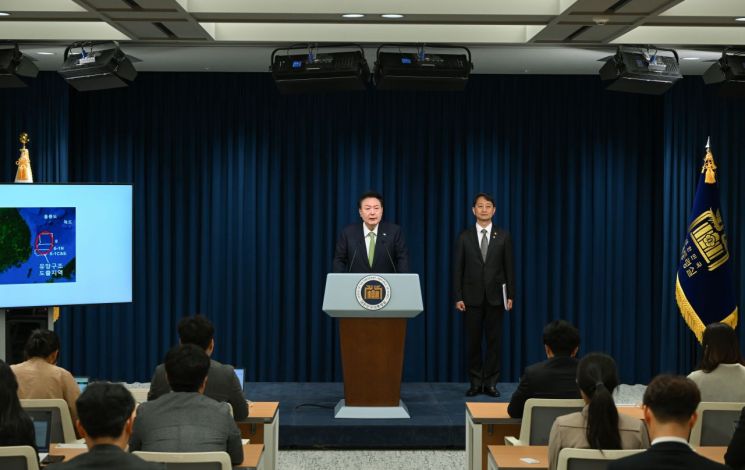 President Yoon Suk-yeol is attending a national briefing held at the briefing room of the Yongsan Presidential Office building in Seoul on the morning of the 3rd, explaining about the oil and gas deposits in the East Sea.
 [Image source=Yonhap News]
So, will the oil field planned for exploration in the waters off Pohang succeed? On the morning of the 3rd, President Yoon Suk-yeol announced during a government briefing that "physical exploration results indicate a high possibility of vast amounts of oil and gas being buried in the waters off Yeongilman Bay, Pohang, Gyeongbuk." The potential reserves could reach up to 14 billion barrels.
Physical exploration involves analyzing surface components using electricity or gravity. In other words, it is the first step to confirming whether oil and gas actually exist beneath the sea. The Ministry of Trade, Industry and Energy approved the exploratory drilling plan that day, and data must be verified through a lengthy process going forward.
Moreover, Yeongilman Bay has previously disappointed us. During the Park Chung-hee administration in the 1970s, attempts were made to drill for oil, but it was found that the seabed resources were blocked by a solid granite layer, making extraction impossible, and the substances inside the rock layer were not crude oil.
Ultimately, only time can provide the answer. President Yoon said during the briefing, "After preliminary preparations, the first drilling operation will begin by the end of this year," adding, "Some results will be available by the first half of next year. I ask the public to calmly observe the drilling results."
© The Asia Business Daily(www.asiae.co.kr). All rights reserved.
![Clutching a Stolen Dior Bag, Saying "I Hate Being Poor but Real"... The Grotesque Con of a "Human Knockoff" [Slate]](https://cwcontent.asiae.co.kr/asiaresize/183/2026021902243444107_1771435474.jpg)


















