Jangchungdan Path of National Defense, Namsan Memory Road... 'Dark Tour' Course
In June, the Month of National Defense, let's reflect on the history we must not forget by exploring the guided tour courses 'Jangchungdan Path of National Defense' and 'Namsan Memory Road' operated by Jung-gu, Seoul.
The 'Jangchungdan Path of National Defense' stretches from Jangchungdan Monument → Korean Confucian Independence Movement Paris Declaration Monument → Statue of Martyr Lee Jun → Monument of Martyr Lee Han-eung → Statue of Martyr Yu Gwan-sun → March 1st Independence Movement Memorial Tower → Statue of Patriot Kim Yong-hwan → to the National Theater. Walking this 6 km course for about two hours allows us to look back on our painful past.
Few people know that the area around Jangchungdan Park is filled with the spirit of national defense. In 1900, Emperor Gojong established Jangchungdan and held memorial rites to honor soldiers who died during the Eulmi Incident. However, in 1910, Japan banned these rites and abolished Jangchungdan, later creating park facilities in the late 1920s. From then on, it became Jangchungdan Park.
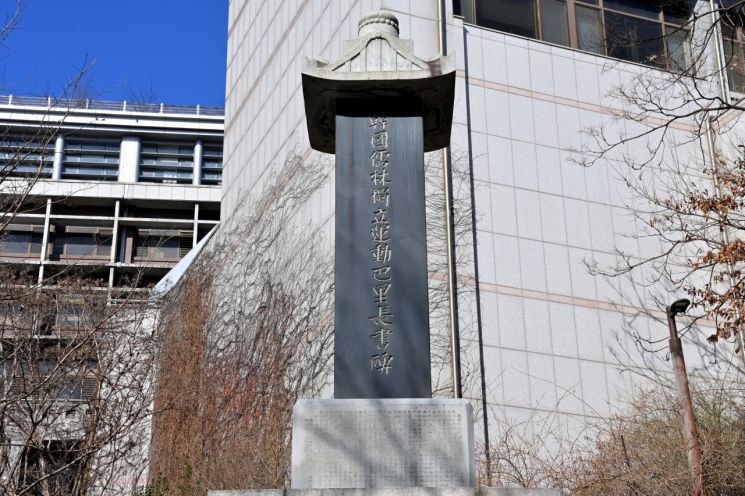
When the March 1st Movement broke out in 1919, 137 representatives of the Confucian community sent a lengthy independence petition of 2,674 characters to the Paris Peace Conference. The Paris Declaration Monument was built to commemorate this. Although the Confucian scholars were persecuted for this event, it became a turning point for the Confucian community to engage in the independence movement.
Martyr Lee Jun was dispatched as a special envoy of Emperor Gojong to the Hague Peace Conference in 1907 along with Lee Sang-seol and Lee Wi-jong. However, due to Japanese obstruction and the cold reception from the great powers, he could not carry out his mission as intended and died in exile, unable to bear the frustration. His remains were brought back to Korea in 1963 and interred in Suyu-ri, and in 1964, a statue was erected in Jangchungdan Park.
Standing in front of the statue of Yu Gwan-sun, a symbol of patriotic martyrs, and the March 1st Independence Movement Memorial Tower marks the climax of the Anguk tour. Originally located in front of Sungnyemun Gate, Yu Gwan-sun's statue was relocated to its current position in 1971, making Jangchungdan Park a sacred place of patriotism. The March 1st Independence Movement Memorial Tower is 19 meters and 19 centimeters tall, symbolizing the year 1919 when the movement occurred.
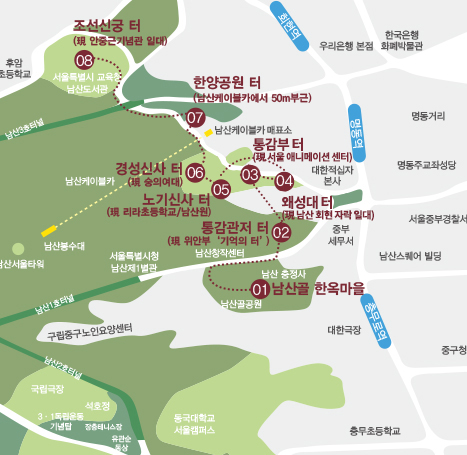
The 'Namsan Memory Road' tour course is a historical trail that revisits traces of Japanese colonial invasion scattered throughout Namsan. The 3 km course, which takes about two hours to walk, includes Namsangol Hanok Village → Site of the Resident-General's Office → Site of the Residency-General → Site of Waseongdae → Site of Nogi Shrine → Site of Gyeongseong Shrine → Site of Hanyang Park → Site of Joseon Shrine, allowing for a 'dark tour' (a trip to tragic historical sites).
During the Japanese colonial period, buildings for colonial rule were constructed throughout Namsan because palaces, temples, and markets were nearby, attracting many people. In 1898, Gyeongseong Shrine was established on the current site of Soongui Women's University, and in 1907, the Residency-General was built on the current Namsan Yejang Park site. The following year, in 1908, the Japanese military police headquarters was established on the current site of Namsangol Hanok Village.
In 1925, Japan established the Joseon Shrine, a symbol of Japanese imperialism, on Namsan. In the process, a significant portion of the Hanyangdoseong Fortress wall built along the slopes of Namsan was destroyed. After the Joseon Shrine was built, the Japanese forced Koreans to adopt their culture and religion. Some stairs leading up to the Joseon Shrine still remain today. The 'Samsuni Stairs,' made famous by the 2005 drama 'My Name is Kim Sam-soon,' are a trace of this.
Guided tours such as 'Jangchungdan Path of National Defense' and 'Namsan Memory Road' can be applied for on the Jung-gu Office website at least five days before the desired tour date. Tours are conducted when groups of four or more are formed.
An official from the district said, "I hope people do not forget the lessons of history hidden behind Namsan's beautiful nature and the sacrifices of our ancestors," adding, "We will continue to discover tourism content that promotes hidden historical and cultural heritage in the city and attracts tourists."
© The Asia Business Daily(www.asiae.co.kr). All rights reserved.
![Clutching a Stolen Dior Bag, Saying "I Hate Being Poor but Real"... The Grotesque Con of a "Human Knockoff" [Slate]](https://cwcontent.asiae.co.kr/asiaresize/183/2026021902243444107_1771435474.jpg)
















