In the Indian general election, exit polls announced that the Bharatiya Janata Party (BJP) led by Prime Minister Narendra Modi achieved a landslide victory, raising expectations that rallies in the Indian stock and bond markets will resume in earnest this week. Recently in India, concerns about low voter turnout had led to speculation that Modi's landslide victory would be difficult, resulting in consecutive sell-offs in stocks and bonds.
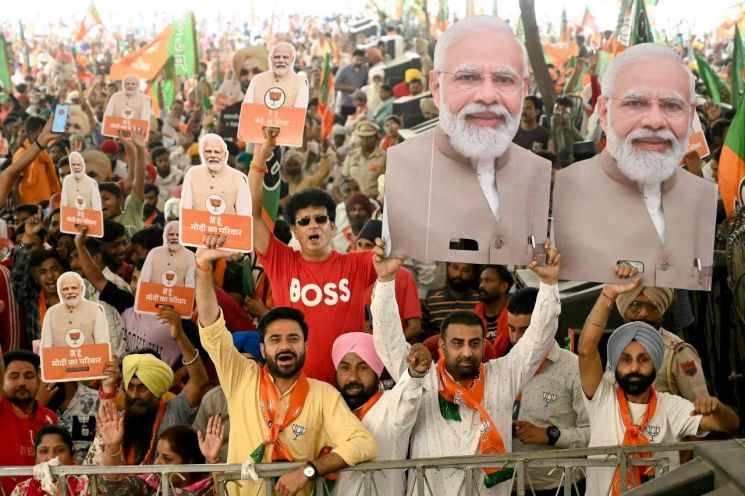
Bloomberg News reported on the 2nd (local time), citing exit polls from major Indian broadcasters. According to the exit polls released the previous day, the BJP-led coalition secured between 353 and 401 seats out of the total 543 seats in the Lok Sabha. This not only surpasses the majority threshold of 272 seats but also exceeds the 352 seats won in the 2019 general election. Securing 400 seats, a target ambitiously set by Prime Minister Modi, is also within reach.
The news agency stated, "These projections could calm investors who were unsettled by recent market volatility. If Modi achieves a landslide victory, he will be able to push forward policies to promote India's economic growth, which is already the fastest-growing in the world," adding, "From Monday the 3rd, Indian stocks, bonds, and the rupee could rise."
Vinit Sambre, who oversees about $12 billion in equities at Mumbai-based DSP Mutual Fund, said, "Some investors were anxious about the election results and skeptical due to increased volatility. Now, things will stabilize," predicting, "The market will respond positively on Monday." Earlier, as foreign investors increasingly doubted Modi's landslide victory, major indices fell nearly 2% last week.
Gary Duggan, Chief Investment Officer (CIO) at Dalma Capital Management in Dubai, said, "The majority size indicated in the exit polls will allow the Indian government to continue its current policy programs without relaxation," and added, "We can expect a 3-5% rebound in the market on Monday." Sandeep Bagla, CEO of Trust Mutual Fund, also expressed optimism, saying, "Uncertainty is finally disappearing."
The election results, conducted over six weeks, are officially scheduled to be announced on the 4th. Depending on the extent of the landslide victory, it is expected to benefit risk assets. If the election results released on the 4th align with the exit polls, the Nifty 50 index, which tracks the stock prices of 50 large-cap Indian companies, is expected to reach an all-time high. Abhay Agarwal, founder of Piper Serica Advisors, said, "Foreign investors should quickly manage their sell positions."
Particular attention is focused on so-called Modi stocks, including state-owned enterprises, infrastructure-related companies, the Adani Group, and Mukesh Ambani. Among the 54 stocks previously identified as Modi stocks by CLSA, about 90% outperformed the Nifty index's growth rate over the past six months.
Moreover, India confirmed expectations of sustained high growth by recording nearly 8% growth in the first quarter. Ahead of the inclusion of Indian government bonds in the JP Morgan Emerging Market Bond Index (GBI-EM) at the end of this month, S&P Global Ratings recently hinted at a potential credit rating upgrade for India. These factors all contribute to revitalizing the financial markets.
Saurabh Bhatia, head of Sapient Finserv, said, "The bond market has been positive in many respects recently," and predicted that the election results will reinforce this. He added, "A strong government brings more fiscal discipline and macroeconomic stability. Bonds will be pleased."
Meanwhile, in India, general election voting took place over seven phases spanning about six weeks starting April 19. After the exit polls were announced, Prime Minister Modi effectively declared victory on social media, stating, "The people of India showed a record voter turnout for our re-election." Modi is expected to become the second prime minister in history, after Jawaharlal Nehru, to secure a third consecutive term.
© The Asia Business Daily(www.asiae.co.kr). All rights reserved.
![Clutching a Stolen Dior Bag, Saying "I Hate Being Poor but Real"... The Grotesque Con of a "Human Knockoff" [Slate]](https://cwcontent.asiae.co.kr/asiaresize/183/2026021902243444107_1771435474.jpg)
















