Gyeongbuk Province Investigates Relationship Between Childbirth Support Funds and Total Fertility Rate
Fertility Rate Decreases Despite Increase in Childbirth Support Funds
A survey result showed that childbirth support funds do not affect the increase in birth rates.
On the 2nd, Gyeongbuk Province conducted a correlation survey on childbirth support funds and total fertility rates over the past 10 years in 22 cities and counties within the province. The results showed that although childbirth support funds increased in the 22 cities and counties, the total fertility rate did not increase and rather showed a decreasing trend.
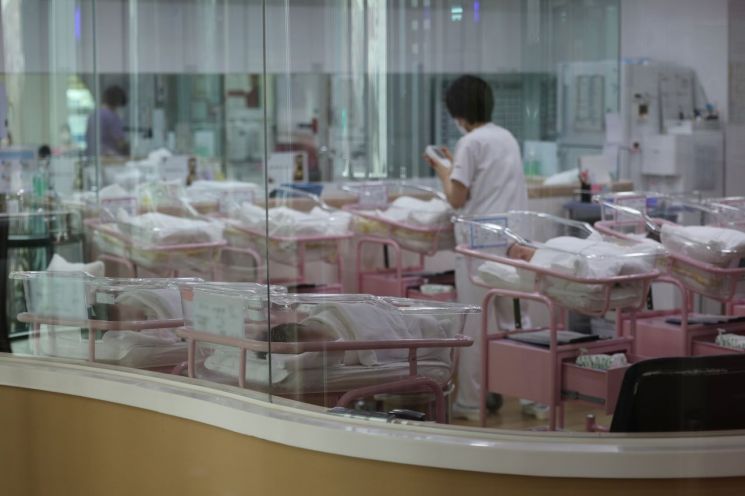 A staff member is taking care of a newborn in the postpartum care center's neonatal room.
 [Image source=Yonhap News]
While childbirth support funds steadily increased by city and county, the total fertility rate in Gyeongbuk Province decreased from 1.46 in 2015 to 0.86 last year. In particular, in Pohang-si and Gumi-si, childbirth support funds and total fertility rates showed an inverse relationship. This is why there are calls for verification of the effectiveness of childbirth support funds and urgent countermeasures. On the ground, there were also criticisms that excessive competition over childbirth support funds has turned into a population poaching battle among neighboring local governments.
After analyzing cases of advanced foreign countries that succeeded in reversing birth rates and research data from national institutions, Gyeongbuk Province found that Germany’s central government provides child allowances until the age of 18, while local governments promote care and parenting service policies. France also has cash support policies such as basic allowances and childcare fee support led by the central government, with local governments focusing on care service support. The core policy direction of Tottori Prefecture in Japan, which raised its birth rate from the lowest level in 2008 to the highest nationwide level (1.6) in 2022, focused more on 'childbirth and childcare services' that help people have children rather than 'cash support.'
Lee Cheol-woo, Governor of Gyeongbuk Province, said, "Cash payments do not help increase birth rates, so we must promote distinctive projects centered on care infrastructure and services," adding, "We should focus on childbirth and childcare services that help people have children rather than cash support."
According to the population trends for March 2024 announced by Statistics Korea last month, the number of births in the first quarter was 60,474, a decrease of 3,994 (6.2%) compared to the same period last year. This is the lowest ever for the first quarter. In particular, the number of births in March dropped below 20,000 for the first time, with 19,669 births, down 1,549 (7.3%) from a year earlier.
Since the number of births is usually higher at the beginning of the year and decreases toward the end, the total fertility rate is likely to decline further for the remaining period. Last year’s annual total fertility rate was 0.72, with quarterly rates of 0.82 in Q1, 0.71 in Q2 and Q3, and 0.65 in Q4.
© The Asia Business Daily(www.asiae.co.kr). All rights reserved.
![Clutching a Stolen Dior Bag, Saying "I Hate Being Poor but Real"... The Grotesque Con of a "Human Knockoff" [Slate]](https://cwcontent.asiae.co.kr/asiaresize/183/2026021902243444107_1771435474.jpg)















