Annual Salary of 156.9 Million KRW with 9 Aides
Controversial Non-Arrest and Immunity Privileges, Rights Stated in the Constitution
The term of the 22nd National Assembly has begun. Although 132 first-term members have entered the National Assembly for the first time, some have had to relinquish their gold badges due to various reasons such as losing elections, not being nominated, or choosing not to run. Each individual member of the National Assembly, a constitutional institution, is granted an annual salary in the range of 100 million KRW along with various tangible and intangible privileges and benefits to support their legislative activities, which they now lose.
First, the annual salary of a member of the National Assembly is 156.9 million KRW, a 1.7% increase from last year. Over a four-year term, this amounts to about 630 million KRW. By category, it includes ▲general allowance of 7.08 million KRW ▲administrative duty allowance of 640,000 KRW ▲fixed meal allowance of 740,000 KRW, among others. Additionally, they receive a legislative activity allowance of 3.14 million KRW and a special activity allowance of 780,000 KRW. Bonuses include a long-service allowance of 7.08 million KRW and a holiday bonus of 8.5 million KRW. (Related article: Rather Cut Down Mountains, National Assembly Members’ Salaries Will Not Be Reduced [News Explanation])

On top of this, various support funds for legislative activities are added. According to the National Assembly Secretariat's '2024 Legislative Activity Support Guide,' the budget for supporting members of the National Assembly this year is 31.6 billion KRW, which is 2.4 billion KRW (7.1%) less than last year. Considering there are 300 members, each member receives about 100 million KRW in support funds.
The support budget is divided into ▲office operation support ▲transportation support such as official business trips ▲legislative and policy development support ▲support for staff in members' offices. Among these, fixed monthly payments include ▲office public utility fees of 950,000 KRW ▲secretarial office operation expenses of 180,000 KRW ▲vehicle fuel expenses of 1.1 million KRW ▲vehicle maintenance expenses of 358,000 KRW. There are also items reimbursed after submission of receipts. Based on the 21st National Assembly, official business trip expenses averaged 4.26 million KRW, and policy material mailing fees averaged about 2.93 million KRW. Additionally, members can use KTX first-class seats, business class airplane seats, and facilities within the National Assembly building such as barbershops, gyms, bathhouses, hospitals, and pharmacies free of charge.
Separately, there are personnel expenses for aides who assist legislative activities. Each member can have up to nine aides: ▲two level-4 aides ▲two level-5 secretaries ▲one each of level-6, 7, and 9 secretaries ▲and two interns, whose salaries are also paid. The combined annual salaries of these aides, ranging from 24 million to 87.6 million KRW, total about 500 million KRW per year.
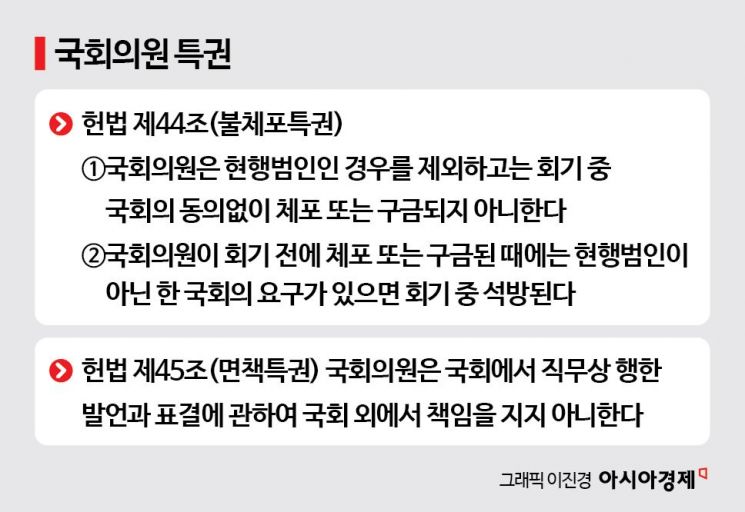
Above all, members of the National Assembly gain intangible and tangible privileges that are difficult to quantify in money. Excluding the authority related to legislative activities such as lawmaking and amendment rights, the most controversial privilege is the 'immunity from arrest.' According to Article 44 of the Constitution, members of the National Assembly cannot be arrested or detained during a session without the consent of the Assembly, except in cases of being caught in the act (Paragraph 1), and if arrested or detained by investigative agencies during a recess, they can be released during the session upon the Assembly's request (Paragraph 2).
To arrest a member who is not caught in the act, the National Assembly must be involved. A motion for consent to arrest submitted to the plenary session requires a majority of the total members present and a majority of those attending to pass. In the 21st National Assembly alone, nine motions for consent to arrest were issued, including for Lee Jae-myung, leader of the Democratic Party, as well as Jeong Jeong-sun, Lee Sang-jik, Jeong Chan-min, Noh Woong-rae, Ha Young-je, Yoon Kwan-seok, and Lee Sung-man, but only five of these motions were approved.
There is also 'parliamentary immunity.' Article 45 of the Constitution stipulates that members of the National Assembly are not held responsible outside the Assembly for statements made or votes cast in the course of their duties within the Assembly. A recent example of parliamentary immunity is former Democratic Party member Kim Ui-gyeom. Kim was sued and accused of defamation under the Information and Communications Network Act for mentioning the so-called 'Cheongdam-dong drinking party allegations' involving President Yoon Seok-yeol and Minister of Justice Han Dong-hoon, but in October last year, he received a non-prosecution decision based on parliamentary immunity. In contrast, Kang Jin-gu, head of the citizen media The Tamza, who was also sued and accused, was sent to the prosecution.
Meanwhile, members who lost all these privileges and ended their terms as of the 29th of last month delivered farewell messages. Lee Sang-min, former People Power Party member who served five consecutive terms in Daejeon Yuseong, said, "As my term as a member of the 21st National Assembly ends on May 29, I would like to extend my greetings," adding, "During my time as a member, I experienced personal honor as well as many achievements and rewards, but there were also shortcomings and mistakes. I will continue to be faithful to justice and act according to the mandate."
Another five-term member, former Democratic Party member Ahn Min-seok, posted on social media, "Every day working for the people and the citizens of Osan was happy and enjoyable," and said, "Now I conclude Ahn Min-seok’s 20-year political life, which was like a storm, practicing 'righteously, cleanly, and warmly.'"
Jang Hye-young, former Justice Party member who entered the National Assembly through proportional representation, said, "Thank you very much for supporting Jang Hye-young’s politics over the past four years. Because of you, Jang Hye-young’s politics for equality and dignity was possible," and revealed her future plans: "Although I have not yet made concrete plans, I intend to continue in politics, maintain the Mapo district office space, and take some time to rest and reflect after my term."
© The Asia Business Daily(www.asiae.co.kr). All rights reserved.
![Clutching a Stolen Dior Bag, Saying "I Hate Being Poor but Real"... The Grotesque Con of a "Human Knockoff" [Slate]](https://cwcontent.asiae.co.kr/asiaresize/183/2026021902243444107_1771435474.jpg)
















