Former US North Korea Nuclear Envoy Gallucci at Jeju Forum Press Meeting
"Possibility of Nuclear War, a Warning That Must Not Happen"
"If Trump Returns to Power, Japan and South Korea May Independently Arm Nukes"
Earlier this year, a U.S. expert on North Korean nuclear negotiations, who drew attention with a column suggesting the possibility of a 'Northeast Asia nuclear war,' presented an analysis stating that "North Korea believes it can change the behavior of South Korea and the United States through compellence using nuclear weapons."
Robert Gallucci, Professor Emeritus at Georgetown University, expressed this view during a press meeting at the Jeju Forum held at the Jeju International Convention Center in Seogwipo, Jeju, on the 30th. He is a former U.S. State Department special envoy and deputy assistant secretary for North Korea, and was a key figure in the 1994 'Geneva Agreed Framework.' In a January contribution to the foreign and security affairs magazine National Interest, he argued that "we should at least keep in mind the possibility of a nuclear war occurring in Northeast Asia this year." Moon Chung-in, Professor Emeritus at Yonsei University and former presidential special advisor for unification, diplomacy, and security during the Moon Jae-in administration, served as moderator and interpreter.
Gallucci Raises 'Nuclear War Concerns'... "North Korea Uses Nuclear Weapons for Coercion"
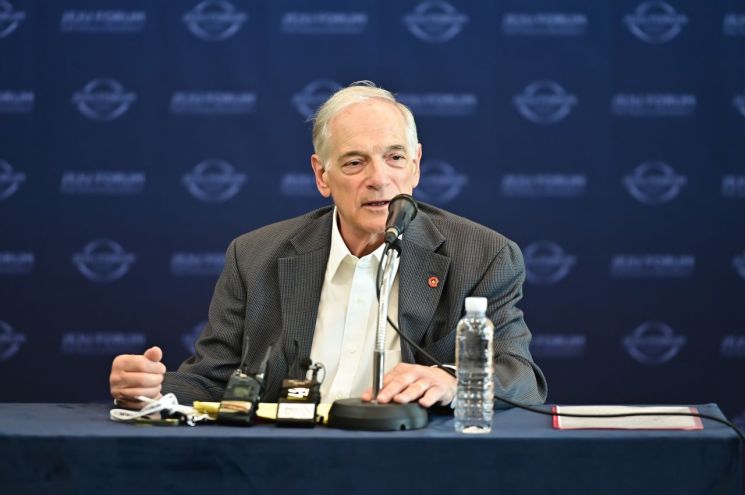 Robert Gallucci, Honorary Professor at Georgetown University, is answering questions from the press at the Jeju Forum press meeting held on the 30th at the Jeju International Convention Center in Seogwipo-si, Jeju. [Photo by Jeju Forum]
When asked about the background for raising the possibility of 'nuclear war triggered by the failure of deterrence against North Korea' or 'escalation due to North Korea's accidental actions,' Professor Gallucci replied, "Rather than focusing on the nuclear war scenario itself, I intended it as a warning that nuclear war must not happen," adding, "The U.S. is working on deterrence against North Korea, but as a realist, I think we must keep the possibility of failure in mind." He explained that nuclear war could start not only from extended deterrence failure but also from unexpected scenarios such as technical problems or missile delivery errors.
He said, "North Korea uses quite hostile language, and South Korea and the U.S. respond accordingly, maintaining a 'strong versus strong' standoff," adding, "Of course, I do not believe North Korea currently has the capability to attack the U.S. mainland, but when China becomes involved (allowing such an attack), we need to consider how we would respond and seek ways to prevent such possibilities. Ultimately, I concluded that dialogue is necessary."
When asked why North Korea continues nuclear development despite warnings from South Korea and the U.S. that the Kim Jong-un regime would end if nuclear weapons are used, Gallucci offered an analysis of North Korea's deterrence strategy. He said, "Despite the U.S. possessing tremendous nuclear and conventional weapons, North Korea continues to develop nuclear weapons because it seems to believe in its own deterrence strategy," explaining, "It appears they believe in a deterrence strategy that suppresses the opponent's will to attack, meaning they think nuclear weapons can prevent attacks against North Korea."
However, he pointed out the problem that North Korea's purpose goes beyond mere deterrence. He added, "North Korea's nuclear development purpose is not only deterrence but also 'compellence'?using nuclear weapons to coerce the U.S. and South Korea," analyzing, "North Korea's logic seems to be that if the U.S. attacks, they can retaliate and punish, and through coercion, they believe they can influence the U.S. and South Korea to change their behavior."
U.S. Republicans Raise 'Tactical Nuclear Redeployment' Theory?Is It Feasible?
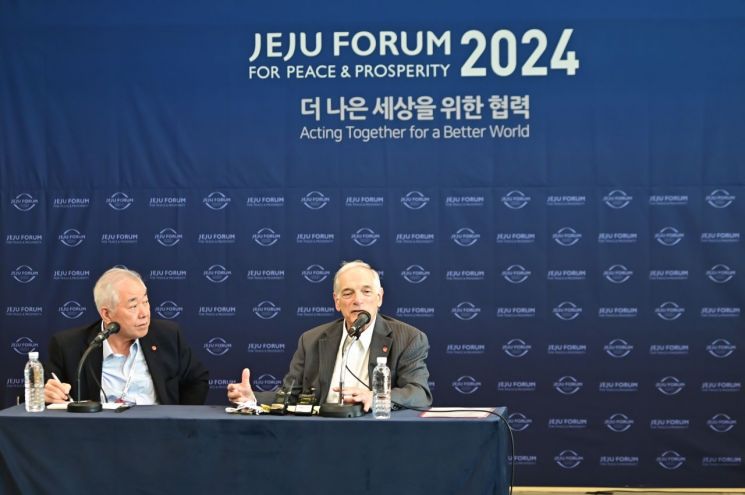 Robert Gallucci, Honorary Professor at Georgetown University, is answering questions from the press at the Jeju Forum press meeting held on the 30th at the Jeju International Convention Center in Seogwipo-si, Jeju.
 [Photo by Jeju Forum]
Professor Gallucci also expressed considerable skepticism about recent mentions by some Republican lawmakers, including Roger Wicker, Ranking Member of the U.S. Senate Armed Services Committee, regarding 'redeployment of tactical nuclear weapons on the Korean Peninsula' as a new option to strengthen extended deterrence or prepare for its failure. He first emphasized the need to understand the concepts of tactical and strategic nuclear weapons. Tactical nuclear weapons include bombs like the 15kt bomb dropped on Hiroshima and the 21kt bomb dropped on Nagasaki. Strategic nuclear weapons are considered to have yields of thousands of kilotons or more, with the U.S. and Russia generally classifying those from 250 to 500kt as strategic.
Gallucci said, "Even a single tactical nuclear weapon can completely destroy a city, so discussing such weapon systems as an option is problematic," criticizing, "(The Republicans' tactical nuclear redeployment theory) is an undesirable and bad idea that does not sufficiently consider the security situation on the Korean Peninsula." He added, "It is easy to say, but tactical nuclear weapons are more powerful than all conventional weapons combined," and questioned, "If tactical nuclear weapons were redeployed to South Korea, there would be no guarantee that North Korea, which claims to already possess nuclear weapons, would not launch a preemptive strike."
"South Korea and Japan Could Independently Arm Nuclear Weapons... Alliances Are More Valuable"
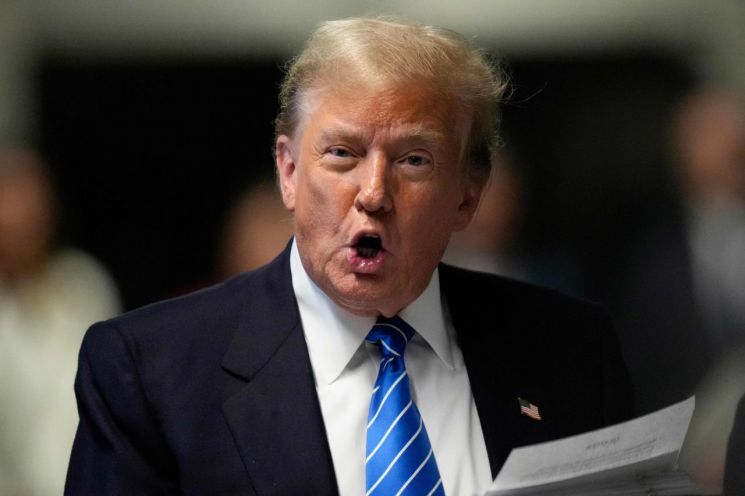
Regarding the steady mention of 'independent nuclear armament' in connection with the U.S. presidential election scheduled for November this year, Gallucci left the possibility open but pointed out that former President Donald Trump needs to understand the importance of the South Korea-U.S. and Japan-U.S. alliances.
When asked about the forecast that "if Trump returns to power, South Korea and Japan could begin nuclear armament within six months of his inauguration," Gallucci said, "Trump does not place much importance on alliances with South Korea and Japan and is uncertain about the security gap caused by the presence of U.S. forces in South Korea and Japan," adding, "I think there is a possibility that South Korea and Japan could move toward independent nuclear armament."
He reiterated the difficulty in predicting Trump's actions but criticized, "Because Trump strongly believes that South Korea and Japan are 'free riders' on the U.S., he demands more defense cost-sharing, which is like how a real estate agent negotiates." He emphasized, "What is clear is that the South Korea-U.S. and Japan-U.S. alliances are not subject to change based on individuals but are based on treaties and U.S. national interests," stressing, "The security of South Korea and Japan is a matter the U.S. must commit to with its life, and South Korea and Japan also have a mutually interdependent role in contributing to the U.S." Furthermore, he added, "Because there is a national consensus in the U.S. on how valuable alliances are, it will be difficult for Trump to easily overturn them."
Assuming the launch of the Biden administration's second term, Gallucci urged efforts for dialogue. He said, "If Biden returns to power, I hope he will seek breakthroughs through dialogue with North Korea," evaluating that in current U.S. diplomacy, based on 'cost' and 'risk,' the North Korean issue is deprioritized compared to the Russia-Ukraine war, Hamas's invasion of Israel, Israel's Gaza Strip invasion, and the Taiwan issue. He advised, "Nevertheless, I hope the Biden administration's second term properly addresses the North Korean issue," adding, "Rather than unilaterally demanding North Korea come to the table, a step-by-step and realistic approach that proposes normalization of relations while freezing and reducing North Korea's nuclear and missile activities will bring progress toward denuclearization."
© The Asia Business Daily(www.asiae.co.kr). All rights reserved.



















