The Constitutional Court ruled on the 30th that the Comprehensive Real Estate Holding Tax (종부세) law, which expanded the taxable base during the Moon Jae-in administration, does not violate the principle of proportionality and does not infringe on property rights. However, dissenting opinions were expressed by some justices regarding the heavy taxation provisions for owners of two houses in designated adjustment areas.
On the same day, the Constitutional Court decided that the provisions in the former Comprehensive Real Estate Holding Tax Act Article 7, Paragraph 1, among others, are not unconstitutional in a constitutional complaint case.

Article 7, Paragraph 1 of the former 종부세 law stipulated that those whose combined official housing prices exceed 600 million won are obligated to pay the 종부세. Article 8, Paragraph 1 stated that the tax base for 종부세 is determined by multiplying the amount exceeding 600 million won in the combined official prices by the "fair market value ratio" as prescribed by Presidential Decree. Furthermore, Article 9, Paragraph 4 delegated the calculation of the "number of houses," which directly affects the 종부세 tax rate calculation, to Presidential Decree.
Claimants who owned houses or land subject to 종부세 taxation as of June 1, 2020, during the Moon Jae-in administration, argued that these tax provisions violated the principle of legality in taxation and the principle of non-delegation of legislative power. In particular, they claimed that applying excessively high tax rates to multi-homeowners violated the principle of proportionality and the principle of equality.
However, the Constitutional Court dismissed these claims and ruled that the provisions do not infringe on property rights. The Court stated, "The public interest gained by curbing excessive real estate holdings and speculative demand for real estate, thereby stabilizing real estate prices, protecting actual demanders, and promoting sound development of the national economy, outweighs the restricted private interests."
Regarding the heavy taxation provisions for multi-homeowners, the Court also said, "Considering that economically, multi-homeowners or owners of high-priced houses are likely to have greater financial capacity than single-homeowners or non-homeowners, there is a rational reason for treating owners of two or fewer houses differently from those owning three or more houses or two houses within designated adjustment areas," and added, "The housing portion of the 종부세 provisions cannot be said to violate the principle of tax equality."
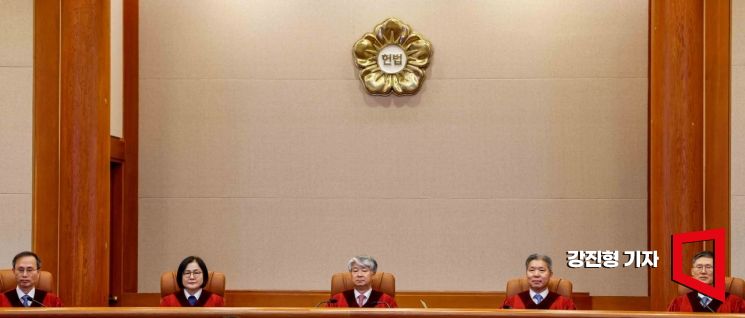 Chief Justice Lee Jong-seok of the Constitutional Court and other constitutional justices are attending the May judgment event held at the Constitutional Court in Jongno-gu, Seoul on the 30th. Photo by Kang Jin-hyung aymsdream@
However, dissenting opinions were expressed regarding the heavy taxation provisions for owners of two houses within designated adjustment areas. Justices Eun Ae Lee, Jeong Jeong-mi, and Jeong Hyeong-sik stated that while the legislative purpose is legitimate, "it is doubtful whether the means to achieve that purpose are appropriate," and expressed concern that "applying increased tax rates and tax burden caps to those who owned two houses in the designated areas before the designation is unfair." They further argued, "It is difficult to expect the effect of stabilizing housing prices in the area by inducing short-term sales through heavy 종부세 taxation on those who owned two houses for various non-speculative reasons before the designation," and pointed out that "the heavy taxation provisions in designated adjustment areas cannot be considered an appropriate means to enhance fairness in tax burdens on real estate holdings or to curb speculative demand for real estate."
© The Asia Business Daily(www.asiae.co.kr). All rights reserved.
![Clutching a Stolen Dior Bag, Saying "I Hate Being Poor but Real"... The Grotesque Con of a "Human Knockoff" [Slate]](https://cwcontent.asiae.co.kr/asiaresize/183/2026021902243444107_1771435474.jpg)

















