The Supreme Court has ruled that climate activists who sprayed green water-based spray paint on a sculpture bearing the name Doosan Enerbility (formerly Doosan Heavy Industries) cannot be punished for property damage.
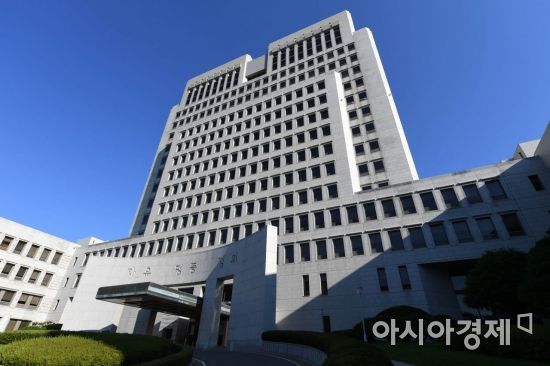
On the 30th, the Supreme Court's First Division (Presiding Justice Kim Seon-su) overturned the lower court's ruling that fined two activists from the Youth Climate Emergency Action group, who were charged with violating the Assembly and Demonstration Act, and remanded the case to the Suwon District Court.
The Supreme Court stated, "Considering the purpose and function of the sculpture in this case, the motives of the defendants' actions, and the discomfort felt by users of the sculpture, it is difficult to conclude that the defendants impaired the utility of the sculpture."
Earlier, the activists were prosecuted for property damage and holding an unauthorized outdoor assembly after spraying green water-based spray paint on a sculpture in front of the Doosan Enerbility headquarters in Bundang-gu, Seongnam-si, Gyeonggi Province on February 18, 2021, with the intent to criticize so-called 'greenwashing.' The prosecution charged them with violating the Assembly and Demonstration Act and property damage, arguing that they held a protest without prior notification and damaged the sculpture.
The first and second trials found the activists guilty of both violating the Assembly and Demonstration Act and property damage, sentencing them to fines of 3 million won and 2 million won, respectively.
However, the Supreme Court's judgment differed. The court found it difficult to see that the activists' spraying of green paint diminished the utility of the sculpture. The court stated, "The defendants immediately cleaned the sculpture after spraying water-based spray paint on it as a means of expressing the climate crisis. If property damage under criminal law is easily recognized in such cases, there is a risk of suppressing freedom of expression, so it is preferable to resolve such matters through civil compensation."
However, the Supreme Court added that this ruling does not mean that all such graffiti acts will be recognized as harmless. A Supreme Court official explained, "Guilt or innocence may vary depending on the case. If spray paint is applied on roads, impairing the function of lane division and directional markings, property damage may be recognized."
© The Asia Business Daily(www.asiae.co.kr). All rights reserved.
![Clutching a Stolen Dior Bag, Saying "I Hate Being Poor but Real"... The Grotesque Con of a "Human Knockoff" [Slate]](https://cwcontent.asiae.co.kr/asiaresize/183/2026021902243444107_1771435474.jpg)
















