National Radiation Emergency Medical Center to Diagnose Exposed Samsung Employees
Treatment of Exposed Patients Handled by Nuclear Hospital
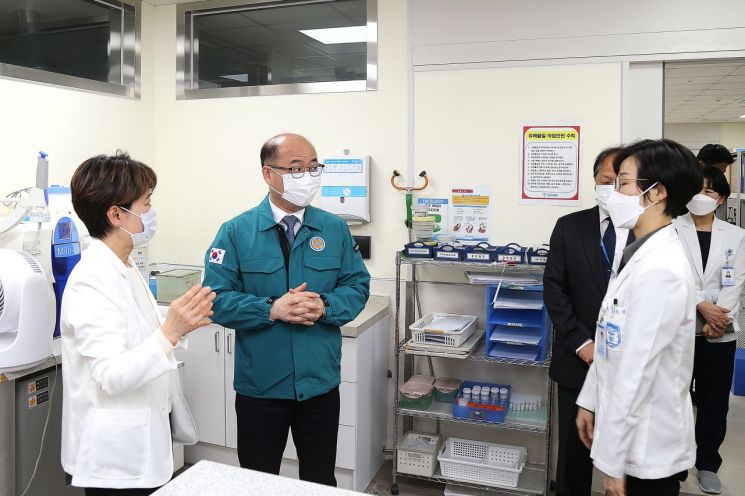 Lee Chang-yoon, the 1st Vice Minister of the Ministry of Science and ICT, visited the Korea Institute of Radiological & Medical Sciences in Nowon-gu, Seoul, on the 325th day to encourage the on-site medical staff.
 [Image source=Yonhap News]
Attention is focused on the Korea Institute of Radiological & Medical Sciences, which examined Samsung Electronics employees exposed to radiation. This has highlighted the renewed need for emergency response institutions and public hospitals capable of handling radiation-related accidents and patient treatment.
The Korea Institute of Radiological & Medical Sciences is a government-funded research institute under the Ministry of Science and ICT that comprehensively conducts medical use and research and development of radiation. Under the institute are the Korea Cancer Center Hospital, the Radiation Medicine Research Institute, and the National Radiation Emergency Medical Center. The Korea Cancer Center Hospital has fulfilled its role as a public hospital even amid the recent medical crisis.
The National Radiation Emergency Medical Center was established on September 26, 2002, to provide emergency treatment and early response for patients exposed to radiation in the event of radiation accidents, disasters, or nuclear terrorism.
According to the center, those exposed undergo tests such as internal contamination tests for radioactivity, chromosome abnormality tests, and blood tests. Depending on the type of test, results usually take about 2 to 3 weeks, but this time they plan to confirm results within one week promptly.

To measure radiation exposure, a detector is first used to check for radiation exposure on the skin and personal belongings. If an alarm sounds, it indicates that clothes or belongings may have been exposed, so all items are removed, and the person takes a shower from head to toe before being measured again. If the alarm still sounds, internal exposure is suspected, so the whole body is measured for about 4 minutes using a precise device called a whole-body counter.
The Korea Institute of Radiological & Medical Sciences explained, "Exposed patients undergo biological dosimetry." Biological dosimetry is a method that examines the degree of radiation exposure in individuals suspected of exposure due to radiation accidents or daily life by analyzing chromosomes in blood cells.
Many radiation exposure-related tests were conducted immediately after the 2011 Fukushima nuclear accident. Various patients, including broadcast journalists returning from Japan, residents, and international students, received treatment through the Radiation Effects Clinic. Since then, the center has established the Radiation Effects Clinic.
While acute radiation syndrome, which causes abnormal symptoms in various parts of the body, can occur with high radiation exposure, the institute explained that the exposed individuals in this case were not in critical condition and were discharged after testing.
The Nuclear Safety and Security Commission also announced on the 29th that the exposed individuals showed localized radiation exposure on their fingers with erythema and swelling, but general blood test results were normal, and follow-up observations such as chromosome abnormality tests will be conducted.
Treatment for radiation exposure skin injuries is supported by the Korea Cancer Center Hospital, which has extensive experience in cancer treatment. An official from the institute explained, "Many patients exposed to radiation receive treatment at the Korea Cancer Center Hospital even if they live far away."
© The Asia Business Daily(www.asiae.co.kr). All rights reserved.
![Clutching a Stolen Dior Bag, Saying "I Hate Being Poor but Real"... The Grotesque Con of a "Human Knockoff" [Slate]](https://cwcontent.asiae.co.kr/asiaresize/183/2026021902243444107_1771435474.jpg)















