Prime Minister Anwar Announces National Semiconductor Strategy
"Train 60,000 Semiconductor Engineers"
Malaysia has announced plans to attract investments worth 150 trillion won to become a semiconductor powerhouse in Southeast Asia.
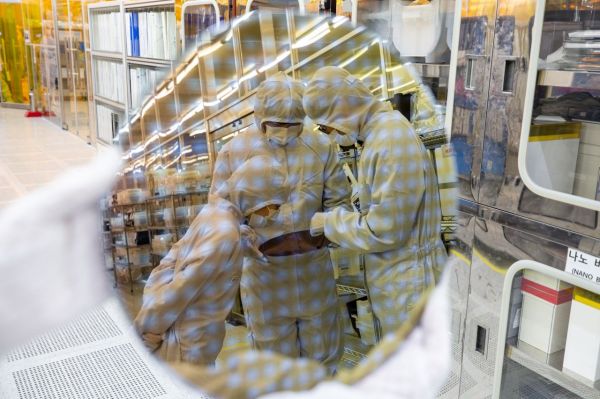 Researchers are conducting semiconductor material and component development research in the 12-inch semiconductor testbed cleanroom at the Daejeon Nano Convergence Technology Institute. It is projected that the global semiconductor shortage will continue until mid-next year. As the local industry in Gunnae, which is pursuing a semiconductor ecosystem advancement strategy, faces the potential impact of this trend, attention is focused on the responses from countries around the world. Our government is also accelerating the advancement of the semiconductor ecosystem. Through the 'K-Semiconductor Strategy Report,' the government envisions a leap to becoming a comprehensive semiconductor powerhouse by 2030 and plans to complete semiconductor localization through massive investments and tax benefits. Having achieved K-quarantine through COVID-19, South Korea is expected to proudly advance K-semiconductors in the global semiconductor hegemony competition. /Daejeon=Photo by Kang Jin-hyung aymsdream@
According to local media on the 29th, Malaysian Prime Minister Anwar Ibrahim stated that the country aims to attract at least 500 billion ringgit (approximately 145 trillion won) in investments to be allocated to semiconductor design, high-performance semiconductor packaging, and semiconductor manufacturing equipment industries. Prime Minister Anwar unveiled the National Semiconductor Strategy (NSS) containing these details at a semiconductor industry event held at the Malaysia International Trade and Exhibition Centre (MITEC) in Kuala Lumpur.
Prime Minister Anwar said Malaysia will be developed into a global semiconductor research and development (R&D) hub and that more than 60,000 semiconductor engineers will be trained. To this end, the government plans to provide at least 25 billion ringgit (7.25 trillion won) in support through sovereign wealth funds and other means.
The semiconductor industry development strategy is composed of three phases. The first phase focuses on strengthening existing semiconductor industry capabilities. The investment attraction of 150 trillion won mentioned by Prime Minister Anwar corresponds to this first phase. However, Anwar did not specify a concrete timeline.
The second phase aims to nurture at least 10 domestic companies with semiconductor design and high-performance semiconductor packaging sales of at least 1 billion ringgit (290 billion won), and at least 100 companies with sales close to 1 billion ringgit.
The final phase plans to significantly increase world-class Malaysian semiconductor design and production. Specifically, the goal is to supply high-performance semiconductors to companies such as Apple, Huawei, and Lenovo, and to have world-leading companies manufacture semiconductors in Malaysia.
Last month, the Malaysian government also announced plans to establish the largest semiconductor design cluster in Southeast Asia. Amid the current US-China tensions prompting global tech companies to diversify their supply chains, Southeast Asia, including Malaysia, is gaining attention as a new semiconductor production base.
© The Asia Business Daily(www.asiae.co.kr). All rights reserved.
![Clutching a Stolen Dior Bag, Saying "I Hate Being Poor but Real"... The Grotesque Con of a "Human Knockoff" [Slate]](https://cwcontent.asiae.co.kr/asiaresize/183/2026021902243444107_1771435474.jpg)















