Smartphone Market Shows Double-Digit Growth in Q1
AI iPhone and Foldable Phones to Launch in Second Half
Memory Demand Rises, Helping Industry Recovery
"Mobile Product Supply May Become Scarce"
In the first quarter of this year, global smartphone sales, including emerging markets such as India, increased by double digits compared to the same period last year. The semiconductor industry, having laid the foundation for recovery thanks to demand for artificial intelligence (AI) servers, has now confirmed through numbers that the mobile front-end market is also showing signs of revival. As smartphone sales, which had been stagnant for some time, show growth, there are forecasts that mobile semiconductor demand in the second half of the year could be stronger than expected.
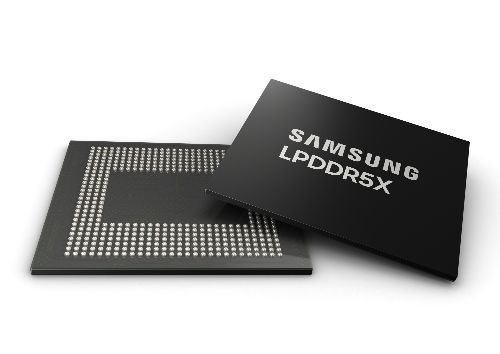 Samsung Electronics introduced last month the low-power double data rate (LPDDR) 5X with an operating speed of 10.7 gigabits per second (Gbps) /
 [Image provided by Samsung Electronics]
Recently, market research firm IDC announced that smartphone shipments in emerging regions such as India and Indonesia increased by more than double digits year-on-year in the first quarter. Specifically, India recorded 34 million units, up 11.5%, and Indonesia saw a sharp increase of 27.4% to 10 million units.
Market research firm Omdia reported similar results. Global smartphone shipments in the first quarter reached 304 million units, an 11.6% increase compared to the same period last year. Omdia highlighted that this growth follows a prolonged market slump from 2021 through last year.
A semiconductor industry official explained, "Unlike high-bandwidth memory (HBM), demand for existing memory had been relatively sluggish. If front-end demand such as mobile increases, it can be seen as a true recovery of the industry."
In particular, the announcement of new smartphone models in the second half of the year is considered a factor stimulating semiconductor demand. Apple will launch the iPhone 16 series in the second half, which is expected to be Apple’s first AI smartphone. Samsung Electronics will also unveil its flagship foldable new models, the Galaxy Z Fold and Flip 6, in July. These products are also expected to support AI functions.
In this case, demand for low-power DRAM and flash memory used for mobile devices is expected to increase. Another industry official said, "If the smartphone market improves, demand for low-power double data rate (LPDDR) DRAM and universal flash storage (UFS) used in devices will also increase."
Supply is limited compared to the increasing demand. Recently, memory companies have been focusing on producing some high-value-added products such as HBM, so production of general DRAM, including mobile DRAM, is inevitably limited. If the demand growth outpaces supply, it could also affect product price increases in the future.
Kim Kyuhyun, head of DRAM marketing at SK Hynix, said in a recent conference call, "If demand improves in existing applications such as PCs and smartphones in the second half, inventory held by customers and memory suppliers will be depleted," adding, "There is also a possibility of product supply shortages."
© The Asia Business Daily(www.asiae.co.kr). All rights reserved.

















