Number of Applicants Increased 2.5 Times Compared to 10 Years Ago
Labor and Tax Accountants Also Hit Record Highs
"Better Cost-Effectiveness Than Law School"
The number of applicants for exams in legal-adjacent professions such as Certified Judicial Scriveners, Labor Consultants, and Tax Accountants has reached an all-time high.
This is analyzed to be due to the recent spread of employment difficulties and job insecurity, leading many examinees to flock to professional occupations that guarantee job stability.
In particular, the 20s and 30s generation find these professions more cost-effective compared to the bar exam, which requires admission to law school, while the 40s and 50s generation are attracted by the fact that economic activity is possible without a mandatory retirement age.
According to the Court Administration Office, the 30th Certified Judicial Scrivener Exam, scheduled for August 31, has 8,255 applicants, recording the highest competition rate of 63.5 to 1 since 2003. The number of applicants has increased more than 2.5 times compared to ten years ago.
Looking at the number of applicants for the Certified Judicial Scrivener Exam over the past five years: △2020 - 4,413 △2021 - 4,910 △2022 - 5,647 △2023 - 7,616, showing an increasing trend every year.
The number of applicants for exams such as Tax Accountant and Labor Consultant also reached record highs.
According to the Human Resources Development Service of Korea, the number of applicants for the first Tax Accountant exam this year was 23,377 (competition rate 33.4 to 1), a 39% increase from last year. The number of Tax Accountant exam applicants was △2020 - 9,506 △2021 - 10,348 △2022 - 12,536 △2023 - 13,768, maintaining the 10,000 range until this year when it sharply increased to over 20,000 for the first time.
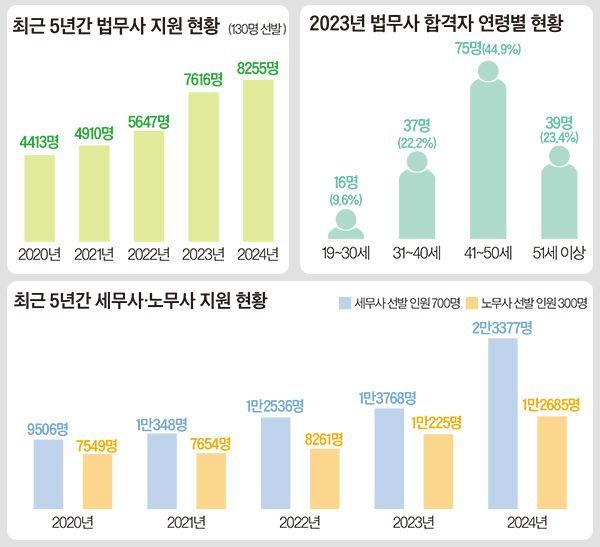
This year, the first Labor Consultant exam also attracted 12,685 applicants (competition rate 42.2 to 1), the highest since the exam was established. The number of Labor Consultant exam applicants was △2020 - 7,549 △2021 - 7,654 △2022 - 8,261, increasing steadily and surpassing 10,000 for the first time last year with 10,225 applicants.
Certified Judicial Scriveners, Labor Consultants, Tax Accountants Popular... Main Reason: ‘Job Stability’
People in their 20s and 30s prefer Labor Consultant and Tax Accountant exams, which can be taken without special qualifications and allow immediate employment upon passing, over the bar exam that requires graduation from law school. Over 90% of last year’s Labor Consultant and Tax Accountant exam passers were in their 20s and 30s.
A 20-something Labor Consultant exam candidate with a law degree explained, “Considering the time and cost involved in preparing for the LEET (Legal Education Eligibility Test), three years of law school, and taking the bar exam to become a lawyer, the cost-effectiveness of the Labor Consultant exam is better. After failing to enter a SKY law school, it seemed difficult to get a job at a large law firm, so I changed my career path to become a Labor Consultant.”
There is also analysis that many humanities graduates, who find it difficult to secure quality jobs due to the recent preference for science majors in large corporations, are challenging themselves in professional occupations.
Many also use legal-adjacent professional certifications as credentials for employment.
A 30-something Labor Consultant who passed last year and is currently working at a labor law firm said, “Due to severe employment difficulties for humanities majors, many prepare for the Labor Consultant certification to enter HR departments of large corporations. Professional certifications have no expiration date, so they are considered a kind of insurance.”
Those in their 40s and older mainly take the Certified Judicial Scrivener exam for retirement preparation.
Looking at last year’s Certified Judicial Scrivener exam passers by age: △19?30 years old: 16 (9.6%) △31?40 years old: 37 (22.2%) △41?50 years old: 75 (44.9%) △51 and older: 39 (23.4%), with nearly 70% in their 40s and 50s.
Certified Judicial Scrivener Choi Ok-hwan analyzed, “It seems that working people prepare for legal-adjacent profession exams as retirement preparation. For those over 40, realistically entering law school is difficult, so there is a clear tendency to challenge professional occupations such as Certified Judicial Scrivener, Tax Accountant, and Labor Consultant.”
The reason for the surge in Labor Consultant exam takers is also closely related to the trend of strengthening labor regulations. Under the Moon Jae-in administration, labor-related regulations increased, including the 52-hour workweek system, the Workplace Harassment Prevention Act, and the Serious Accident Punishment Act. Under the Yoon Suk-yeol administration, labor reforms such as flexibilization of the 52-hour workweek and transparency in union accounting have been promoted. The increasing number of court rulings overturning previous interpretations, such as the ‘invalidity of wage peak system’ ruling, and the growing complexity of laws and policies are also factors increasing demand for Labor Consultants.
The popularity of Tax Accountants is largely due to the overall increase in demand for tax services such as capital gains tax and gift tax.
Choi Won-seok, director of Eduwill Tax Accountant Academy, explained, “The average acquisition period for a Tax Accountant license is 2 years and 6 months, which is relatively short compared to other professional certifications like lawyers and accountants. Another advantage is that employment or opening a practice is possible even after the age of 40.”
Meanwhile, according to the Korea Employment Information Service, the average annual salary for professionals as of 2021 is △Lawyers and Accountants: 77.7 million KRW △Appraisers: 67.67 million KRW △Tax Accountants: 67.5 million KRW △Certified Judicial Scriveners: 66.17 million KRW △Patent Attorneys: 65.08 million KRW △Customs Brokers: 51.8 million KRW △Labor Consultants: 50.76 million KRW.
According to the National Tax Service, the average annual salary of wage earners in 2022 was only 31.65 million KRW.
Yu Chang-soo, deputy director of Prime Law Academy, said, “It is becoming increasingly difficult to get a job at desired companies every year, so many jump straight into professional exams right after graduating from university. Also, many working people feel dissatisfaction with income and job insecurity, so the number of those preparing for exams while working has greatly increased.”
Meanwhile, unlike legal-adjacent professions, the popularity of civil service exams, once considered the epitome of ‘stable jobs,’ is waning.
According to the Ministry of Personnel Management, this year’s national civil service level 9 open recruitment will select 4,749 people, with 103,597 applicants, resulting in a competition rate of 21.8 to 1. Compared to 2011’s 93.3 to 1, this is about a quarter. The level 5 civil service exam, represented by the administrative exam, shows a similar trend. The competition rate for the level 5 national civil service and diplomatic candidate exam was 43.3 to 1 in 2021 and 35.1 to 1 this year. This means that popularity for public service overall is declining regardless of rank.
There is also analysis that demand for civil service exams among highly educated individuals has shifted to Certified Judicial Scrivener, Labor Consultant, and Tax Accountant exams. Although the time and effort required are doubled, these professions are perceived to guarantee job stability and offer relatively high salaries.
The Ministry of Personnel Management raised the starting salary (step 1) for level 9 civil servants by 6% this year compared to last year to further improve treatment for low-ranking civil servants. However, considering additional allowances, the 2024 starting salary for level 9 civil servants is only 30.1 million KRW annually (about 2.51 million KRW monthly).
By An Hyun and Lee Soon-gyu, Legal News Reporters
※This article is based on content supplied by Law Times.
© The Asia Business Daily(www.asiae.co.kr). All rights reserved.
![Clutching a Stolen Dior Bag, Saying "I Hate Being Poor but Real"... The Grotesque Con of a "Human Knockoff" [Slate]](https://cwcontent.asiae.co.kr/asiaresize/183/2026021902243444107_1771435474.jpg)















