Establishing 'Janggi Jeonse 2' with Incentives for Childbirth
Up to 20 Years Residency Allowed for One Childbirth
Priority Purchase Rights Granted for Two or More Children
300 Households to be Supplied at Olympic Park Foreon in Second Half
Introducing 'Newlywed Safe Housing' Near Subway Stations
Seoul City will supply more than 4,000 rental housing units, including long-term jeonse housing, by 2026 to alleviate the housing burden of newlyweds. Childless newlyweds will also be allowed to move in, and if they have children, they can live there for up to 20 years. Priority purchase rights will be granted if they have two or more children.
On the 29th, Seoul City announced the ‘Expansion Plan for Newlywed Housing to Address Low Birth Rates,’ which includes supplying ‘Long-term Jeonse Housing 2’ for newlyweds and ‘Safe Housing for Newlyweds,’ a customized residential space for newlyweds.
Long-term Jeonse Housing, introduced by Mayor Oh Se-hoon in 2007, is rental housing where residents can live for up to 20 years at a price below 80% of the surrounding jeonse market price. The city evaluates this housing model as contributing to increased birth rates, noting that the number of children born after moving into long-term jeonse housing was about 27% higher compared to other public rental housing.
Mayor Oh Se-hoon of Seoul explained, "Previously, having many children was advantageous for moving into public housing, but now it is possible to move in without children. If children are born after moving in, residents can stay for up to 20 years, and if they have two or more children, they will also have the opportunity to own their home."
Prospective couples can also move in... 20 years residence if children are born
Seoul City will introduce ‘Long-term Jeonse Housing 2’ for newlyweds starting in the second half of this year. The focus is on expanding move-in opportunities for childless newlyweds and providing childbirth incentives. Although there was a newlywed category in the existing long-term jeonse housing, priority was given to large families, making it practically impossible for newlyweds to move in.
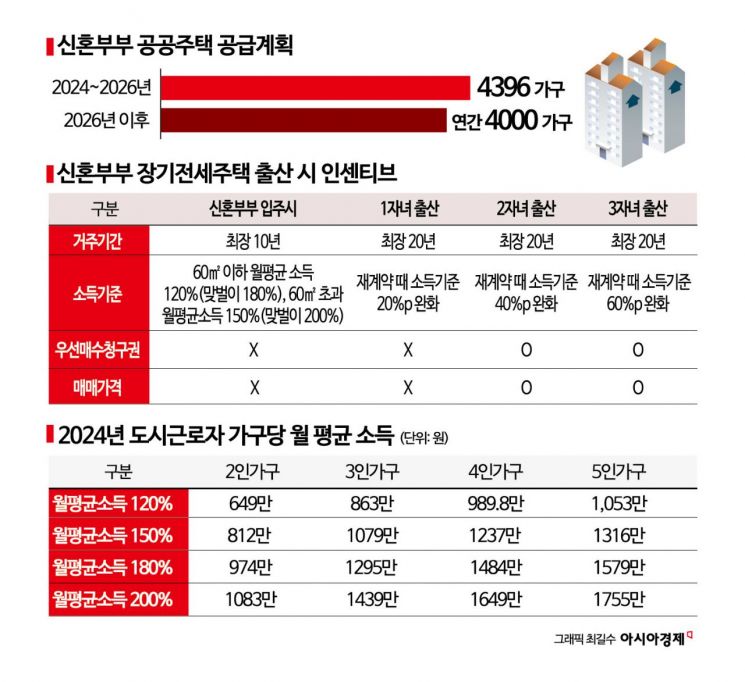
The city plans to supply 2,396 units of long-term jeonse housing over three years until 2026. In the past five years, only 511 units were supplied to newlyweds. Including long-term jeonse housing and 2,000 units of Safe Housing for Newlyweds, a total of 4,396 rental housing units will be supplied over the next three years. After 2026, the plan is to increase the supply to 4,000 units annually.
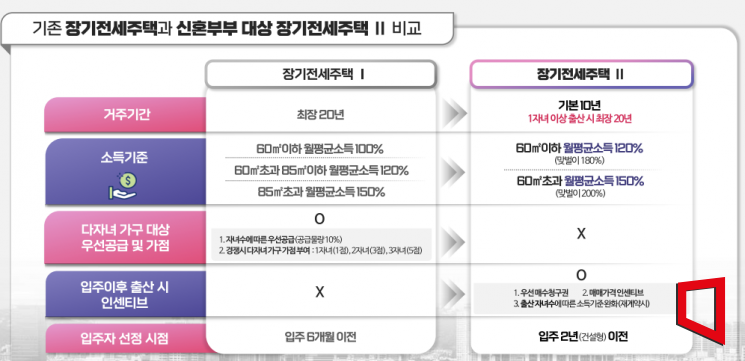
Eligibility for moving in requires applicants to be newlywed households without home ownership. Anyone who has registered their marriage within the last seven years or plans to register within six months can apply. Seoul City plans to prioritize supplying 300 units of long-term jeonse housing to newlyweds at Olympic Park Foreon in July. The goal is to supply 188 units in the first half of 2025, 450 units in the second half of 2025, 331 units in the first half of 2026, and 1,127 units in the second half of 2026.
Among the planned 2,396 units of Long-term Jeonse Housing 2, 927 units will be constructed using public land such as Guryong Village (300 units), Seongdui Village (175 units), and Jangji Garage Site (154 units). The remaining 1,469 units will be supplied through purchasing reconstructed or station-area housing such as Jayang 1 District (177 units) and Miseong Clover (76 units). For the construction type, residents will be recruited when the construction progress reaches 40% about two years before move-in.
Han Byung-yong, Director of Seoul City’s Housing Policy Office, said, "If a resident gives birth during the waiting period after being selected, the residence period can be extended to include that time. Most rental housing donated through reconstruction will be supplied as long-term jeonse housing, and half of those will be allocated for newlyweds."
The childbirth incentive for newlyweds will be determined based on the announcement date of resident recruitment. Instead of awarding points based on the number of children for Long-term Jeonse Housing 2 applicants, selection will be made based on three criteria ranked by score: continuous residence period in Seoul, combined subscription period for newlywed housing, and subscription savings period.
Income criteria relaxed to allow middle-class newlyweds to move in
The income criteria for applying for public rental housing under 60㎡ exclusive area have been relaxed to 120% or less of the average monthly income of urban workers per household (6.49 million KRW for two-person households). The previous income criterion for long-term jeonse housing was 100% or less. For rental housing over 60㎡ exclusive area, the income limit has been improved from 120% or less to 150% or less of the average monthly income of urban workers (8.12 million KRW for two-person households). Income regulations for dual-income households have also been newly established: 180% or less for under 60㎡ (9.74 million KRW for two-person households) and 200% or less for over 60㎡ (10.83 million KRW for two-person households).
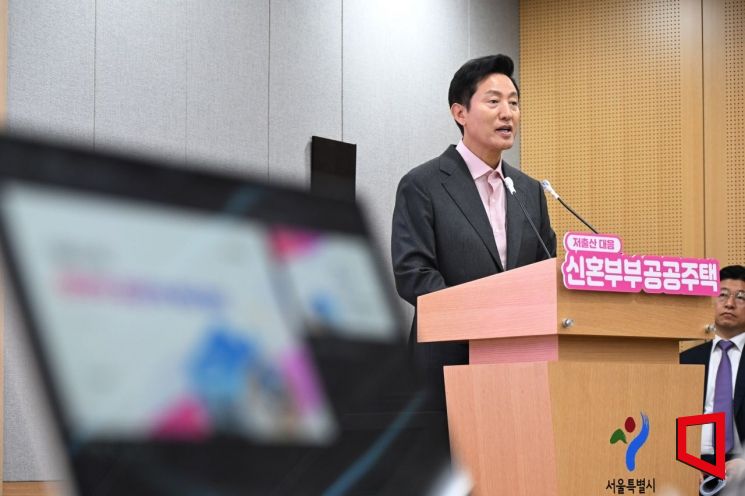
Mayor Oh said, "The number one reason people hesitate to have children is housing, which is the most important consideration. Due to Seoul’s high housing costs, not only low-income but also middle-class families recognize housing as their biggest concern when planning to have children. Based on this, we decided to relax the income criteria."
The relaxation of income criteria for dual-income households is expected to take place after approval from the Ministry of Land, Infrastructure and Transport. The city has also requested the ministry to provide incentives for households that have children after moving in, not only for long-term jeonse housing but also for other public rental housing. The rules regarding the area standards for rental housing occupied by two newlyweds also need to be revised.
Han Byung-yong, Director of the Housing Policy Office, said, "Currently, the area limit for two newlyweds moving in is 40㎡, but we are negotiating to revise the rules to increase this to 49㎡ or more. The allocation by area for Olympic Park Foreon is still undecided. We expect to complete negotiations by July and then announce recruitment."
The city will provide incentives such as extended residence periods and priority purchase rights based on the number of children born. If one child is born after moving in, the residence period can be extended from 10 to 20 years. Priority purchase rights are granted if two or more children are born. If two children are born, residents can purchase the home they lived in after 20 years at 10% below market price; if three children are born, at 20% below market price. Income criteria applied at contract renewal will also be relaxed by 20 percentage points for households with children.
2000 units of station-area ‘Safe Housing for Newlyweds’ supplied by 2026
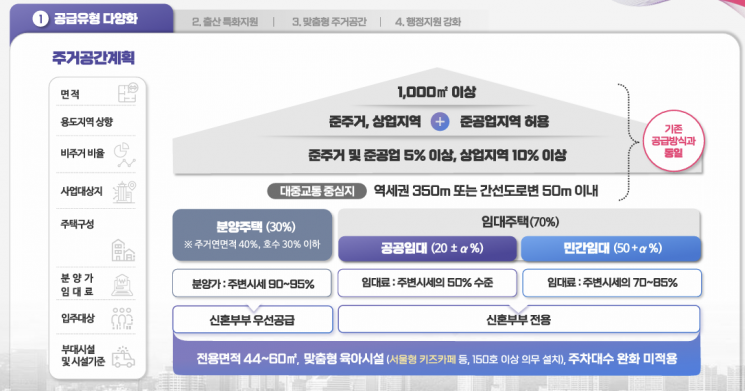
Seoul City will introduce a new rental housing supply model for newlyweds called ‘Safe Housing for Newlyweds.’ It targets newlyweds within seven years of marriage and prospective newlyweds, supplying 70% as rental and 30% as sale housing. Private rental housing will be supplied at 70-85% of the surrounding market price, and public rental housing at about 50% of market price.
Safe Housing for Newlyweds offers customized spaces and services tailored to the characteristics of newlyweds. Considering changes in household composition, it includes structures such as alpha rooms and children’s rooms, and installs high-end built-in appliances like refrigerators and air conditioners for convenience. These houses will be built within 350 meters of station areas or within 50 meters of main roads. The city plans to recruit pilot sites next month and establish ordinances and operational standards in July. The area of Safe Housing for Newlyweds will be between 44㎡ and a maximum of 60㎡.
Han Byung-yong, Director of the Housing Policy Office, said, "We are also considering converting unstarted Youth Safe Housing projects into Safe Housing for Newlyweds. It is estimated that about 20 projects face difficulties due to PF (Project Financing) issues. We plan to review mainly sites where changes to land area, parking plans, and unit sizes are possible, and expect that about 5-6 sites can be converted to newlywed housing."
Unlike Youth Safe Housing, which was supplied 100% as rental, Safe Housing for Newlyweds can supply 30% as sale housing. The zoning area will be granted the maximum legal floor area ratio. When upgrading from a type 2 general residential area to a semi-residential area, the maximum floor area ratio can be up to 500%. Newlyweds moving into Safe Housing for Newlyweds will also be granted priority purchase rights. Public rental residents will have priority transfer rights after 20 years of residence, and private rental residents after 10 years. The sale price will be 90% or less of the appraised value, and 80% or less if three or more children are born.
Mayor Oh said, "We plan to operate this system temporarily until December 2026 and aim to supply about 2,000 units within the year. If we steadily supply about 4,000 units annually combining Long-term Jeonse Housing 2 and Safe Housing for Newlyweds, we will be able to cover about 10% of the total demand from newlyweds."
© The Asia Business Daily(www.asiae.co.kr). All rights reserved.
![Clutching a Stolen Dior Bag, Saying "I Hate Being Poor but Real"... The Grotesque Con of a "Human Knockoff" [Slate]](https://cwcontent.asiae.co.kr/asiaresize/183/2026021902243444107_1771435474.jpg)

















