About 85 Asiatic Black Bears Estimated in Jirisan Area
If You Encounter a Bear, Do Not Avoid Eye Contact and Back Away Slowly
As the restoration project for the endangered Asiatic black bear (반달가슴곰) in Jirisan reaches its 20th year this year, recent reports of sightings of the bear on Jirisan hiking trails have raised concerns, urging hikers to be cautious. Recently, a video posted on social media by a hiker who encountered an Asiatic black bear near the Beksoryeong Shelter in Jirisan National Park on the 23rd has become a hot topic on multiple online communities.
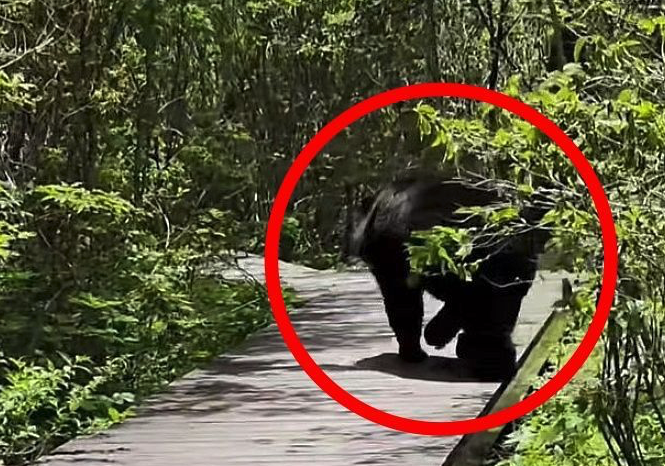 As this year marks the 20th anniversary of the restoration project for the endangered Asiatic black bear in Jirisan, reports of sightings of the bear on Jirisan hiking trails have recently increased, prompting hikers to exercise caution.
 [Photo source=Online Community]
The video shows a bear emerging from the bushes and walking. The bear glanced at the hiker once before leading the way along the trail. Soon after, the bear ran back into the bushes and disappeared from sight. The hiker who posted the video wrote, "Both the Jirisan bear and we were startled." Netizens responded with comments such as "It's a relief that the bear is thriving," "People have entered the bear's territory," and "The size of the Asiatic black bear is bigger than expected."
The restoration project was initiated after the presence of a very small number of Asiatic black bears was confirmed in Jirisan in 2000, highlighting the need for conservation. It was predicted that if left unattended, the Asiatic black bear would become extinct in South Korea within 20 years. The Korea National Park Service launched a restoration project in 2020 aiming for a minimum viable population of 50 bears. Bears were brought in from Russia and other countries and continuously released into the wild, while those unable to adapt were relocated to breeding facilities for care.
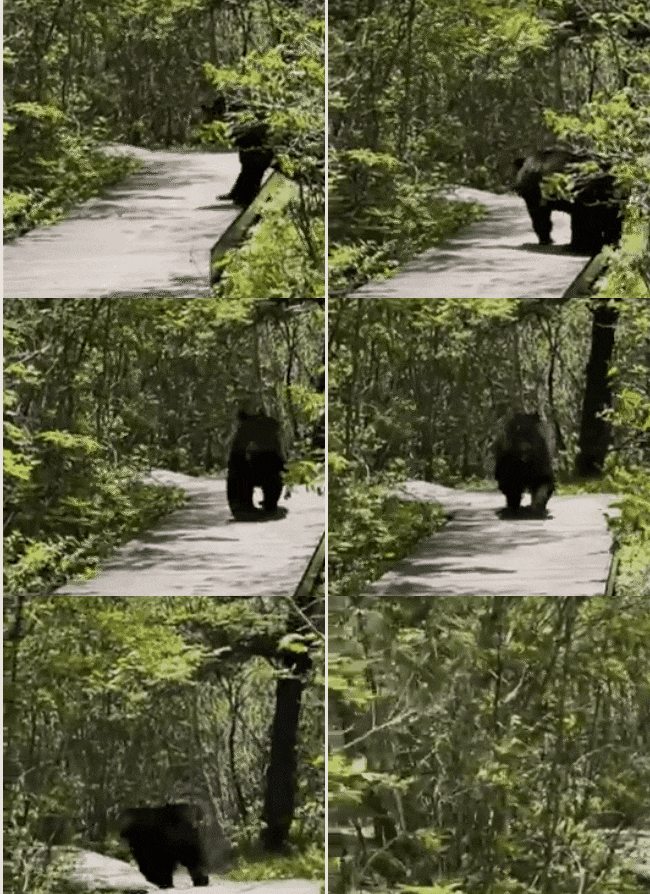 In 2004, the Korea National Park Service launched a restoration project aiming to establish a minimum viable population of 50 bears by 2020. They continuously released Asiatic black bears imported from Russia and other countries, while bears that could not adapt to the wild were relocated to breeding facilities for care.
 [Photo by Online Community]
The restoration project has achieved partial success, and it is currently estimated that about 85 Asiatic black bears inhabit the Jirisan area. The National Park Service explains that the probability of encountering a bear on hiking trails is less than 1%. However, this recent increase in sightings is believed to be due to the bears’ expanded range during mating season. To avoid encounters with bears, hikers should use designated trails and it is recommended to hike in groups of two or more rather than alone.
Additionally, hikers should not leave behind leftover food or fruit. If you encounter a bear, do not avoid eye contact; instead, slowly back away to increase distance. If the bear is staring from afar, slowly raise your arms above your head to appear larger, which may cause the bear to mistake you for a bigger animal and encourage it to leave.
© The Asia Business Daily(www.asiae.co.kr). All rights reserved.
![Clutching a Stolen Dior Bag, Saying "I Hate Being Poor but Real"... The Grotesque Con of a "Human Knockoff" [Slate]](https://cwcontent.asiae.co.kr/asiaresize/183/2026021902243444107_1771435474.jpg)
















