Chaesangbyeong Special Act, 179 Votes in Favor, 111 Against, 4 Invalid Votes
President Yoon Suk-yeol's exercise of the right to request reconsideration (veto) on the 'Special Act on the Appointment of a Special Prosecutor for the Investigation of Obstruction and Concealment of the Truth Regarding the Death of a Marine in the Line of Duty (Special Prosecutor Act for Chae Sang-byeong)' was rejected in the National Assembly plenary session re-vote on the 28th. The 'Special Act on Support for Victims of Jeonse Fraud and Housing Stability (Jeonse Fraud Special Act)' and the Act on the Honor and Treatment of Democratic Meritorious Persons (Democratic Meritorious Persons Act) passed the plenary session.
In the re-vote of the Special Prosecutor Act for Chae Sang-byeong held at the last plenary session of the 21st National Assembly that afternoon, out of 294 members present, 179 voted in favor, 111 against, and 4 invalid votes, resulting in rejection. Consequently, the Special Prosecutor Act for Chae Sang-byeong will be automatically discarded.
According to the anonymous voting results that day, the Special Prosecutor Act for Chae Sang-byeong was rejected with 179 votes in favor, 111 against, and 4 invalid votes out of 294 members present.
According to the National Assembly Act, a bill on which the president exercises a veto returns to the National Assembly to be either discarded or re-voted. The approval quorum requires ▲a majority of the total members present and ▲two-thirds or more of the members present. Among the total 296 members, two independent members, Yoon Kwan-seok and Lee Soo-jin (Seoul Dongjak-eul), were absent that day.
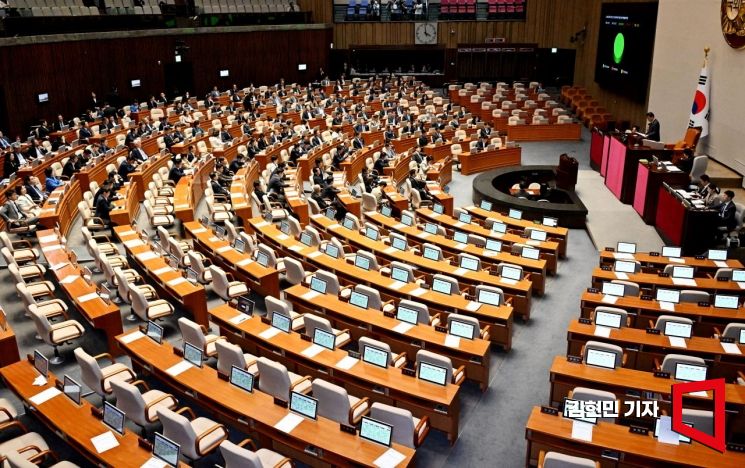 On the 28th, the Special Act on Jeonse Fraud Amendment Bill is being passed solely by the opposition party at the plenary session held at the National Assembly. Photo by Kim Hyun-min kimhyun81@
Initially, some members of the People Power Party who had predicted to defect (vote in favor) in this vote did not seem to affect the outcome. Earlier, the People Power Party had decided as a party stance to reject the Special Prosecutor Act for Chae Sang-byeong in the re-vote at a party meeting held before the National Assembly plenary session that afternoon.
Ruling Party Walkout During Jeonse Fraud Special Act Vote... Passed with 170 Votes in Favor
After the re-vote on the Special Prosecutor Act for Chae Sang-byeong, the Jeonse Fraud Special Act vote proceeded with the ruling party having left, passing with 170 votes in favor and zero against.
The Jeonse Fraud Special Act passed this time introduces a 'prior relief, subsequent recovery' program, where the Housing and Urban Guarantee Corporation (HUG) and others use the Housing and Urban Fund to publicly purchase the lease deposit return claims of victims of jeonse fraud, prioritizing compensation of the damages first, and later recovering the funds through debt collection and sales.
The opposition parties, including the Democratic Party, had previously passed the bill for direct submission to the plenary session at the Land, Infrastructure and Transport Committee on February 27th solely by the opposition.
On the other hand, the ruling party opposed the bill citing difficulties in rapid relief, increased public burden in case of recovery difficulties, and fairness issues with similar fraud victims. The government also announced strengthened support measures for housing stability for victims of jeonse fraud through a joint inter-ministerial plan the day before.
Since the government and the ruling party have clearly expressed opposition to the bill, it is highly likely that President Yoon will exercise his veto. As the term of the 21st National Assembly expires on the 29th, if President Yoon exercises the veto, the bill is expected to be discarded.
Floor leader Choo Kyung-ho said to reporters at the National Assembly that day, "Today's agenda was unilaterally demanded by the Democratic Party without any agreement," and added, "As repeatedly explained, this law has many problems, so naturally it cannot be implemented, and therefore we plan to recommend exercising the right to request reconsideration."
Four Bills Unilaterally Submitted by the Opposition Also Passed... Vetoes Expected One After Another
Without bipartisan agreement, four bills including the Democratic Meritorious Persons Act were passed solely by the opposition parties such as the Democratic Party in the National Assembly plenary session. The Democratic Meritorious Persons Act includes provisions to designate people who suffered during democratization movements other than the April 19 Revolution and the May 18 Democratization Movement, which already have special laws, as meritorious persons, granting benefits to them and their families.
Additionally, the following bills were also passed: ▲the 'Special Act on Relief and Support for Victims of the April 16 Sewol Ferry Disaster' amendment bill extending medical expense support for victims until April 15, 2029; ▲the 'Act on Support for the Sustainable Development of the Korean Beef Industry' to support farms for the development of the Korean beef industry; ▲and the 'Act on the Establishment of Agricultural and Fishery Chambers' to provide legal grounds for establishing representative organizations of farmers and fishermen.
Bills directly submitted to the plenary session such as the 'Fair Trade in Franchise Business Act' granting franchisees collective bargaining rights against franchisors, the 'Rice Management Act Amendment' requiring the government to purchase excess rice production at a specified price during price crashes, and the 'Amendment to the Act on Distribution and Price Stabilization of Agricultural and Marine Products' aiming to introduce a price stabilization system for major agricultural products were submitted to the plenary session but were not put on the agenda due to disagreements between the ruling and opposition parties, thus failing to pass.
© The Asia Business Daily(www.asiae.co.kr). All rights reserved.

















