Publication of Report on Revitalizing Korea-Africa Economic Cooperation
Agriculture, Infrastructure, Minerals, Digital Cooperation
On the Occasion of June Korea-Africa Summit
Expectations for Strengthened Economic Cooperation and Trade Development
The Korea International Trade Association's International Trade and Commerce Research Institute emphasized the need to expand cooperation with Africa, where continuous economic growth is expected, in sectors such as agriculture, urban infrastructure, minerals, and energy in its report titled 'Measures to Revitalize Korea-Africa Economic Cooperation' published on the 29th.
The report proposed 'K-A.F.R.I.CA' as a comprehensive economic cooperation plan between Korea and Africa, containing the following content. It takes the first letters of Agriculture (A), urban infrastructure (F), minerals and energy (R), and digital technology (I) in English, highlighting the necessity of mutual cooperation (Cooperative Allies) in each sector.
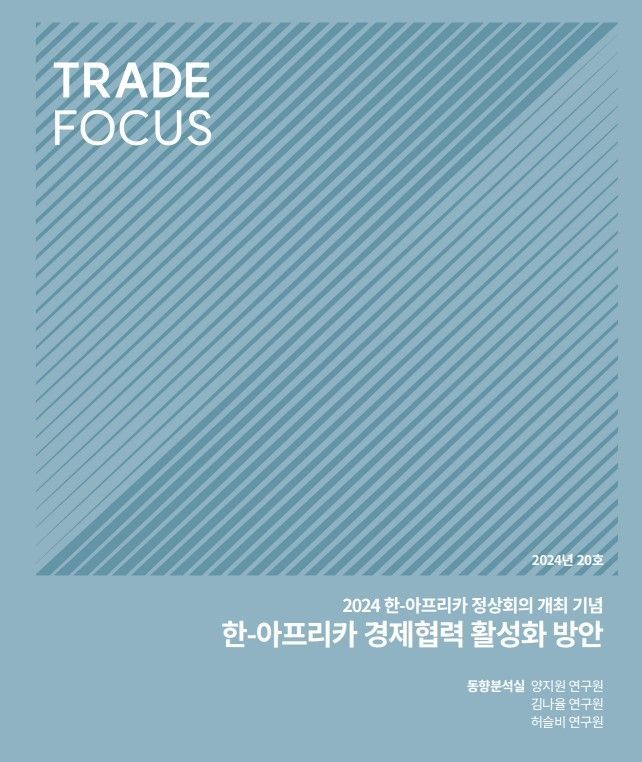 Cover of the report "Measures to Revitalize Korea-Africa Economic Cooperation" published on the 29th by the Korea International Trade Association International Trade and Commerce Research Institute. Photo by KITA
Underlying this is the judgment that Africa will become a 'land of opportunity' for Korea. The report pointed out that Africa's economic growth rate has surpassed the world average since 2000 and emphasized that high growth rates of 3.8% and 4.1% are expected for this year and next year, respectively. Meanwhile, trade between Korea and Africa has been rapidly increasing since 2020 based on a complementary structure of capital goods exports (50.8%) and primary product imports (54.7%), leveraging Africa's abundant resources and Korea's manufacturing capabilities. Korea's main exports are ships and parts (44.2%) and petroleum products (18.0%), while imports mainly consist of fossil fuels (coal 21.6%, natural gas 12.6%) and luxury foods (3.5%).
The sector where Korea and Africa should cooperate first is minerals and energy. Korea can enhance the stability of mineral procurement through establishing mineral refining and smelting facilities in Africa and participating in multilateral resource development consultative bodies. At the same time, Africa can achieve economic self-reliance by expanding the mining ecosystem beyond simple extraction to high value-added stages, which is expected to create a win-win effect. In the renewable energy sector, customized development strategies tailored to the characteristics of each country are necessary, as promising fields differ by country.
The report also noted abundant cooperation opportunities in agriculture due to persistent food shortages in some parts of Africa. Korea has strengths in post-harvest management of agricultural products and rice processing and storage technologies, enabling official development assistance (ODA) for modernizing agricultural infrastructure, exporting agricultural machinery, improving crop varieties, enhancing agricultural productivity, and increasing the added value of agricultural products. Additionally, major African countries are promoting regional economic integration through economic corridor projects connecting key African cities alongside new city developments. In this regard, Korea is expected to cooperate in construction and machinery exports related to urban infrastructure, infrastructure consulting support, and participation in industrial complex development.
The information and communication technology (ICT) market should also be closely watched. The ICT markets of four major African countries?South Africa, Nigeria, Kenya, and Ghana?are expected to grow at an average annual rate of 6.7% over the next five years, indicating abundant growth potential in Africa's digital economy. Korea can expand various types of appropriate technology ODA projects utilizing its globally competitive ICT product exports and related technologies. Furthermore, as Africa has recently been recognized as a testbed for global social ventures, Korea's IT-related startups should be supported in demonstration and technology commercialization to actively enter the African market.
Korea has established cooperative relationships with 54 African countries through diplomatic ties, trade, investment, and ODA. Discussions on pursuing a Free Trade Agreement (FTA) and economic cooperation plans to expand trade have also been ongoing. The upcoming Korea-Africa Summit scheduled for June is expected to serve as an opportunity to strengthen economic cooperation and expand trade.
Yang Ji-won, a researcher at the Korea International Trade Association, stated, "We expect the 2024 Korea-Africa Summit to broaden the horizon of cooperation between the two regions," and emphasized, "The Korean government should improve the environment for domestic companies entering Africa by supporting overseas investment insurance, realizing refunds on resource development investment funds, and consider concluding FTAs with key countries such as Morocco, Egypt, and Tanzania, thereby establishing a continuous and future-oriented partnership from a mid- to long-term perspective."
© The Asia Business Daily(www.asiae.co.kr). All rights reserved.
![Clutching a Stolen Dior Bag, Saying "I Hate Being Poor but Real"... The Grotesque Con of a "Human Knockoff" [Slate]](https://cwcontent.asiae.co.kr/asiaresize/183/2026021902243444107_1771435474.jpg)















