No Obligation to Unlock Mobile Phones
Conflict Between Criminal Investigations and Fundamental Rights
Some Countries Move Toward Legislation
Recently, major suspects in high-profile cases, such as trot singer Kim Ho-jung, actor Yoo Ah-in, and Park Mo, who helped a fugitive accomplice, have repeatedly caused difficulties in investigations by refusing to submit their iPhone passwords. In principle, a court-issued warrant for the seizure and search of a mobile phone only grants the authority to extract information related to the criminal facts, so there is no obligation to disclose the password stored in one's mind. Some voices argue that even in cases of heinous crimes, there should be measures to forcibly unlock mobile phones.
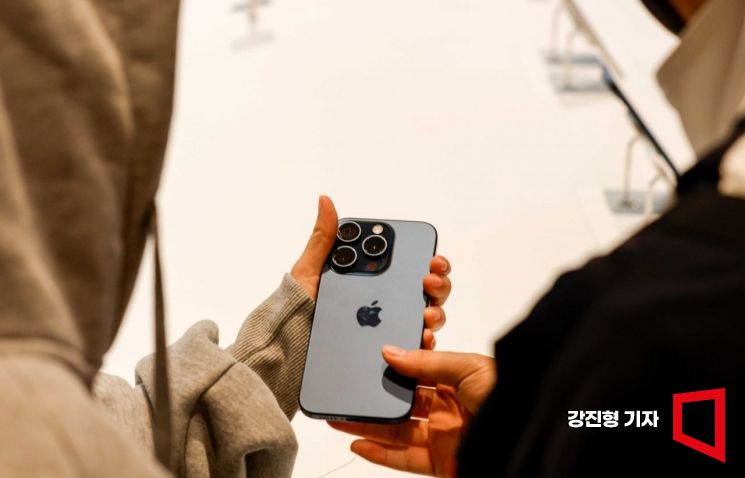 Customers are examining the iPhone 15 series at the Apple Store Myeongdong branch in Jung-gu, Seoul.
 [Photo by Kang Jin-hyung]
On the 29th, a police official explained, "It cannot be said that iPhone passwords cannot be unlocked across the board. It varies depending on various factors such as the model and version," adding, "It is not fixed; as devices evolve, the analysis framework is also upgraded." This means that if mobile phone manufacturers increase encryption levels, investigative agencies research and adopt new methods.
Generally, investigative agencies request suspects to provide the password of the mobile phone secured through seizure and search for swift investigation. Although digital forensic devices can be used to attempt unlocking, it takes a long time and sometimes fails. An iPhone password can create as many as 56 billion combinations when mixing numbers and uppercase and lowercase English letters. If the password is entered incorrectly more than five times, the phone locks for one minute, and thereafter, the lock time increases sequentially to 5 minutes, 15 minutes, and 1 hour with each wrong attempt. After more than 10 failed attempts, the data stored on the phone is permanently deleted.
Conflicts over criminal apprehension and constitutional rights infringement are also occurring overseas. In the United States, disputes between investigative authorities and Apple have continued since September 2014. The Federal Bureau of Investigation (FBI) has demanded Apple to unlock passwords in cases involving terrorism, mass shootings, and drugs. On the other hand, Apple refuses, arguing that it would weaken the security of all users. In 2016, the U.S. District Court for the Eastern District of New York ruled that "the authorities' request could undermine the spirit of the Constitution and should be addressed by Congress," stating there is no need to unlock the iPhone.
Currently, U.S. investigative agencies contract with private companies to unlock iPhone passwords. Using equipment from the Israeli information technology company Cellebrite, it is known that even if an incorrect password is entered on an iPhone, delays or interruptions in the process can be prevented. However, forensic analysis of a single phone costs about 200 to 300 million won, and the time required is unknown.
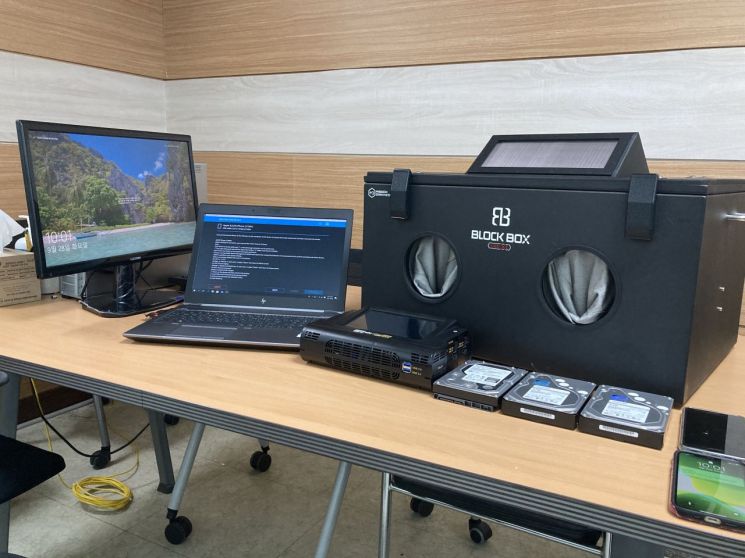
Some countries have legislated the obligation to unlock mobile phone passwords. In the United Kingdom, failure to disclose passwords in cases involving child pornography and terrorism results in aggravated punishment. The Netherlands explicitly grants the authority to order suspects to unlock passwords under the Criminal Procedure Act. In South Korea, former Minister of Justice Choo Mi-ae attempted to promote a law requiring the disclosure of mobile phone passwords but halted it amid public backlash.
Im Jong-in, honorary professor at Korea University's Graduate School of Information Security, pointed out, "Since there is a constitutional right to refuse to give self-incriminating testimony, it depends on the case," but added, "There is a need for technical cooperation from companies, even if limited, for serious criminals such as heinous offenders or suspects related to national security."
© The Asia Business Daily(www.asiae.co.kr). All rights reserved.
![Clutching a Stolen Dior Bag, Saying "I Hate Being Poor but Real"... The Grotesque Con of a "Human Knockoff" [Slate]](https://cwcontent.asiae.co.kr/asiaresize/183/2026021902243444107_1771435474.jpg)
















