KOFIA Hosts 'Capital Market Value-Up International Seminar' to Explore Measures
Yoshio Horimoto, Director of Japan Financial Services Agency, Presents 'Capitalism Policy Achievements'
"Capital market value-up can serve as a virtuous economic cycle policy that breathes vitality into our economy and can be a breakthrough in the era of low growth, low birthrate, and aging population, allowing everyone to win-win. The Korea Financial Investment Association and the financial investment industry will continue their strenuous efforts to achieve capital market value-up."
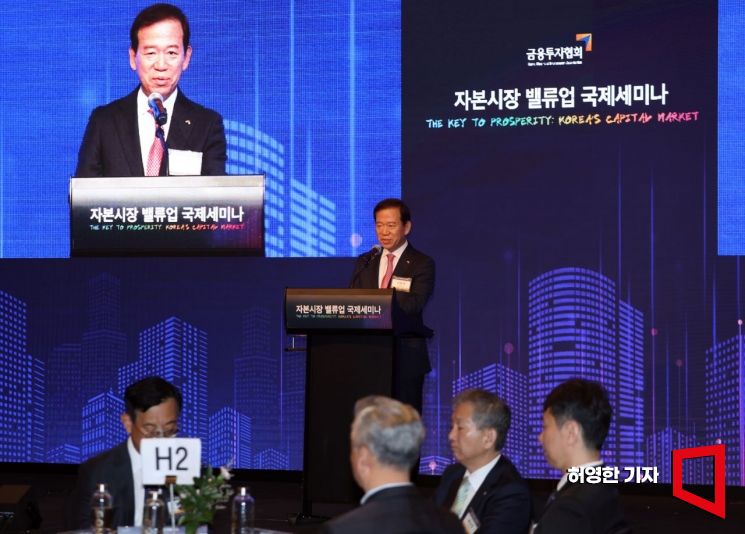 At the Capital Market Value-Up International Seminar held on the 28th at the Conrad Hotel in Yeouido, Seoul, hosted by the Korea Financial Investment Association, Seo Yoo-seok, Chairman of the Korea Financial Investment Association, is delivering the opening address. Photo by Heo Young-han younghan@
On the 28th, Seo Yoo-seok, Chairman of the Korea Financial Investment Association, made this statement while hosting the 'Capital Market Value-Up International Seminar' at the Conrad Hotel in Yeouido, Seoul.
The Capital Market Value-Up International Seminar was organized to explore ways to enhance the value of our capital market through Japan's success cases and recommendations from top domestic and international experts, amid rising public interest in resolving the Korea discount issue.
The seminar, held under the slogan "The Key to Prosperity: Korea’s Capital Market," was attended by over 200 stakeholders from the financial investment industry, government, and academia.
The seminar began with an opening address by Chairman Seo Yoo-seok, followed by congratulatory remarks from Baek Hye-ryun, Chairperson of the National Assembly’s Political Affairs Committee; Kang Min-guk, ruling party secretary of the same committee; Hong Sung-guk, opposition party secretary; Kim Ju-hyun, Chairman of the Financial Services Commission; and Lee Bok-hyun, Governor of the Financial Supervisory Service.
The seminar proceeded with 'Session 1: Keynote Presentations' and 'Session 2: Discussions.' The first keynote speaker, Yoshio Horimoto, Director of the Japanese Financial Services Agency, presented on "Key Contents and Achievements of Japan’s New Capitalism Policy."
The Kishida Fumio Cabinet, launched in October 2021, implemented value-up policies under the broad framework of "New Capitalism." In June 2022, it announced specific implementation plans. Since then, Japan’s value-up policy has been regarded as successful, with the Nikkei 225 average stock price, Japan’s representative stock index, surpassing the record set during the bubble economy 34 years ago to reach an all-time high.
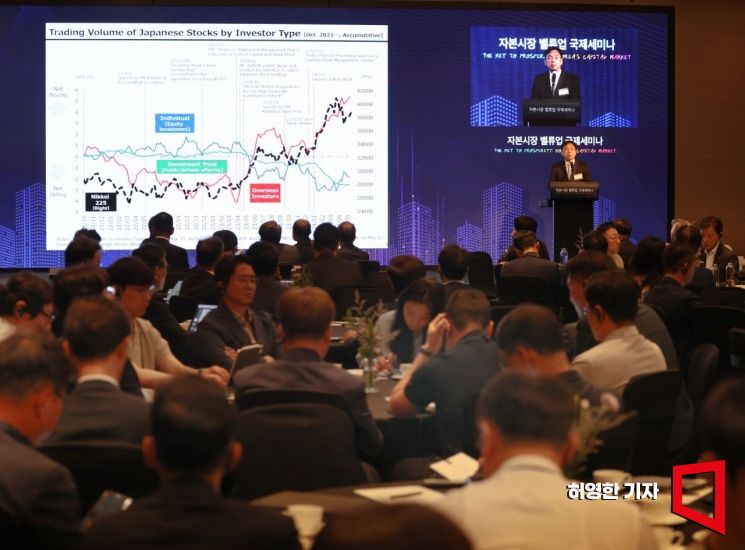 At the Capital Market Value-Up International Seminar hosted by the Korea Financial Investment Association on the 28th at the Conrad Hotel in Yeouido, Seoul, Yoshio Horimoto, Director General of the Japan Financial Services Agency, is delivering the keynote speech. Photo by Younghan Heo younghan@
He identified three success factors: △ extensive structural reforms to channel household assets into the capital market △ close communication between senior government officials, including the Prime Minister, and overseas investors △ policy outcomes felt through tax incentives and financial education.
In particular, the government implemented the "Asset Management Nation Realization Plan," which shifts household assets, previously concentrated in savings and deposits, into financial investment products. Through this, the government urged behavioral changes and reforms among various actors in the "investment chain," including households, companies, and financial institutions.
He explained, "Japanese retail investors did not see investment returns after the bubble economy," adding, "Our goal is to enable investors, even with small amounts, to achieve returns and form stable funds."
He also emphasized that active communication with overseas investors and policy outcomes such as tax incentives played a role. He stated, "We had one-on-one discussions with global overseas investors," and "We examined why the world should choose Japan and how to emphasize Japan’s strengths to investors."
Furthermore, he noted that these achievements were realized through long-term implementation rather than short-term perspectives. He explained, "Japan has implemented various responses under a deflationary economy over the past 10 to 20 years," and "From the perspective that investment in Japan must be promoted, we went through various trials and errors and concluded that unless the entire investment cycle is transformed, the capital market cannot sustainably develop in the long term."
The second keynote speaker, Jeon Eun-jo, Senior Partner at McKinsey & Company, presented on "Ways to Value-Up the Korean Capital Market." Jeon said, "The undervaluation of Korean companies has been empirically confirmed through quantitative analysis," and "It is closely related to poor financial performance indicators such as profitability."
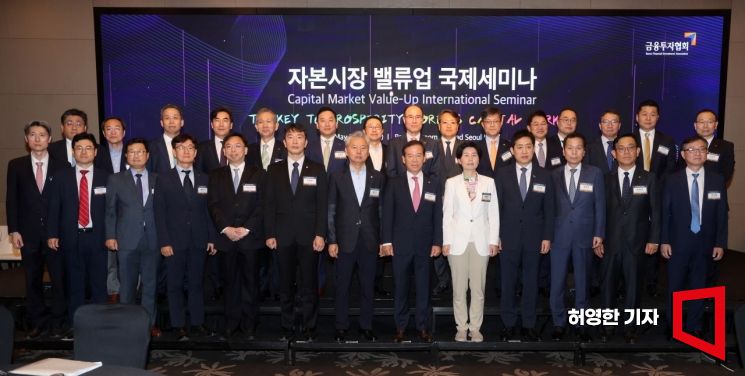 At the Capital Market Value-Up International Seminar held on the 28th at the Conrad Hotel in Yeouido, Seoul, hosted by the Korea Financial Investment Association, guests and speakers are taking a commemorative photo. Photo by Heo Younghan younghan@
He emphasized that for resolving the Korea discount, corporate growth is the most important factor. He argued, "Korean companies lack growth and profits," and "They are fundamentally undervalued because they cannot deliver results."
He also stressed that to escape undervaluation, listed companies must strive to improve capital efficiency, profit indicators, and qualitative indicators. Additionally, general investors should expand long-term investments as watchdogs of companies’ value-up efforts, and institutional investors need responsible engagement activities.
He stated, "Financial investment companies should pursue fundamental changes in corporate finance business through specialization in investment banking (IB), while continuing efforts to attract household assets into the capital market," adding, "The government needs a comprehensive approach linking industrial and financial policies, and prompt resolution of institutional issues such as tax policies is necessary."
© The Asia Business Daily(www.asiae.co.kr). All rights reserved.
![Clutching a Stolen Dior Bag, Saying "I Hate Being Poor but Real"... The Grotesque Con of a "Human Knockoff" [Slate]](https://cwcontent.asiae.co.kr/asiaresize/183/2026021902243444107_1771435474.jpg)


















