Democratic Party Likely to See Income Replacement Rate Decline in 22nd National Assembly
Negotiations on Base Reform May Also Become Difficult
Delaying Special Prosecutor Law for Chae Sang-byeong and Discussing Pension Reform Measures
With only two days left until the end of the 21st National Assembly, the possibility of pension reform is also closing. Some in the political sphere point out that even if the Chae Sang-byeong Special Prosecutor Act is delayed to the next National Assembly, the pension reform bill should be handled in this session.
In politics, there is a forecast that if pension reform focused on parameter reform is not achieved in the 21st National Assembly, the window of opportunity may close. A Democratic Party official said, "There is tremendous internal opposition regarding the Democratic Party's decision to lower the income replacement rate from 50% to 44% during this reform. We are even being called traitors," adding, "If the reform fails this time, the 22nd National Assembly will start with an income replacement rate of 50%." If the 21st National Assembly passes, the common ground that the ruling and opposition parties have discussed for agreement so far will disappear, and negotiations may start over from scratch.
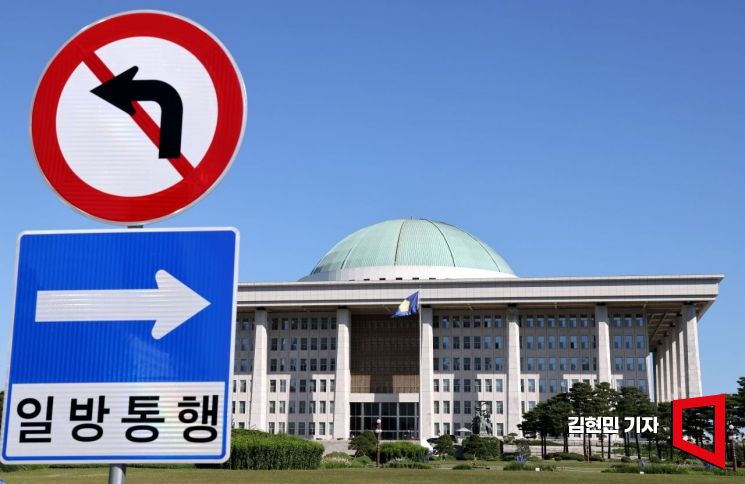 The confrontation between the ruling and opposition parties over the 'Marine Corps Corporal Chae Special Prosecutor (Special Investigation) Act' and the National Pension reform plan is reaching its peak. The final plenary session of the 21st National Assembly, scheduled for the 28th to re-vote on the 'Corporal Chae Special Prosecutor Act' and other matters, is shrouded in tension at the National Assembly. Photo by Kim Hyun-min kimhyun81@
In fact, Lee Jae-myung, leader of the Democratic Party, mentioned at the highest council meeting the day before, "Civil society groups advocating for a 50% income replacement rate are strongly opposing the Democratic Party's acceptance of the 44% plan," and said, "(In the 22nd National Assembly) we will work on supplementing issues such as raising the income replacement rate." This statement implies that if the reform fails this time, there may be a retreat to the previous position.
In the People Power Party, prospective party leaders such as Na Kyung-won and Representative Yoon Sang-hyun have shown a progressive stance by accepting Lee’s proposal for now and suggesting pushing for structural reform in the 22nd National Assembly. However, the People Power Party leadership maintains the position of postponing discussions to the 22nd National Assembly to handle structural reform together.
In the political sphere, there are also calls to handle the pension reform bill even if the Chae Sang-byeong Special Prosecutor Act and other bills are postponed to the next National Assembly to overcome this situation. A political insider said, "The ruling party’s biggest concern is the Chae Sang-byeong Special Prosecutor Act, but if the handling of this law is postponed to the 22nd National Assembly and pension reform is pursued, negotiations could open up." The insider also mentioned, "Speaker Kim Jin-pyo’s remark at a press briefing on the 26th that ‘pension reform is much more important than the Chae Sang-byeong Special Prosecutor Act’ is in this context." For now, there is some willingness within the ruling party to accept Lee’s pension reform proposal, and from the opposition’s perspective, if there is no defection of double-digit ruling party members, they cannot pass the Chae Sang-byeong Special Prosecutor Act, so achieving pension reform instead is worth trying.
© The Asia Business Daily(www.asiae.co.kr). All rights reserved.
![Clutching a Stolen Dior Bag, Saying "I Hate Being Poor but Real"... The Grotesque Con of a "Human Knockoff" [Slate]](https://cwcontent.asiae.co.kr/asiaresize/183/2026021902243444107_1771435474.jpg)















