KCCI 'Implications of Employment Characteristics of Science and Technology Personnel' Report
"Job Growth Speed Outpaces Supply"
Male Proportion Still Dominant
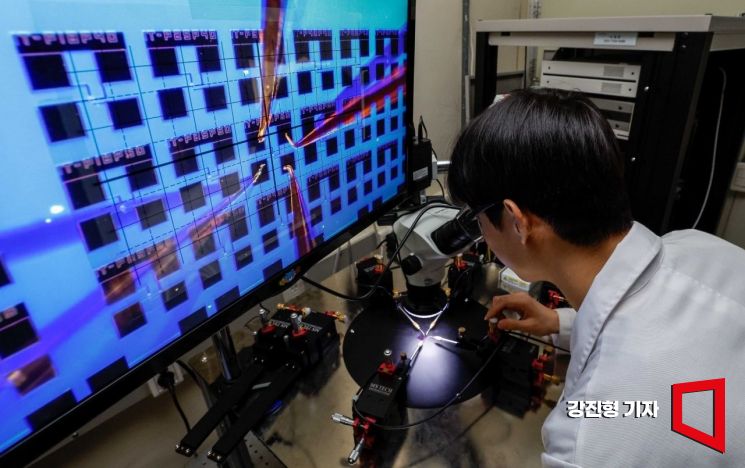 On the 20th, a KIST researcher is inspecting the pattern of a next-generation ultra-low power magnetic memory device developed by the Korea Institute of Science and Technology (KIST) in Seongbuk-gu, Seoul. Unlike conventional silicon semiconductors, the next-generation ultra-low power spin memory device uses 'spin' and aims to operate with only 1/1000 of the power of silicon semiconductors, making it a new concept semiconductor device that can be driven with very minimal ultra-low power. Photo by Jinhyung Kang aymsdream@
An analysis has revealed that the rate of increase in science and technology jobs in South Korea is outpaced by the rate at which science and engineering graduates are entering the workforce. This raises concerns about a potential future shortage in the supply of science and technology personnel.
The Korea Employers Federation (KEF) released a report titled "Recent Employment Characteristics and Implications of Science and Technology Personnel" on the 28th, detailing these findings.
According to the report, as of April last year, the number of science and technology personnel was estimated at 1.96 million, having grown at an average annual rate of 5.3% over the past four years since 2020. The increase is attributed to the impacts of COVID-19 and the Fourth Industrial Revolution accelerating workforce growth.
The number of individuals holding a bachelor's degree or higher in science and engineering fields reached 5.66 million, growing at an average annual rate of 3.6% over the past four years. KEF explained, "The slower growth rate of science and engineering degree holders compared to the increase in science and technology personnel suggests that the production of higher education graduates is not keeping pace with job creation."
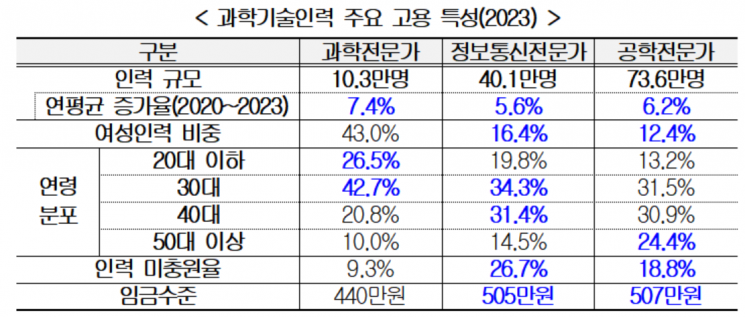
The report analyzed science and technology jobs by dividing them into three categories: science, information and communications technology (ICT), and engineering, based on raw data from the Statistics Korea regional employment survey. First, science experts (according to the standard occupational classification, including ▲life and natural science experts and testers ▲humanities and social science experts) numbered 103,000 as of April last year, increasing at an average annual rate of 7.4% over the past four years. The proportion of personnel in their 20s and 30s was 69.2%, and the share of highly educated individuals holding a master's degree or higher was 56.2%, higher than both the overall labor market and the average for science and technology personnel.
The average monthly wage was estimated at 4.4 million KRW. This figure includes all bonuses and in-kind benefits received at the main workplace over the past three months before taxes, as compiled by Statistics Korea. Samples without recorded average wages over three months were excluded.
Information and Communications Technology (ICT) experts (according to the standard occupational classification, including ▲computer hardware and communications engineering experts ▲computer systems and software experts ▲data and network experts ▲information systems and web operators ▲communications and broadcasting transmission equipment technicians) numbered 401,000, growing at an average annual rate of 5.6% over the past four years.
Male workers accounted for 83.6%, an overwhelming majority. The unfilled vacancy rate was 26.7%, the highest among science and technology jobs. Despite a job vacancy ratio (job openings / job seekers) of 0.24, which favors employers, the high unfilled vacancy rate indicates that even with many applicants, companies struggle to hire the personnel they desire due to a shortage of qualified candidates.
Engineering experts (including ▲architecture and civil engineering ▲chemical engineering ▲metallurgy and materials engineering ▲electrical and electronic engineering ▲mechanical and robotics engineering ▲environmental engineering, gas, energy technicians and testers ▲aircraft and ship engineers and controllers) numbered 736,000, the largest group. Their average annual growth rate over the past four years was 6.2%.
Similarly, the proportion of male workers was dominant at 87.6%. Additionally, the share of personnel aged 50 and above was 24.4%, exceeding other fields by more than 10 percentage points. The average monthly wage was 5.07 million KRW, higher than that of ICT experts (5.05 million KRW) and science experts.
Kim Sun-ae, head of the KEF Employment Policy Team, stated, "Although the demand for science and technology personnel in the industrial sector is rapidly increasing, the persistent issues of quantitative supply shortages and qualitative mismatches in personnel raise concerns about a worsening shortage of science and technology workers and a decline in national competitiveness." She emphasized, "It is necessary to establish multifaceted talent development policies and strategies, including innovation in university education systems, expanded utilization of youth and female workers, and deregulation of advanced industries." She also noted, "Considering the differing characteristics of personnel across science and technology fields, tailored policy support by sector is required."
© The Asia Business Daily(www.asiae.co.kr). All rights reserved.
![Clutching a Stolen Dior Bag, Saying "I Hate Being Poor but Real"... The Grotesque Con of a "Human Knockoff" [Slate]](https://cwcontent.asiae.co.kr/asiaresize/183/2026021902243444107_1771435474.jpg)

















