NYT "Differences Confirmed on Sensitive Issues Including North Korea"
"South Korea, China, and Japan face long-standing complex issues, so it is uncertain how dramatically cooperation will be promoted."
As the South Korea-China-Japan summit resumed after about four years and six months, on the 27th (local time), U.S. media outlets all gave significant coverage to the news. Generally, the perspective was cautious of China's moves to create rifts in the South Korea-U.S.-Japan trilateral cooperation amid escalating U.S.-China tensions.
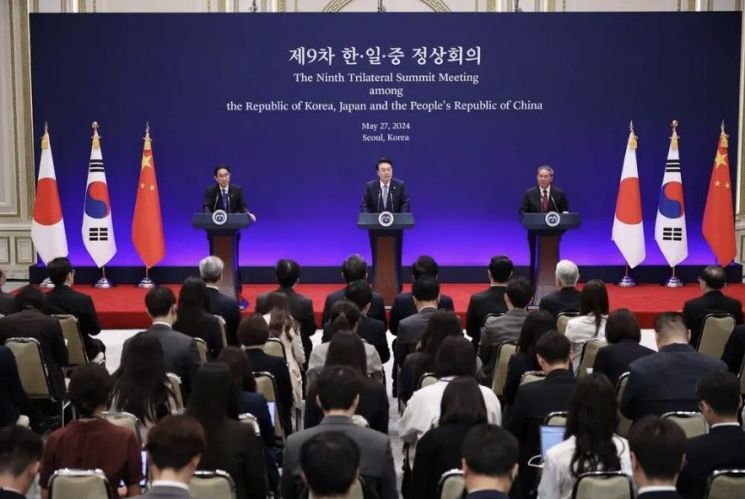
The U.S. Associated Press (AP) reported, "The resumption of top-level talks among the three Northeast Asian countries and their agreement on the need to improve relations is a positive signal for cooperation," but also assessed that it is uncertain whether groundbreaking progress will be made among the three countries.
The agency noted, "Despite the seemingly friendly atmosphere of the talks, Chinese Premier Li Qiang expressed China's unease over South Korea and Japan's moves to strengthen their security alliance with the U.S.," adding, "Beijing views this as an attempt to form a bloc to contain China."
The U.S. daily The New York Times (NYT) evaluated that the agenda of the three countries' talks focused only on areas where common ground could be easily found, and clear differences were confirmed on sensitive issues.
The newspaper reported, "The talks mainly focused on areas where common ground could be easily found, such as supply chain protection, trade revitalization, cooperation on aging populations, and new infectious disease issues," and "avoided thorny regional security issues like Taiwan and North Korea."
In particular, it pointed out that North Korea's announcement of plans to launch a reconnaissance satellite just before the South Korea-U.S.-Japan summit revealed differences in positions among the three countries.
The newspaper wrote, "North Korea's increasingly aggressive military posture is deepening concerns in South Korea and Japan," adding, "President Yoon Suk-yeol and Japanese Prime Minister Fumio Kishida strongly condemned North Korea's satellite launch plans, but Premier Li did not criticize North Korea and instead called on all parties for restraint and political resolution." It continued, "With the strategic competition between the U.S. and China intensifying during years of hiatus, relations between China and the two U.S. allies have also deteriorated in recent years," and "experts regard the revival of the trilateral summit itself as an achievement."
The U.S. economic daily The Wall Street Journal (WSJ) reported, "Despite China's call to move away from protectionism, the three countries failed to agree on initiatives to abandon protectionism," and "instead, they agreed on the need to continue communication in the area of export controls." This implies that China tried but failed to bring South Korea and Japan into an opposition front against the U.S. tariff increases on Chinese imports.
The newspaper stated, "China will continue to face limitations in persuading U.S. allies to pursue stronger trade relations with China," and reported that the three countries also failed to form a consensus on Taiwan and North Korea issues.
Meanwhile, the U.S. will hold a South Korea-U.S.-Japan deputy foreign ministers' meeting in Washington D.C. on the 31st to counter China's attempts to divide the trilateral cooperation.
© The Asia Business Daily(www.asiae.co.kr). All rights reserved.
![Clutching a Stolen Dior Bag, Saying "I Hate Being Poor but Real"... The Grotesque Con of a "Human Knockoff" [Slate]](https://cwcontent.asiae.co.kr/asiaresize/183/2026021902243444107_1771435474.jpg)















