'3rd Fund' 344 Billion Yuan Scale
Likely to Invest in High Value-Added Chip Manufacturing Including HBM
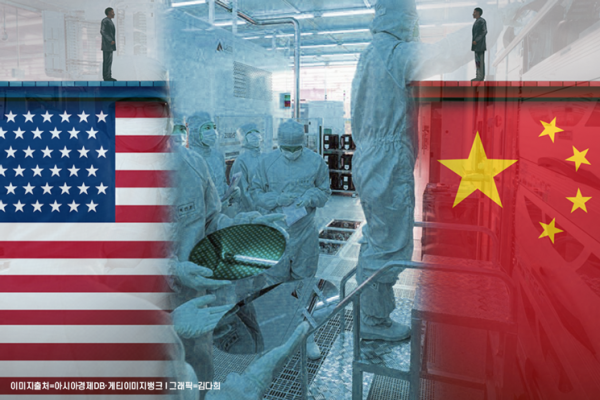
Amid escalating U.S. pressure on China regarding advanced industries, China has established its largest-ever national semiconductor fund. This move is interpreted as a strategy to accelerate the construction of an independent supply chain in response to U.S. regulations, including tariff hikes.
According to the National Enterprise Credit Information Publicity System operated by the Chinese government on the 27th, the "National Integrated Circuit Industry Investment Fund" No. 3, valued at 344 billion yuan (approximately 64.6823 trillion KRW), was registered and established with the Beijing Municipal Market Supervision Administration on the 24th. Also known as the "Big Fund," this fund was first created in 2014 with a scale of 98.7 billion yuan, and the No. 2 fund was 204.1 billion yuan in 2019. The newly established No. 3 fund is the largest ever, combining the scale of the previous two funds.
The fund's business scope includes private equity fund management, venture capital fund management services, equity investment, investment management, and asset management. The largest shareholder is the Ministry of Finance of China, holding a 17% stake, with a paid-in capital of about 60 billion yuan. The second-largest shareholder is China Development Bank Capital, holding 10.5%. Other major contributing shareholders include China Construction Bank, Bank of China, Postal Savings Bank, Industrial and Commercial Bank of China, and Agricultural Bank of China, each investing 21.5 billion yuan, and Bank of Communications investing 20 billion yuan. The six major state-owned banks collectively hold 37.06% of the shares.
The Big Fund has previously provided funding not only to China's largest chip foundry company, Zhongxin Guoji (SMIC), and Hua Hong Semiconductor, but also to flash memory manufacturer Yangtze Memory Technologies (YMTC) and several smaller companies and funds. The specific sectors where the newly established No. 3 fund will invest have not been disclosed.
However, the market expects the fund to focus on fostering Chinese manufacturers of materials such as silicon wafers, chemicals, and industrial gases, as well as the development of manufacturing equipment subject to export restrictions. This is in line with the efforts of China's semiconductor giants to shift procurement from overseas major companies to domestic sources. Huaxin Securities recently reported that, in addition to semiconductor investments, equipment and materials, as well as high-value-added DRAM chips like High Bandwidth Memory (HBM), are likely to be key targets. The Nihon Keizai (Nikkei) newspaper also predicted that investments will concentrate on artificial intelligence (AI) products, which have become difficult to import due to U.S. export controls on semiconductor products and manufacturing equipment.
© The Asia Business Daily(www.asiae.co.kr). All rights reserved.

















