Government Launches Space Aviation Agency and Passes Preliminary Feasibility for Satellite Communication
Big Tech Like SpaceX and Amazon Accelerate Space Development
"Momentum Awaiting with Micro Cluster Satellites and Lunar Probe Development"
Recently, the Space Aviation Agency, often referred to as the Korean version of NASA, officially launched, creating a favorable environment for the expansion of business by domestic private companies involved in satellite development. As a result, investment in space development is expected to expand significantly, leading to a surge in satellite launches. Analysts in the securities industry emphasize the need to pay attention to domestic companies capable of collaborating with global firms.
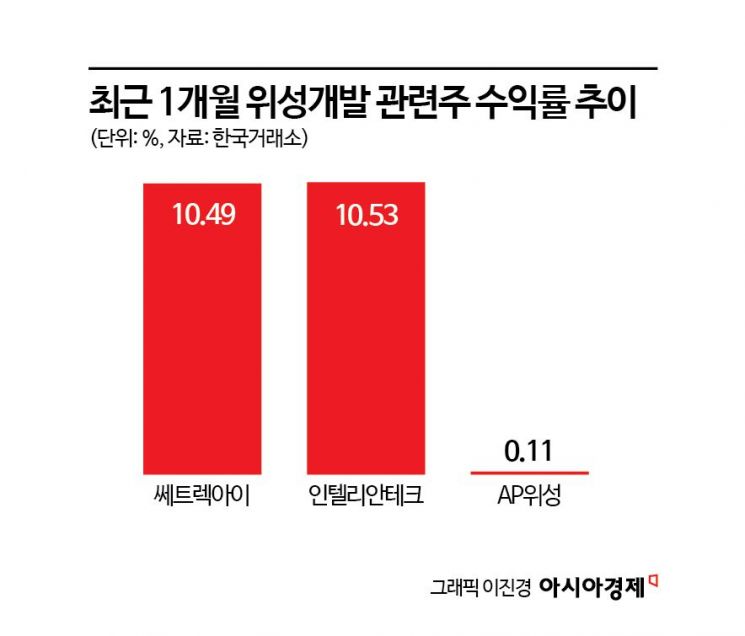
According to the Korea Exchange on the 28th, Setrec Eye, a satellite system development company, saw its stock price rise by 10.49% over the past month as of the closing price on the 27th, reaching 51,600 KRW. During the same period, Intellian Technologies, which produces satellite communication antennas and other equipment, rose by 10.53% to 68,200 KRW, showing strong performance among companies related to satellite development.
The rise in stock prices of satellite-related companies is interpreted as a reflection of the government's active commitment to space development projects becoming a reality. With the official launch of the Space Aviation Agency the day before, numerous organizations scattered across the space industry are expected to be systematized, enhancing mid- to long-term sustainability and expertise. Additionally, the government previously passed the preliminary feasibility study for the "Technology Development Project to Secure Competitiveness in the Low Earth Orbit Satellite Communication Industry" at the 4th National Research and Development Project Evaluation Committee. The project period is from 2025 to 2030, with a total budget of approximately 320 billion KRW. Through this project, the launch of low earth orbit communication satellites based on 6G standards and the establishment of satellite communication systems, including ground stations and terminals, will be actively pursued.
This preliminary feasibility study for low earth orbit satellite communication succeeded on its third attempt after failing consecutively in 2021 and 2022. With this approval, the industry expects domestic companies developing satellites, user antennas, gateways, and more to benefit. In particular, since this project is a pilot network to build a low earth orbit satellite communication system, there is potential for further business expansion in the future. Moreover, the market anticipates initial public offerings (IPOs) from aerospace-related companies such as Innospace and Lumir, while the government is preparing for the launch of ultra-small cluster satellites and lunar exploration spacecraft, promising continuous momentum.
Kim Doohyun, a researcher at Hana Securities, stated, "The low earth orbit satellite communication market, which will lead the growth of the space industry, is expected to grow from $31.2 billion in 2021 to $216.2 billion by 2030, with global companies such as SpaceX, Amazon, and OneWeb actively investing in related businesses." He analyzed, "The investment background is that low earth orbit satellites will lead the Internet of Things (IoT) market in the upcoming hyper-connected 6G era." He added, "With the privatization of the space industry, there are countless fields where domestic small and medium-sized enterprises can enter. Attention should be paid to companies like Intellian Technologies and AP Satellite, which generate performance in antennas, terminals, ground stations, and launch vehicles, and have references with global clients."
Recently, the rapid increase in demand for observation satellites for military purposes due to emerging global geopolitical risks is also a positive factor for the growth of the space industry. Jung Eehun, a researcher at Eugene Investment & Securities, said, "Government-led satellite development projects and orders for core satellite components and satellite systems in the defense sector are expected to increase." He pointed out, "In particular, Setrec Eye is the only company in Korea that develops complete artificial satellite systems, including the satellite body, payload, and control systems." He added, "Moreover, except for some components such as solar panels and batteries, most satellite parts, including cameras, sensors, and Global Positioning System (GPS) receivers, are designed and produced in-house. Having received equity investment from Hanwha Aerospace and incorporated as a subsidiary, it can benefit from the increasing demand for satellite development as a key part of the Hanwha Group's space business division."
© The Asia Business Daily(www.asiae.co.kr). All rights reserved.

















