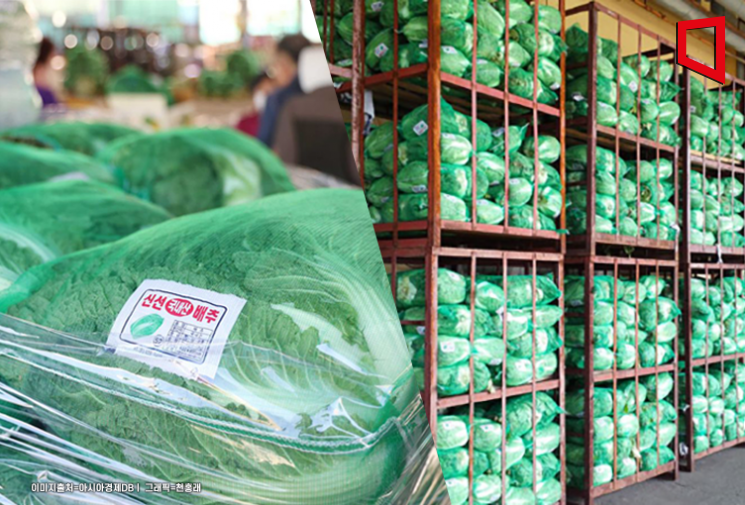
The government expects a decrease in the supply of napa cabbage and radish this summer due to hot and humid weather conditions, and has decided to stockpile 10,000 tons of spring napa cabbage and 5,000 tons of spring radish in preparation.
On the 27th, the Ministry of Agriculture, Food and Rural Affairs announced that it is making thorough preparations before and after to prevent instability in agricultural product supply and demand caused by weather disasters such as heavy rains and heatwaves this summer.
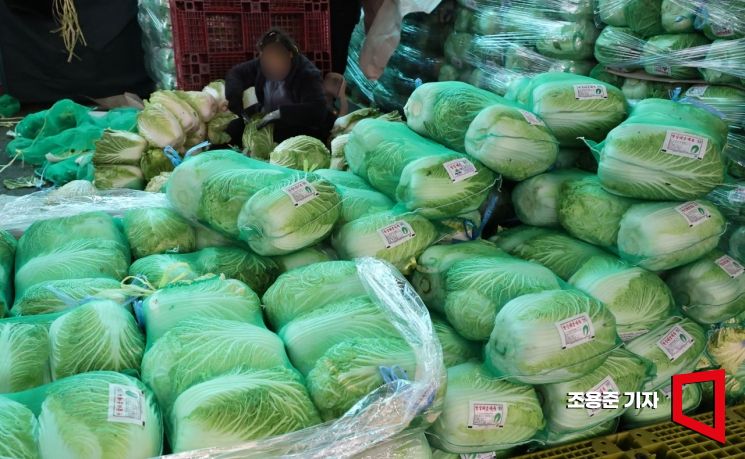
According to the Ministry, during summer, the supply of highland open-field vegetables such as napa cabbage and radish tends to be unstable due to hot and humid weather conditions, leading to price increases. Last year, heavy rains caused flooding in greenhouses growing lettuce and other vegetables, temporarily reducing the shipment volume of facility-grown vegetables. According to the Korea Meteorological Administration's mid-term forecast, this summer's rainfall and temperature are expected to be similar to or higher than the average (1991?2020), with possibilities of heavy rains due to atmospheric instability and expanded typhoon impacts caused by rising sea surface temperatures. Therefore, thorough preparations are necessary to stabilize the supply of agricultural products vulnerable to summer weather disasters.
The Ministry forecasts a decrease in summer supply as the cultivation (intended) area of summer napa cabbage from July to October is expected to decrease by 4.6% compared to last year, and the cultivation (intended) area of summer radish is also expected to decrease by 3.2% compared to last year.
A Ministry official stated, "Currently, the price of napa cabbage is falling compared to last year as open-field spring napa cabbage, with a cultivation area 4.4% larger than last year, is being shipped in full swing. Radish prices have been strong since March due to poor winter radish harvests. However, prices are expected to decline as spring radish shipments increase from June."
Accordingly, to stabilize the supply of summer napa cabbage and radish, the Ministry plans to support pesticide use and provide technical guidance through the open-field vegetable growth management council. Additionally, to prepare for supply instability from July to September and demand during the Chuseok holiday, it plans to stockpile 10,000 tons of spring napa cabbage and 5,000 tons of spring radish, whose production is increasing. To enable rapid resumption of production in case of crop loss due to summer weather disasters, 2 million reserve napa cabbage seedlings will be prepared. Furthermore, to expand supply during mid to late September, when prices are highest, an additional 6,700 tons of summer napa cabbage cultivation area will be secured through contract farming with the NongHyup. Also, 6,200 tons of napa cabbage under shipment agreements from June to September will be secured through shipment control facilities of major production area NongHyups such as Daegwallyeong and Andong to stabilize summer supply.
Yeolmu, which can substitute for summer kimchi made with napa cabbage, has seen a yearly decrease in cultivation area due to reduced consumption. However, it has a relatively short production period of about 30 days and can be grown in general facilities, making its shipment volume highly sensitive to price changes. As of May, prices are somewhat higher than last year, but the Ministry expects stabilization after June due to increased sowing area. The Ministry will continue to monitor crop conditions in major production areas and provide technical guidance. In case of a sharp decline in yield due to a surge in pests and diseases during summer, it plans to support re-sowing costs to facilitate early recovery of supply.
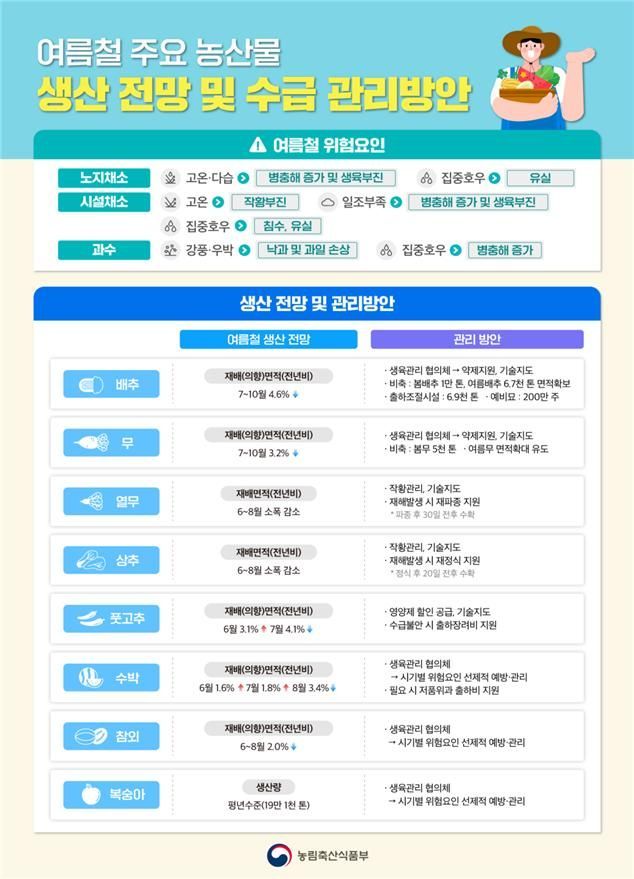
Regarding watermelons, according to the Korea Rural Economic Institute (KREI), the shipment area in August is expected to decrease by about 3.4% compared to last year, but the shipment areas in June and July, which account for a large share of shipments, are expected to increase by 1.6% and 1.8% respectively, maintaining the overall summer shipment area at last year's level. Due to poor weather conditions during the flowering and growth period in March and April, the May harvest was poor, resulting in higher prices compared to last year. However, shipments will begin in late May in the main summer production area of Eumseong, Chungbuk, and shipments from Buyeo and Nonsan, where growth has recovered, will continue, so prices are expected to stabilize after June compared to May.
For chamoe (Korean melon), the summer shipment area from June to August is expected to decrease by about 2% compared to last year due to reduced cultivation area in major production regions. Prices are expected to be somewhat high from late May to early June due to reduced shipment volume, but as the fruit set condition is currently good, shipment volume is expected to recover after early June, stabilizing prices, according to the Ministry.
A Ministry official said, "During summer, heavy rains and heatwaves increase the risk of pests and diseases, greenhouse flooding, and fruit drop. Therefore, the Ministry is focusing on pre-harvest management through crop-specific growth management councils, securing stockpiles in advance to prepare for supply instability caused by weather disasters, and supporting rapid production resumption in case of disasters to ensure stable supply of agricultural products during summer."
© The Asia Business Daily(www.asiae.co.kr). All rights reserved.
![Clutching a Stolen Dior Bag, Saying "I Hate Being Poor but Real"... The Grotesque Con of a "Human Knockoff" [Slate]](https://cwcontent.asiae.co.kr/asiaresize/183/2026021902243444107_1771435474.jpg)

















