Professor Jinman Kim of Kongju University Meeting
"KS Standards Must Change to Increase Mixed Material Ratios"
Emphasizing the Need for Recycling Circular Resources
"It is important to carefully examine the intentions of European Union (EU) countries, which are facing the challenge of reducing greenhouse gas emissions yet are not hesitating to make massive investments in the cement industry."
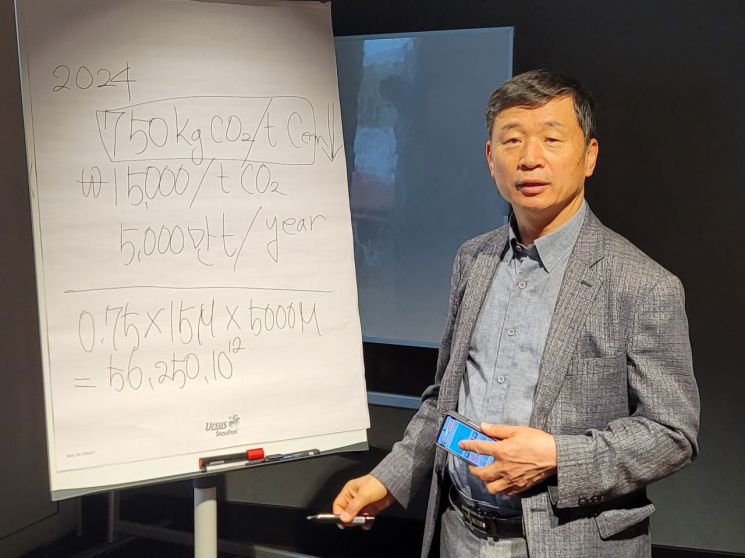 Professor Jinman Kim of the Department of Green Smart Architectural Engineering at Kongju National University is explaining carbon dioxide emission reduction at the "Global Cement Industry Carbon Neutrality Promotion Trends" meeting held at a hotel in Vienna, Austria, on the 23rd.
 [Photo by Korea Cement Association]
Professor Kim Jin-man of the Department of Green Smart Architectural Engineering at Kongju National University stated this at a briefing on "Global Trends in Carbon Neutrality Promotion in the Cement Industry" held on the 23rd at a hotel in Vienna, Austria. He said, "The future of greenhouse gas reduction lies in Europe." Professor Kim is recognized as a long-time researcher of the cement industry and co-chairman of the Cement Green New Deal Committee.
He first argued that the KS (Korean Industrial Standards) should be revised to allow an increased ratio of supplementary materials in cement manufacturing. He emphasized the need to reduce the clinker ratio, which is a semi-finished product of cement, to lower carbon emissions. Typically, producing 1 ton of cement emits about 700 kg of carbon dioxide, of which 420 kg?or 60%?comes from the use of limestone in clinker production.
Europe freely allows the use of a total of 10 types of supplementary materials, including blast furnace slag, recycled concrete, silica fume, two types of pozzolan, two types of fly ash, and two types of burnt shale limestone powder. The maximum allowable usage is up to 36%. In contrast, Korea's ordinary Portland cement standards permit only limited use of two out of four types?blast furnace slag, fly ash, pozzolan, and limestone powder?with a maximum ratio of 10%.
Professor Kim said, "Unlike Korea, which has only one type of slag cement mixed with slag generated from the steel industry, Europe utilizes various supplementary materials to produce blended cement that reduces the limestone proportion and maximizes greenhouse gas emission reduction. Korea's standards for supplementary material use are significantly lower in both types and quantities compared to Europe. To achieve carbon neutrality in the domestic cement industry, active consideration of relaxing KS standards is necessary."
He also stressed the need to reduce greenhouse gas emissions by recycling circular resources such as waste plastics, waste tires, and waste vinyl instead of fossil fuels like bituminous coal. He explained, "Europe has already smoothly replaced bituminous coal with combustible waste, and in Germany, there are cement plants that have achieved up to 100% fuel substitution. On the other hand, the domestic cement industry's fuel substitution rate is only 35%. Contrary to global standards, negative perceptions prevail due to opposition from civic groups and some environmental activists, resulting in not only a lack of prompt response but also falling behind, which is concerning."
He raised his voice for the government's support for the cement industry. Professor Kim said, "'Housing sovereignty' must be given up if cement necessary for securing housing is dependent on overseas sources, just as there is the term 'food sovereignty.' It is very regrettable that the environment for alternative fuel conversion in the cement industry has led to conflicts with the environmental industry domestically. The government needs to properly coordinate by understanding the characteristics of the industry."
© The Asia Business Daily(www.asiae.co.kr). All rights reserved.
![Clutching a Stolen Dior Bag, Saying "I Hate Being Poor but Real"... The Grotesque Con of a "Human Knockoff" [Slate]](https://cwcontent.asiae.co.kr/asiaresize/183/2026021902243444107_1771435474.jpg)















