Germany Has the Shortest Working Hours in Europe
'Growth Plan' to Escape the 'Low Growth Quagmire'
The German government is promoting a policy to provide tax reductions to people who work longer hours in order to revitalize the economy.
 In February 2022, the German flag was hoisted at the Port of Hamburg, Germany.
 [Image source=Reuters Yonhap News]
The Financial Times (FT) recently reported that the German government is preparing a "growth plan" to strengthen compensation for long working hours. The media stated, "It will include tax reductions on overtime and reforms to welfare benefits," adding, "The German Ministry of Finance is pushing to reduce taxes on work exceeding 41 hours per week and to change the unemployment benefits system." Across Europe, working hours have decreased since the COVID-19 pandemic, leading to analyses that economic growth has slowed as a result. The media also noted that due to aging populations and shrinking workforces, countries are seeking alternatives.
The background for this policy is the worsening economic situation. Triggered by Russia's invasion of Ukraine and the resulting energy crisis, including natural gas supply issues, Germany's GDP growth rate contracted by -0.2% last year. Although it rebounded to 0.2% in the first quarter of this year, experts predict the annual growth rate will remain below 1%. In other words, Germany has fallen into a "low-growth trap."
According to 2022 OECD data, Germany has the shortest average working hours among developed countries. In particular, the average annual working hours of Germans have decreased by 30% over the past 50 years. While South Korea's annual average working hours are 1,901, the U.S. average is 1,811, and the European average is 1,607, Germany's is 1,341 hours. The media pointed out that "the relatively high proportion of German women working part-time and an increased preference for leisure are the causes."
Related systems also encourage a culture of working less. Low-wage workers in Germany pay a significant portion of additional income in taxes or lose social security benefits when they work more. Enzo Weber, a researcher at the Nuremberg Institute for Employment Research, cited part-time jobs that allow tax-free earnings of up to 538 euros (about 790,000 KRW) per month and the "tax splitting" rule that permits joint taxation for married couples as examples, explaining, "The German tax system lacks many incentives for women to work long hours."
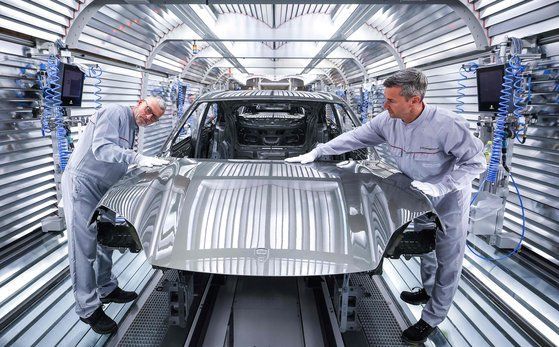 A worker is assembling a vehicle at the Porsche automobile factory in Leipzig, Germany.
 Photo by AFP Yonhap News
However, the media pointed out that the German government's policy change attempts could face backlash from workers. Most German labor unions oppose the Ministry of Finance's proposals for overtime tax reductions and changes to the unemployment benefits system. Instead, the unions advocate for working fewer hours. In fact, this year, the German Railway Union announced plans to reduce weekly working hours from the current 38 to 35 by 2029.
© The Asia Business Daily(www.asiae.co.kr). All rights reserved.
![Clutching a Stolen Dior Bag, Saying "I Hate Being Poor but Real"... The Grotesque Con of a "Human Knockoff" [Slate]](https://cwcontent.asiae.co.kr/asiaresize/183/2026021902243444107_1771435474.jpg)
















