Neutral Interest Rate Rising Makes Return to Ultra-Low Rates Difficult Even if Base Rate Falls
'Assessment Report on the Possibility of Returning to Low Rates Due to Monetary Policy Shift'
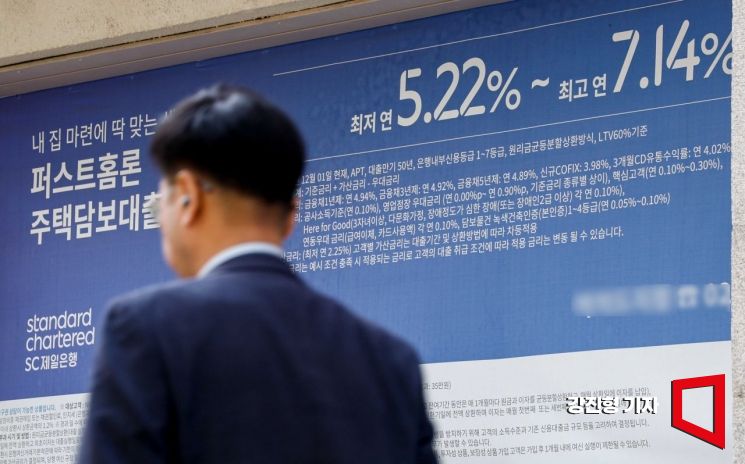 A banner displaying loan interest rates is hung on the exterior wall of a major bank in Seoul. Photo by Jinhyung Kang aymsdream@
There is an argument that even when central banks lower their benchmark interest rates, market interest rates will not return to the ultra-low levels seen after the past global financial crisis.
According to the report titled "Assessment of the Possibility of Returning to Low Interest Rates Following a Shift in Monetary Policy" by the Korea Capital Market Institute on the 27th, if South Korea and the United States enter a phase of benchmark rate cuts in the future, long-term government bond yields are expected to decline. However, the likelihood of returning to the low interest rates around 1% seen in the past is considered low.
After the global financial crisis, both the U.S. and South Korea lowered their benchmark interest rates close to zero to stimulate their economies, which led to long-term government bond yields falling to the 1-2% range. Recently, as discussions about potential rate cuts have emerged in both countries, market interest has grown regarding how much the central banks will lower their benchmark rates and how much market interest rates will fall.
Regarding expectations for monetary policy, the report diagnoses that if neither country experiences a recession, the terminal benchmark interest rate for this rate-cutting cycle will be formed at the level of the nominal neutral rate (equilibrium interest rate). The neutral rate refers to a balanced interest rate level that allows the economy to recover its potential growth rate without inflationary or deflationary pressures.
The report evaluates that nominal neutral rates in both South Korea and the U.S. have shifted upward since the spread of COVID-19 infections, with a clear difference in the degree of increase between the two countries.
South Korea’s nominal neutral rate rose from around 1.8% in the late 2010s to the mid-2% range by the end of last year, with the upper estimate reaching 2.8%. The U.S. nominal neutral rate increased more steeply than South Korea’s, rising from the mid-1% range shortly after the global financial crisis to the mid-3% range by the end of last year, with the upper estimate reaching 4.3%.
The report suggests that the rise in equilibrium interest rates may reflect structural economic changes such as globalization and demographic shifts. Kang Hyun-joo, Senior Research Fellow at the Korea Capital Market Institute and author of the report, explained, "In both South Korea and the U.S., nominal neutral rates have shifted upward since the pandemic, forming at higher levels than during the previous low-interest-rate period. Since the terminal benchmark interest rate in this rate-cutting cycle is expected to be formed at the nominal neutral rate level, it will be higher than in the 2010s."
Senior Research Fellow Kang emphasized, "The low interest rates in the 2010s were an exceptional phenomenon resulting from quantitative easing, which impaired the bond market’s risk assessment function. It is necessary to prepare for the risk that long-term interest rates may not return to low levels, and caution is needed in decision-making based on the expectation that long-term rates will fall significantly when benchmark rates are cut."
© The Asia Business Daily(www.asiae.co.kr). All rights reserved.
![Clutching a Stolen Dior Bag, Saying "I Hate Being Poor but Real"... The Grotesque Con of a "Human Knockoff" [Slate]](https://cwcontent.asiae.co.kr/asiaresize/183/2026021902243444107_1771435474.jpg)















