Inspection of Financial Investment and Insurance Sectors with High Real Estate PF Proportion
Unfavorable Contract Terms for Borrowers Detected
Q3 Improvement Plan Prepared... "Correction Requests Are Difficult"
The Financial Supervisory Service (FSS) conducted an inspection of seven companies in the financial investment, insurance, and small financial sectors with a high proportion of real estate project financing (PF) transactions during March and April. The inspection uncovered five major areas for improvement related to PF fee practices. The financial authorities plan to form a task force (TF) to develop improvement measures in the third quarter. However, since these issues fall under 'practices' rather than violations, the measures are expected to be non-binding.
On the 24th, the FSS held a briefing titled "Results of Real Estate PF Fee Inspection and Plans for Operating the Institutional Improvement TF," where it announced the inspection results and future plans for institutional improvements.
At the briefing, Hwang Sun-oh, Deputy Director of the Financial Investment Division at the FSS, stated, "We do not plan to intervene regarding whether the fee calculation is excessive or not. Our plan is to improve parts of the calculation methods or procedures that are commonly considered unreasonable."
Typically, financial companies charge various fees under different names such as handling, extension, and advisory fees when dealing with PF loans, considering factors like funding costs and target profit margins. These fees include both interest-like fees and fees for services delegated by the borrower to the financial company. Fees are generally determined through negotiations among the lending syndicate, taking into account the fee items and rates proposed by the lead financial institution.
However, following complaints from the construction industry about excessive fees related to real estate PF, the authorities began on-site inspections focusing on sectors with a high proportion of real estate PF. The inspection targets included three securities firms, two insurance companies, and two capital companies.
The inspection revealed issues such as △unstructured PF service fee charging practices △contract terms in PF agreements unfavorable to borrowers △lack of consistent interest rate calculation standards when calculating interest rate caps △inadequate record management related to financial services △insufficient information provision to borrowers regarding PF fees.
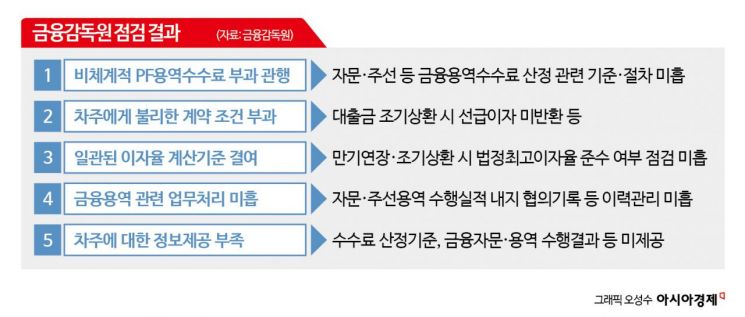
For example, a representative issue was the lack of internal standards and procedures for calculating fees when financial companies collect advisory and arrangement fees for PF. Consequently, there has been a business practice of including compensation for loan risk burden when setting financial service fees. Additionally, some PF agreements imposed contract terms unfavorable to borrowers, such as non-refund of prepaid interest even if the loan is repaid early. Clauses stating that arrangement fees cannot be reclaimed under any circumstances were also found.
The financial authorities do not plan to conduct further inspections of the industry. Based on these findings, a task force involving the financial sector, construction industry, and market experts will be formed to develop institutional improvement measures in the third quarter. This will enable the financial industry to voluntarily implement improvements to eliminate unreasonable fee practices.
Deputy Director Hwang Sun-oh urged, "Correction demands usually require legal violations, but this case is viewed as a matter of practice. Please understand that we approached this from the perspective that it is not a desirable practice."
Meanwhile, other notable issues were discovered during the inspection process. One case involved embezzlement of PF fees through affiliated companies, for which the authorities have filed charges with the prosecution due to the high likelihood of legal violations related to private gain. Regarding a second case involving separate cash collection for collateral purposes, the authorities are currently conducting a legal review, and results are expected in the future.
© The Asia Business Daily(www.asiae.co.kr). All rights reserved.
![Clutching a Stolen Dior Bag, Saying "I Hate Being Poor but Real"... The Grotesque Con of a "Human Knockoff" [Slate]](https://cwcontent.asiae.co.kr/asiaresize/183/2026021902243444107_1771435474.jpg)
















