"Unusually intense pressure even surprising locals"
A ban has been imposed on South Korean singer Kim Yeon-ja in North Korea. The authorities have instructed judicial agencies not to listen to or sing Kim Yeon-ja's songs.
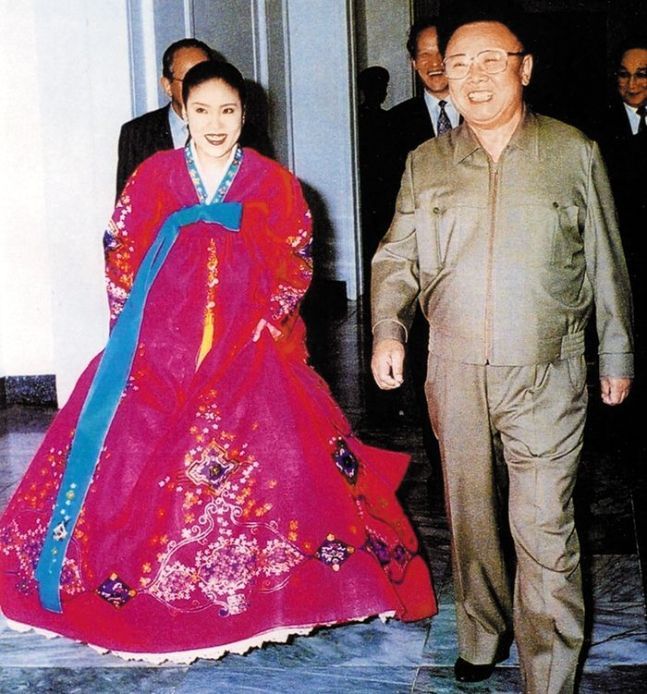 A photo of Kim Yeon-ja, who went to perform in Pyongyang in April 2001 at the invitation of North Korea, taken with Kim Jong-il, then Chairman of the National Defense Commission of North Korea.
 [Photo by Sangyeon Planning]
On the 24th, Radio Free Asia (RFA) reported this, citing sources residing in North Hamgyong Province, stating, "This is the first time that even the singer's name has been singled out to ban a song trend." It is described as an unprecedentedly strong pressure measure.
Kim Yeon-ja participated in the '19th and 20th April Spring Friendship Art Festivals' held in Pyongyang in 2001 and 2002, becoming the first South Korean singer to hold a solo concert in North Korea. During the performance, she sang "Chilgapsan," "Jeongseon Arirang," as well as North Korean songs like "Whistle" and "Imjingang." She also sang "Our Wish is Unification" together with North Korean audiences. She is known as the favorite singer of Chairman Kim Jong-il. Kim Jong-il even sent a special train to invite Kim Yeon-ja to his villa.
Kim Yeon-ja recently recalled the time on a variety show, saying, "I went into the house with Kim Jong-il, had a cup of coffee, and talked," and "At first, we talked about music, but the second time we met, I asked about his blood type. However, the people around us were very cautious. It turned out that asking about blood type was taboo," sharing behind-the-scenes stories.
After the performance, Kim Yeon-ja's songs became the favorites of North Korean residents. RFA reported that the reason her songs became banned is likely because they are the most frequently sung socially and are very popular among the residents.
Sources said, "Along with banning Kim Yeon-ja's songs, 'Morning Dew' and 'Our Wish is Unification,' known as residents' favorite songs, have also been re-designated as banned songs," adding, "Other songs related to South Korean landmarks such as 'Ulsan Taryeong,' 'Gyeongbokgung Taryeong,' and 'Bukaksan's Song' are considered crimes just to listen to." They also said, "There is a speechless atmosphere due to the pressure to eliminate even the songs that the previous leader (Kim Jong-il) liked."
North Korea has been tightening control over the influx of external culture, including enacting the 'Anti-Reactionary Thought and Culture Expulsion Law' in December 2020, which punishes distributors of South Korean video materials with the death penalty and viewers with up to 15 years in prison. South Korean cultural content is identified as a cause of attempts to overthrow the regime, and whenever internal unity is needed, residents caught watching South Korean dramas, movies, and songs have been severely punished.
Reports have emerged that seven North Korean students caught watching the Netflix drama "Squid Game" were sentenced to heavy punishments including life imprisonment, and a resident who sold a USB device containing the drama was executed by firing squad. Past footage was also released showing two 16-year-old North Korean boys receiving a public trial on an outdoor sports field while handcuffed for watching South Korean dramas.
© The Asia Business Daily(www.asiae.co.kr). All rights reserved.
![Clutching a Stolen Dior Bag, Saying "I Hate Being Poor but Real"... The Grotesque Con of a "Human Knockoff" [Slate]](https://cwcontent.asiae.co.kr/asiaresize/183/2026021902243444107_1771435474.jpg)















