This year, the United States is expected to experience the worst hurricane season on record, with the highest number of hurricanes ever.
On the 23rd (local time), according to The Guardian, NBC News, Fox Weather, and others, the U.S. National Oceanic and Atmospheric Administration (NOAA) forecasted that 17 to 25 storms will form in the Atlantic this year, with 8 to 13 developing into hurricanes with wind speeds exceeding 119 km/h. This is the highest number ever recorded in NOAA's May hurricane season forecasts. In particular, 4 to 7 of these potential hurricanes are predicted to bring strong winds of 185 km/h.
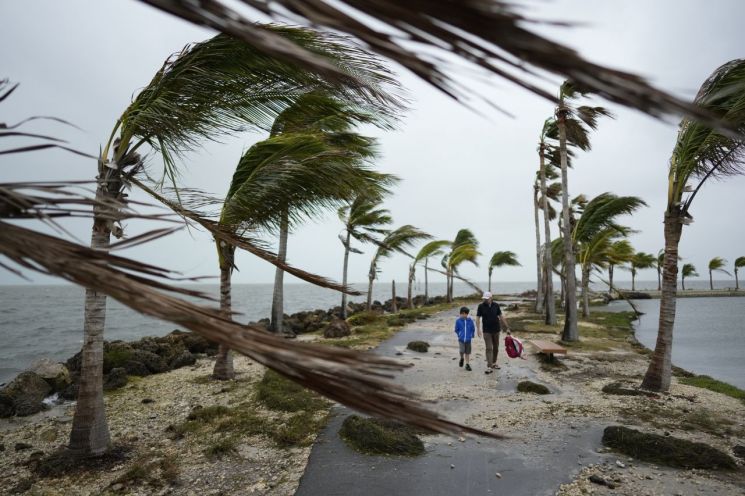
The causes of this high number of hurricanes include the highest recorded sea surface temperatures in the Atlantic since observations began, the development of La Ni?a and El Ni?o phenomena in the Pacific, and reductions in Atlantic trade winds and jet streams. La Ni?a refers to the cooling of sea surface temperatures near the equatorial eastern Pacific, while El Ni?o refers to the warming of sea surface temperatures in the same region.
Ken Graham, director of the U.S. National Weather Service (NWS), stated, "All the factors are in place to produce an active hurricane season." NOAA forecasters estimated an 85% chance of an above-average hurricane season along the Atlantic coast.
This outlook is confirmed by other institutions as well. According to the U.S. Colorado State University and the Barcelona Supercomputing Center, which predict hurricanes annually, an average of 23 storms will occur in the Atlantic this year, with 11 developing into hurricanes, and 5 of those hurricanes reaching Category 3 or higher. Hurricanes are classified into five categories, from the weakest Category 1 to the strongest Category 5.
Category 1 hurricanes have wind speeds of 74 to 95 mph (119 to 153 km/h) and can cause damage to trees and unsecured mobile homes, with damage increasing as the category rises. Category 5 hurricanes have wind speeds exceeding 157 mph (252 km/h) and can cause catastrophic damage to life and property.
The hurricane season generally starts on June 1 and ends on November 30, with the peak usually occurring in late summer and early fall. Global warming is considered a major factor that intensifies the destructive power of hurricanes. As the atmosphere warms, storms approaching the coast are likely to have stronger winds and a higher probability of extreme rainfall.
It is particularly unusual this year that the sea surface temperatures are high while the likelihood of La Ni?a is also increasing. Brian McNoldy, a researcher at the University of Miami, said, "It is hard to find similar conditions in past records. The Atlantic has never experienced such high sea surface temperatures combined with La Ni?a. We are definitely in uncharted territory."
In fact, Hurricane Idalia, which struck the U.S. last year, intensified from Category 1 to Category 4 in just 24 hours. This trend makes hurricane preparedness more difficult and shortens the time residents have to evacuate, which is a major factor in increasing damage.
© The Asia Business Daily(www.asiae.co.kr). All rights reserved.
![Clutching a Stolen Dior Bag, Saying "I Hate Being Poor but Real"... The Grotesque Con of a "Human Knockoff" [Slate]](https://cwcontent.asiae.co.kr/asiaresize/183/2026021902243444107_1771435474.jpg)















