Domestic Sellers Joining eBay Increase by 50% Year-on-Year
Fashion and Beauty Item Sales Rise Due to Hallyu Popularity
Qoo10 and Alibaba Also Operate Cross-Border E-Commerce Platforms
1Q Overseas Cross-Border Purchase Amount Up 37% from Last Year
Domestic sellers (K-sellers) are increasingly engaging in so-called 'reverse direct purchasing' by entering overseas platforms to sell domestic products. Recently, as Chinese overseas direct purchasing platforms (C-commerce) such as AliExpress, Temu, and Shein target domestic consumers, K-sellers are also pioneering new sales channels through overseas platforms.
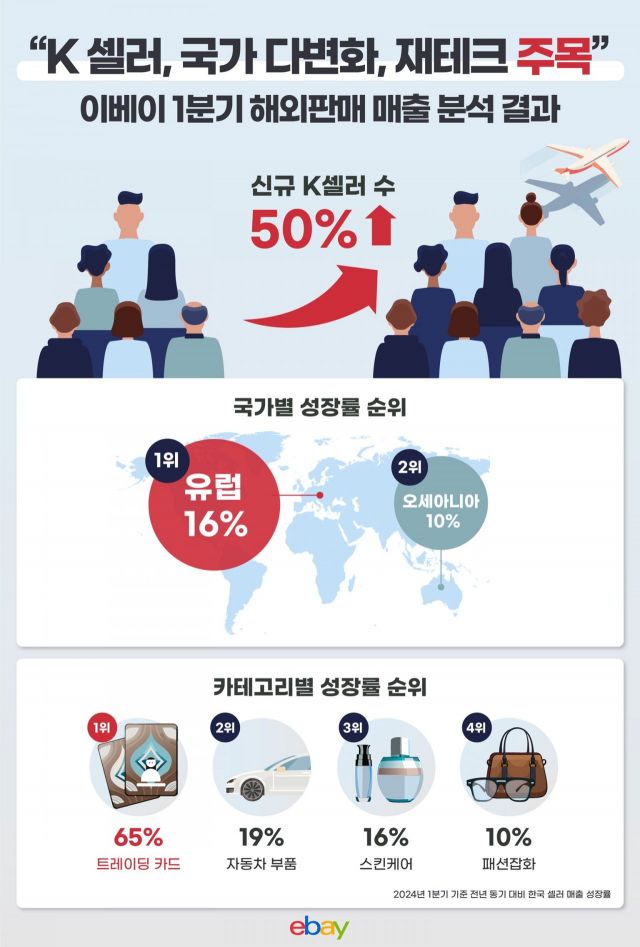
According to eBay Korea on the 24th, the number of domestic sellers who started selling overseas through eBay's e-commerce platform in the first quarter of this year increased by 50% compared to the same period last year.
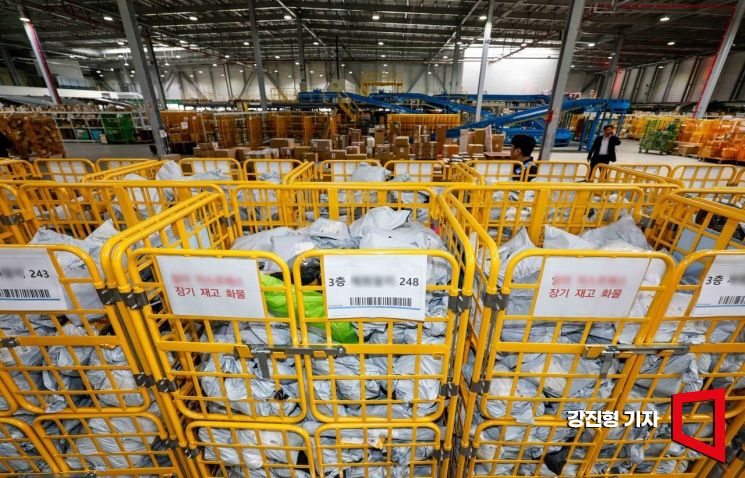 On the 16th, a customs official at the Incheon Airport Customs Express Logistics Center is organizing long-term stock cargo delivered from China. Photo by Jinhyung Kang aymsdream@
eBay Korea diagnosed that many K-sellers have turned their attention overseas due to factors such as the global popularity of K-content, the ongoing 'strong dollar phenomenon,' and intensified competition in the domestic e-commerce market. eBay, a U.S.-based e-commerce company, operates in more than 190 countries worldwide. Korean sellers who join eBay upload products to the platform, enabling them to sell items simultaneously in multiple countries through eBay.com.
The countries where K-sellers on eBay are increasing their sales are also diversifying. In the first quarter of this year, the region with the highest sales growth for domestic sellers was Europe, which saw a 16% increase compared to the same period last year. Oceania, including Australia and New Zealand, followed with a 10% increase. eBay Korea attributes this to the rising demand for Korean products as K-pop gains popularity in these countries.
Looking at the products with significant sales growth by category, trading cards increased by 65% compared to the same period last year. In addition, sales of ▲auto parts (19%) ▲skincare (16%) ▲fashion (10%) also rose. Amid strong exports by domestic automobile companies, fashion and beauty items featured in Korean movies and dramas, part of K-content, are believed to have gained popularity.
Other global e-commerce platforms besides eBay are also supporting K-sellers by building global platforms to help them open new sales channels. Qoo10 recently announced the completion of the integrated platform 'Wish Plus (Wish+),' which combines the e-commerce platform 'Wish' that it recently acquired. Launched in 2010, Wish is a global platform operating in over 200 countries, with more than 500 million app downloads on Android alone. Through Wish Plus, Qoo10 has established a global platform that merges the Asia-focused platform 'Qoo10' with the North America and Europe-focused platform 'Wish.'
Qoo10 expressed its ambition to use Wish Plus as a gateway for exporting Korean products. The plan is to onboard a large number of Korean sellers, focusing on product categories such as beauty, food, and fashion. They expect strong responses from the key market of the U.S., particularly from the 20-40 age group with a favorable view of Korean products, the middle class, and Asian consumers within the U.S.
Alibaba.com, which operates AliExpress, is also running the 'Korea Industry Leader Project' to support Korean companies' overseas exports. This project helps selected domestic companies, chosen through a screening process, to enter the global market with support from Alibaba.com. Alibaba operates B2B platforms such as 'Alibaba.com,' which is active in over 200 countries, as well as e-commerce platforms like 'Lazada' focused on Southeast Asia and 'Miravia' targeting Spanish-speaking regions.
As reverse direct purchasing through global platforms becomes more active, the number of domestic sellers generating sales overseas is also increasing. The growing scale of overseas reverse direct purchasing this year supports this trend. According to Statistics Korea's 'Overseas Direct Sales and Purchase Trends,' online overseas direct sales in the first quarter of this year amounted to 399.1 billion KRW, a 37% increase from 291.3 billion KRW in the first quarter of last year. However, this is a 15.4% decrease compared to the previous quarter, the fourth quarter of last year (471.9 billion KRW).
The country with the highest amount of overseas direct sales in the first quarter was China, with online overseas direct sales to China reaching 243.4 billion KRW. However, duty-free shop sales accounted for the majority at 225.1 billion KRW. Following China were the U.S. (58.2 billion KRW), Japan (54.5 billion KRW), and ASEAN countries (30.8 billion KRW).
© The Asia Business Daily(www.asiae.co.kr). All rights reserved.
![Clutching a Stolen Dior Bag, Saying "I Hate Being Poor but Real"... The Grotesque Con of a "Human Knockoff" [Slate]](https://cwcontent.asiae.co.kr/asiaresize/183/2026021902243444107_1771435474.jpg)
















