Seoul National University-Ewha Womans University Joint Research Team Develops Next-Generation Artificial Olfaction System Using AI
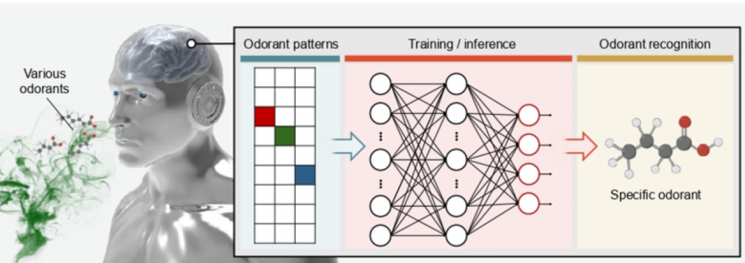 Schematic diagram of the pattern recognition-type next-generation neuromorphic artificial olfactory system. This system detects odor substances, forms unique patterns, and then infers the odor substances through neural network learning using these patterns.
Unlike the extensively studied human senses of vision and hearing, olfaction and taste are unique fields. Artificial olfaction technology, or the "electronic nose," remains at a level far below actual olfactory performance. This is because olfaction must recognize much more complex chemical outputs compared to vision and hearing.
While human olfaction patterns and distinguishes a variety of complex odor substances, artificial olfaction technology has mainly been limited to discriminating single substances or mixtures of substances that are very easy to distinguish. A technology that can solve this problem through artificial intelligence (AI) has been developed by a domestic research team.
On June 27, a joint research team led by Professor Junhak Oh of the Department of Chemical and Biological Engineering at Seoul National University and Professor Taehyun Park of the Department of Food and Nutrition at Ewha Womans University announced the development of a next-generation artificial olfaction system combining human olfactory receptors with neuromorphic devices.
The artificial olfaction system mimics human olfaction to detect and analyze odors. It is expected to bring innovative changes in various fields such as healthcare, security, environment, and food. This system, with fast detection speed and high accuracy, enables real-time monitoring of compound types and concentrations. It can also be used in environments difficult for humans to access, making it recognized as an important technology that opens new application areas.
The joint research team created three types of human olfactory receptors as nanodiscs and introduced them into neuromorphic devices. The developed system shows high sensitivity to various odor substances through the olfactory receptors. Additionally, based on the neuromorphic device, it was able to recognize and learn odor information patterns and then infer unknown odors.
The research team explained that a notable achievement of this study is that the artificial olfaction system can distinguish various odor substances at the molecular chain length level through artificial neural network learning, as well as discriminate mixtures of these substances with very high accuracy.
Professor Taehyun Park said, "The neuromorphic device, which mimics the human brain, learns and infers the unique pattern information of odor substances created by the olfactory receptor array, making it very similar to human olfaction," adding, "We expect this research result to greatly contribute to the on-device implementation of olfaction."
Professor Junhak Oh stated, "This is an innovative research result that can be applied to various fields such as biomedical areas for patients with anosmia or hyposmia and neural interface technologies connecting the brain and computers, as it introduces actual human olfactory receptors into a neuromorphic system that mimics the human brain."
The research results were published in the prestigious international journal Science Advances. This research was conducted with support from the Ministry of Science and ICT and the National Research Foundation of Korea through the Mid-career Researcher Support Program, Basic Research Laboratory Support, Nanomaterial Technology Development, as well as support from the Toray Science Foundation and the Ministry of Trade, Industry and Energy.
▲Neuromorphic: A neologism combining the words neuron and morphic, referring to technology or systems designed by mimicking the structure and function of the human brain.
© The Asia Business Daily(www.asiae.co.kr). All rights reserved.

















