Four Years Since the Revised Road Traffic Act Enforcement
486 Child Traffic Accidents Last Year
0.6% Increase Compared to 2020
Although the so-called 'Minsik Act,' which limits vehicle speeds and strengthens enforcement and penalties within school zones, has been in effect for over four years, the total number of traffic accidents involving children has not significantly decreased. This points to the limitations of reducing accidents solely through stricter penalties and enforcement.
According to the National Police Agency on the 24th, there were 486 traffic accidents involving children aged 12 and under in school zones last year, a 0.6% increase compared to 483 cases in 2020, when the revised Road Traffic Act was first implemented. Compared to 514 cases in 2022, the number of accidents only slightly decreased by 5%.
The number of fatalities remained at a similar level. Last year, two children died in school zone accidents, maintaining a range of two to three deaths annually over the past four years.
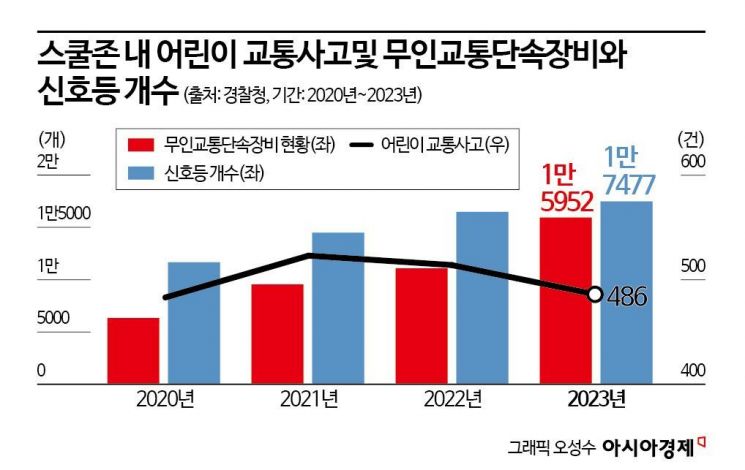
Although the government has taken measures such as significantly increasing the number of enforcement devices in school zones and limiting travel speeds to 30 km/h since the revised Road Traffic Act came into effect, these efforts have had minimal impact on substantially reducing accidents.
In fact, the number of traffic lights installed nationwide in school zones last year was 17,477, 1.5 times more than the 11,652 installed in 2020. The number of unmanned traffic enforcement devices recorded in the same year was 15,952, a 2.5-fold increase from 6,336 in 2020.
However, the number of traffic violations actually increased. Last year, a total of 6,712,004 violations were detected by unmanned cameras in school zones nationwide, a 3.5-fold increase compared to 2020. Even considering the increase in enforcement devices during this period, the rise in violations is substantial.
A police official explained, "(The number of child traffic accident fatalities) basically remains in the single digits, so the margin of increase or decrease is inevitably small," adding, "According to the Organization for Economic Cooperation and Development (OECD) standards, Korea ranks among the higher levels in child traffic protection."
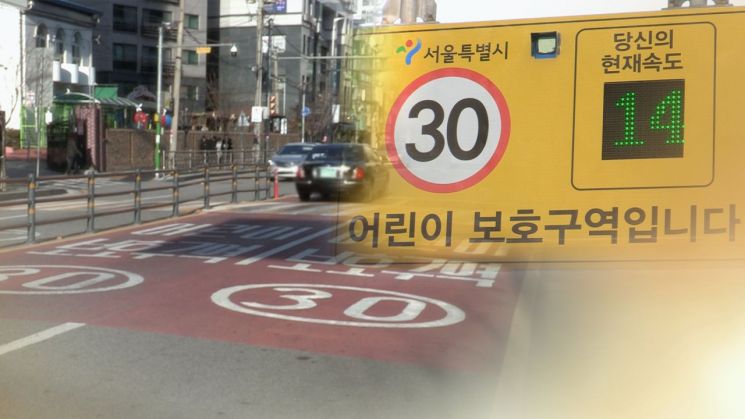
On the other hand, some argue that to effectively reduce the number of accidents, the criteria for designating school zones need to be refined. Under current law, in addition to kindergartens and elementary schools, areas recognized as needing child protection can be additionally designated as school zones through discussions between local government heads and provincial police chiefs. However, there are cases where areas with low child pedestrian traffic are designated as school zones, which is analyzed to have limited effectiveness in reducing child traffic accidents.
Professor Choi Jaewon of the Korea Road Traffic Authority said, "The designation of school zones should be refined based on actual surveys of child pedestrian traffic," adding, "If a section has few children passing through, the designated school zone area should be able to be relocated elsewhere. Precise investigations and designations are expected to enhance enforcement and accident reduction effects."
The need to improve safety facilities within school zones has also been raised. While some accidents occur due to driver negligence such as drunk driving or failure to comply with speed limits, many accidents also happen due to a lack of safety facilities like protective fences and the absence of sidewalks.
Senior Researcher Cho Junhan of the Samsung Traffic Safety Culture Institute explained, "In school zones where the road width is less than 9 meters, sidewalks cannot be installed on both sides, causing vehicles and pedestrians to share the road, which often leads to accidents," adding, "In places where sidewalk installation is difficult, it is necessary to designate pedestrian-priority roads where pedestrians have the right of way over vehicles."
He continued, "On four-lane roads or locations with downhill slopes, it is important to install anti-jaywalking facilities such as central dividers and protective fences in appropriate places to create safe school routes," emphasizing, "Ensuring that safety facilities are properly secured is crucial."
© The Asia Business Daily(www.asiae.co.kr). All rights reserved.
![Clutching a Stolen Dior Bag, Saying "I Hate Being Poor but Real"... The Grotesque Con of a "Human Knockoff" [Slate]](https://cwcontent.asiae.co.kr/asiaresize/183/2026021902243444107_1771435474.jpg)
















