Avoiding War Risk, Taking Detour Route
Flying 85km Further Than Existing Path
May Disrupt Breeding Schedule
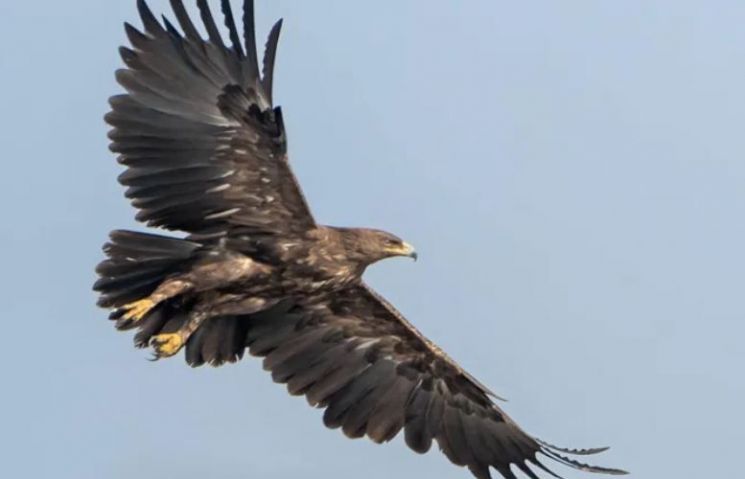
A representative migratory bird, the eagle, has been found to have changed its flight path over the past two years. This is due to the prolonged war in Ukraine. However, by choosing a route that is more difficult and longer than the previous flight path, there is growing concern that the eagles' lives are also at risk.
On the 22nd (local time), the BBC reported on the eagle flight path research results from the British Trust for Ornithology. Scientists affiliated with the organization attach GPS tracking devices to the legs of eagles to monitor the migratory routes of the birds annually. However, it is said that the flight routes of eagles have changed drastically over the past two years.
The timing of the route change was February 2022. Coincidentally, this coincides with the period when Russia invaded Ukraine. At that time, Russian armored units crossed the Ukrainian border and moved south, leading to intense battles across northern Ukraine.
Charlie Russell, a researcher at the University of East Anglia in the UK who led the study, said, "It is true that the war in Ukraine has had a tremendous impact on people and the environment," adding, "This study provided a rare opportunity to capture how human warfare affects the natural world."
The eagles being tracked by the research team are Greater Spotted Eagles. They are about 65?75 cm in size and were designated as a second-class endangered wild species in 2017. In Korea, they arrive around October each year and inhabit until March of the following year as winter migratory birds. They prey indiscriminately on rodents, mammals, amphibians, insects, other birds, and animal carcasses.
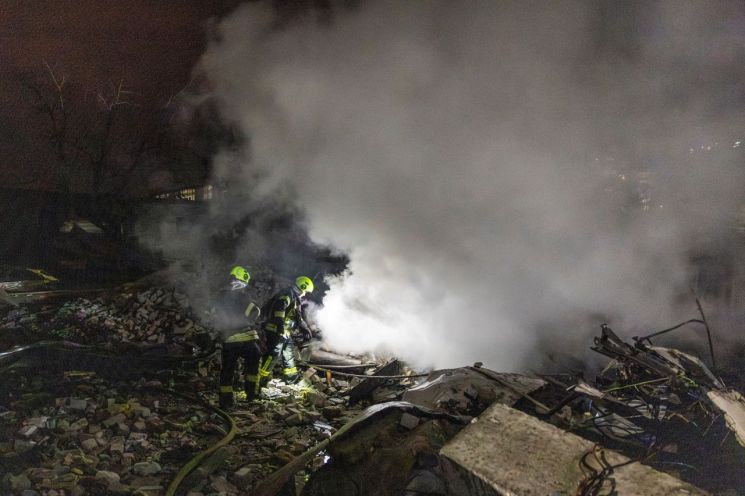 Firefighters in Kramatorsk, a major city in Donetsk Province, Ukraine, are extinguishing the remaining flames at a water purification plant destroyed by Russian missiles.
 [Image source=Yonhap News]
Animal protection and research organizations have been tracking the movements of Greater Spotted Eagles since 2017. However, no one expected that the migratory routes would change due to the war.
Now, the Greater Spotted Eagles are traveling an average of 85 km farther than before. But the bigger problem is that they no longer have time to "refuel." Migratory birds need to stop at several intermediate resting points before reaching their destination to rest sufficiently and replenish calories, but now safe resting spots have disappeared.
Because of this, it is highly likely that they arrive at their destination in an extremely exhausted state, raising concerns that their breeding schedules may be disrupted. Researcher Russell said, "For wild animals with small populations, any variable that interferes with breeding threatens the entire species," adding, "From a biologist's perspective, this is a very worrying situation."
© The Asia Business Daily(www.asiae.co.kr). All rights reserved.
![Clutching a Stolen Dior Bag, Saying "I Hate Being Poor but Real"... The Grotesque Con of a "Human Knockoff" [Slate]](https://cwcontent.asiae.co.kr/asiaresize/183/2026021902243444107_1771435474.jpg)
















