Ruling Party Emphasizes Prosecution First in Public Corruption Investigation Office, Calling It "Political Conflict's Dark Intent"
Opposition Threatens "Impeachment Possibility"
Ruling Party Faces Internal Rift if Many Defections Occur
With the National Assembly plenary session scheduled for the 28th to reconsider the 'Chae Sang-byeong Special Prosecutor Act,' attention is focused on whether more than 10 dissenting votes will emerge within the People Power Party. Assuming all incumbent lawmakers attend the plenary session, the Special Prosecutor Act will pass if at least 17 members of the People Power Party vote in favor. Although the party is confident the bill will be rejected internally, it is difficult to predict the outcome prematurely since 58 People Power Party candidates lost or were not nominated in the April 10 general election.
The People Power Party is opposing the opposition's reconsideration of the Special Prosecutor Act, calling it a 'political conflict provocation.' They criticize the Democratic Party's attempt to handle matters under investigation by the High-ranking Officials' Crime Investigation Unit (HOCI) through the Special Prosecutor Act as 'self-contradictory' and point out it is a "dark intention to drag the issue into political strife." On the 24th, at a party strategy meeting held at the National Assembly, Floor Leader Choo Kyung-ho emphasized, "Representative Lee Jae-myung said the introduction of HOCI aims to realize the value of equality before the law through investigations without sanctuary, and Floor Leader Park Chan-dae said the establishment of HOCI was former President Moon Jae-in's first pledge and a core of prosecutorial reform."
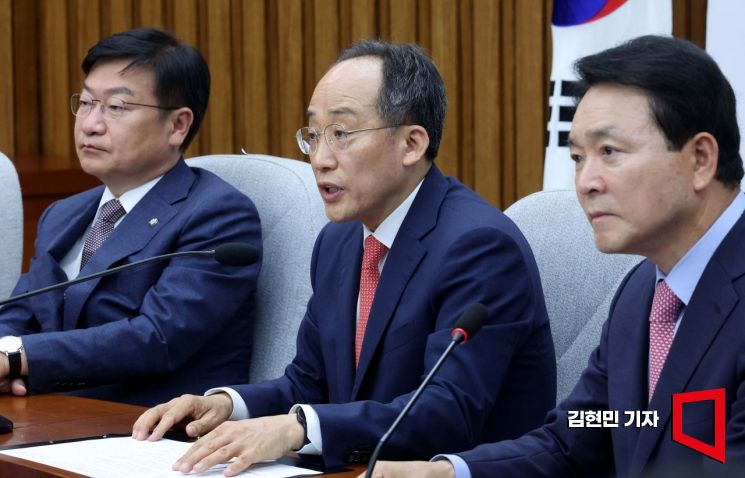 Chu Kyung-ho, floor leader of the People Power Party, is speaking at the floor strategy meeting held at the National Assembly on the 24th. Photo by Hyunmin Kim kimhyun81@
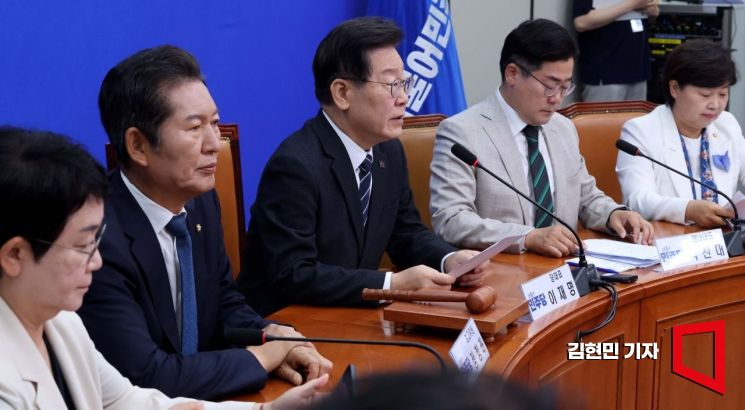 Lee Jae-myung, leader of the Democratic Party of Korea, is speaking at the Supreme Council meeting held at the National Assembly on the 24th. Photo by Hyunmin Kim kimhyun81@
On the other hand, the opposition, including the Democratic Party, is attempting to enforce the Special Prosecutor Act as the 'will of the people.' Having already emphasized the president's autocratic image through the veto, they are now threatening impeachment if the Special Prosecutor Act is vetoed. Recently, within the Democratic Party, there have been moves to appoint Choo Mi-ae as the chair of the Legislation and Judiciary Committee, a strategy to regain the party loyalty of hardline supporters who defected following Woo Won-shik's election as National Assembly Speaker. The Special Prosecutor Act also appears to be a means to rally the support base again. On the 24th, at a Supreme Council meeting at the National Assembly, Democratic Party Floor Leader Park Chan-dae warned, "It is more accurate to call it a conscience vote rather than a dissenting vote," adding, "If you oppose the veto against overwhelming public opinion and vote against it, you will be swept away by the people's anger and meet your end alongside unjust power."
Within the People Power Party, as of the 24th, no one besides lawmakers Kim Woong, Ahn Cheol-soo, and Yoo Ui-dong has publicly expressed support for the Special Prosecutor Act. However, since 58 People Power Party candidates lost or were not nominated in the last election, predictions are uncertain. They appear to have not yet made up their minds. A lawmaker nearing the end of their term said in a phone interview, "Attending the plenary session is a duty of a lawmaker," but added, "Voting is a secret ballot in principle, so I cannot comment."
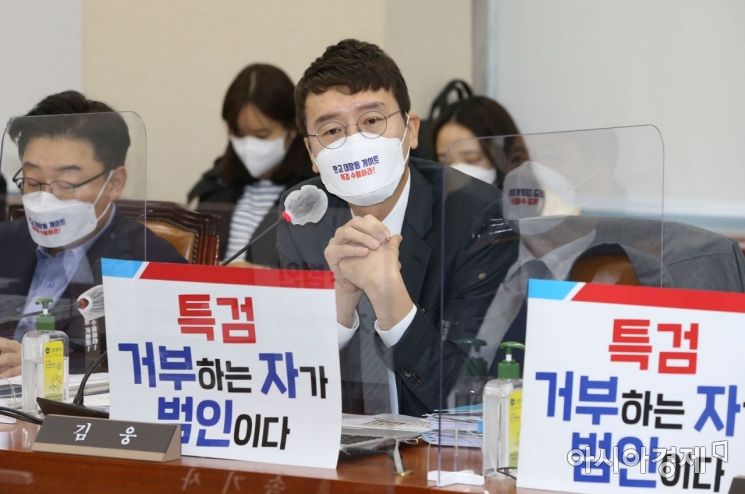 Kim Woong, a member of the People Power Party, is questioning Ahn Kyung-duk, Minister of Employment and Labor, during the National Assembly's Environment and Labor Committee's audit of the Ministry of Employment and Labor held at the National Assembly on the 21st. Photo by Yoon Dong-joo doso7@
Choe Guk, leader of the Choe Guk Innovation Party, said on MBC Radio on the 24th, "Those who lost nomination or election will return to politics in the by-elections next year or the general election four years later, by which time the Yoon Seok-youl administration will have either completely weakened or ended," adding, "Besides Kim Woong, Ahn Cheol-soo, and Yoo Ui-dong, I know of about three more people who think they should support it considering two or four years from now." He also predicted, "When the 22nd National Assembly convenes, they will likely push for the Special Prosecutor Act again. If it is confirmed that additional votes in favor come from beyond those three, it will cause a split."
Heo Eun-ah, leader of the Reform New Party, told reporters after a Supreme Council meeting on the 24th regarding dissenting votes from the ruling party, "Our internal survey showed about 10 votes, but now that vote monitoring has been strengthened, we will have to wait and see." She added, "(People Power Party lawmakers) find it difficult to respond. They have many thoughts and seem cautious about areas without secrecy," and said, "I understand that not only we but also the Democratic Party and other parties are continuously persuading them."
Even if dissenting votes do not reach 17, if they exceed 10, the Special Prosecutor Act will be rejected in this plenary session, but the outcome in the 22nd National Assembly cannot be guaranteed. With only 108 seats, the People Power Party's veto can be nullified if just eight members defect. Since lawmakers Ahn Cheol-soo, Kim Jae-seop, and Han Ji-ah have already expressed support for the Special Prosecutor Act, internal control may become more difficult in the 22nd National Assembly depending on this vote's outcome.
© The Asia Business Daily(www.asiae.co.kr). All rights reserved.



















