Minister Lee Sang-min Emphasizes Commitment to 'Medical Reform'
Daekyo Association Reviews Next Year's College Admission Changes
Medical School Expansion to Be Confirmed After 27 Years
4 of 9 National Universities Face Challenges Revising Academic Regulations
As the collective action by doctors opposing the government's increase in medical school admissions has surpassed three months, the government has proposed to engage in dialogue with the medical community without any predetermined framework. With the Korea Council for University Education (KCUE) finalizing the university admission plan on the 24th, marking the procedural completion of the medical school expansion, the government also urged resident doctors to return to their duties.
Lee Sang-min, Minister of the Ministry of the Interior and Safety (Deputy Head of the Central Disaster and Safety Countermeasure Headquarters), stated at the Central Disaster and Safety Countermeasure Headquarters meeting held at the Government Seoul Office on the morning of the 24th, "The government will actively engage in dialogue with the medical community without restrictions on format or agenda," adding, "We ask the medical community to now come to the dialogue table and join us in reforming the broad framework of the Republic of Korea's healthcare system."
Minister Lee also emphasized that resident doctors should return to the field and participate in the dialogue. He said, "To all resident doctors, please no longer ignore the public's anxiety and patients' suffering, and promptly return to the patients' side," and "As the future leaders of healthcare, we ask you to actively participate in discussions and fully express your on-site opinions."
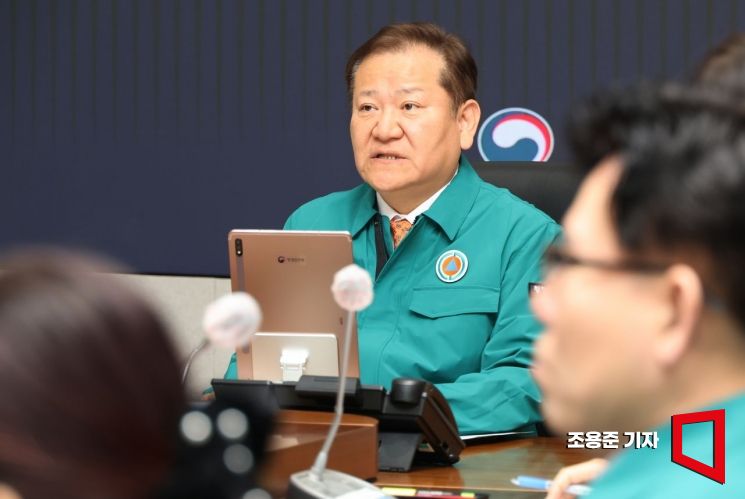 On the 29th, the final day of the deadline for residents to return set by the government, Lee Sang-min, Minister of the Interior and Safety, attended the Central Disaster and Safety Countermeasures Headquarters meeting held at the Government Seoul Office in Jongno-gu, Seoul, and delivered opening remarks. Photo by Jo Yong-jun jun21@
The government is deliberating carefully on disciplinary measures for resident doctors who have not returned. Although the initial stance was a tough response, as the departure of resident doctors has prolonged, problems have accumulated in the medical field. Not only is there a palpable 'medical crisis' felt by patients, but resident doctors preparing for the specialist exam early next year may lose their eligibility due to insufficient training periods.
However, the government’s determination for 'medical reform' remains firm. Minister Lee stated, "Medical reform is an urgent task that can no longer be postponed to save essential and regional healthcare in crisis," and "While making every effort to quickly resolve public inconvenience, the government will also steadfastly pursue reforms to normalize healthcare."
As the procedure to reflect the increase in medical school admissions in the university entrance examination system is effectively concluding on this day, the government will continue discussions on medical reform. The Presidential Committee on Medical Reform held its first meeting of the 'Medical Workforce Expert Committee' under its umbrella to discuss measures to reduce resident doctors' working hours.
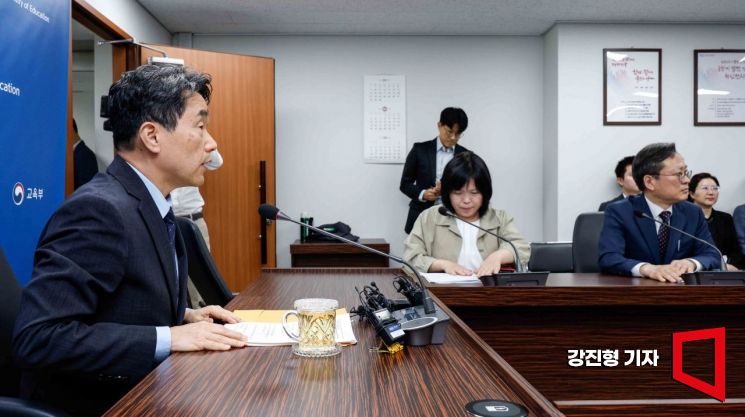 Lee Ju-ho, Deputy Prime Minister for Social Affairs and Minister of Education, is delivering opening remarks at the "Medical School Operating University Presidents' Meeting" held on the 20th at the Korea Educational Facilities Safety Institute in Yeongdeungpo-gu, Seoul. Photo by Kang Jin-hyung aymsdream@
On the same day, the KCUE held the second University Admission Committee meeting of the year at 2:30 p.m. at the Conference House Dalgaebi in Jung-gu, Seoul, to review and finalize changes to the '2025 University Admission Implementation Plan.' This marks the first increase in admissions in 27 years since 1998.
The total number of admissions for 40 medical schools nationwide next year will increase by 1,509 from the previous year to 4,567. The finalized implementation plan will include how each university will select the increased number of medical students, the selection ratio for regional talent admissions, and the proportions of early and regular admissions. Once the KCUE finalizes the plan, universities will publish the early admission guidelines containing these details on their websites by the 31st of this month.
However, last-minute difficulties continue within universities. Among nine national universities, four have either rejected or postponed amendments to their academic regulations. Kyungpook National University rejected the amendment at its council meeting the previous day. Jeju National University also held a faculty council meeting on the same day to reconsider the amendment but decided to postpone the agenda. Gyeongsang National University and Jeonbuk National University rejected the academic regulation amendments reflecting the medical school expansion at their respective faculty and university councils on the 22nd.
The Ministry of Education maintains that even if the academic regulation amendments are not finalized at each university, the admission process for next year can proceed with the increased number of students. This is because, under the Higher Education Act, the university president holds the final authority.
© The Asia Business Daily(www.asiae.co.kr). All rights reserved.
![Clutching a Stolen Dior Bag, Saying "I Hate Being Poor but Real"... The Grotesque Con of a "Human Knockoff" [Slate]](https://cwcontent.asiae.co.kr/asiaresize/183/2026021902243444107_1771435474.jpg)
















