La Nina Occurrence Probability Increases... Crop Yields May Be Hit
Climate Inflation Expected Due to Abnormal Weather
The rebound of exchange-traded funds (ETFs) related to agricultural products is showing unusual signs. Despite a downward trend over the past two years and hitting 52-week lows until last month, they have recently shown signs of recovery. Experts advise paying attention to investments in agricultural product-related ETFs, as agricultural prices are expected to continue rising due to the high probability of La Ni?a, abnormal weather, and geopolitical risks predicted for this year.
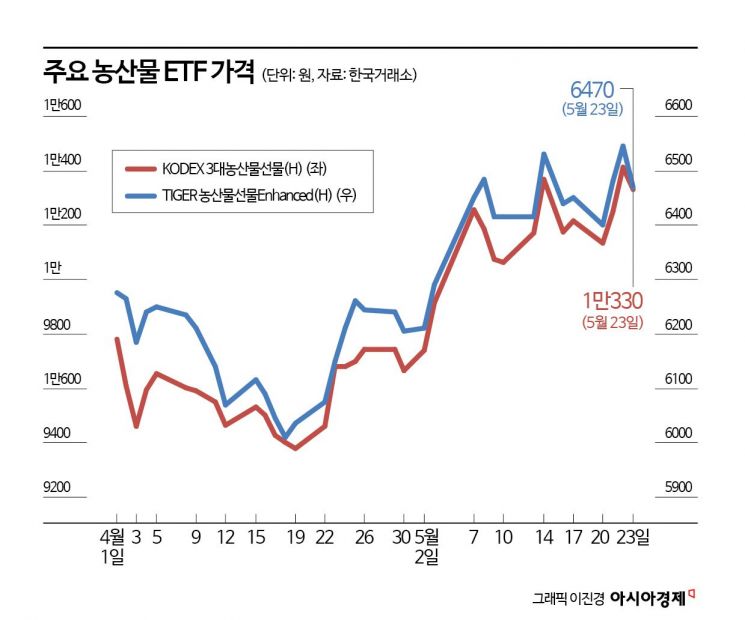
According to the Korea Exchange on the 24th, as of the closing price on the 23rd, ETFs investing in representative agricultural products such as corn, soybeans, and wheat, namely KODEX 3 Major Agricultural Products Futures (H) and TIGER Agricultural Products Futures Enhanced (H), rose by 9.20% and 6.50%, respectively, over the past month. This is because grain prices, which had been declining steadily since the second half of 2022, began to rebound from April.
The recent rebound in grain prices is interpreted as being due to La Ni?a, which is highly likely this year. The Climate Prediction Center (CPC) of the U.S. National Oceanic and Atmospheric Administration (NOAA) forecasted that the probability of La Ni?a occurrence will gradually increase toward the end of the year, reaching 86% in the fourth quarter. La Ni?a refers to a situation where the sea surface temperature in the eastern Pacific Ocean remains at least 0.5 degrees Celsius below average for five months or more.
When La Ni?a occurs, it causes heavy rainfall in the major grain-producing areas of southern China, worsening crop conditions. It also causes droughts in major grain-producing regions such as the United States, Argentina, and Brazil, which produce about 80% of the world's corn and soybeans, thereby reducing crop supply. Choi Jin-young, a researcher at Daishin Securities, said, "El Ni?o, which had been holding back the rebound in grain prices, has ended, and La Ni?a is now expected," adding, "From the second half of this year, upward pressure on grain prices will expand significantly." He further explained, "Since we are currently in a neutral phase transitioning from El Ni?o to La Ni?a, price ceilings are inevitable," but emphasized, "Attention should be paid to heavy rains in Southeast Asia and southern China, which are part of La Ni?a phenomena."
Additionally, La Ni?a induces cold waves in the United States, increasing heating demand. As the price of natural gas, which is needed for heating, rises, the price of nitrogen-based fertilizers, which use natural gas as a raw material, also increases, potentially passing on to grain prices.
Furthermore, abnormal weather caused by global warming and geopolitical risks are also expected to influence the rise in agricultural product prices. Kim Dae-jun, a researcher at Korea Investment & Securities, said, "Crop production has decreased and prices have risen due to weather anomalies such as droughts and heavy rains around the world," adding, "Spain has experienced drought for two years, and Brazil has seen record heavy rains, causing agricultural prices to rise." He also noted, "The U.S. Department of Agriculture has mentioned the possibility of supply disruptions due to geopolitical risks as a factor for crop supply shortages."
© The Asia Business Daily(www.asiae.co.kr). All rights reserved.
![Clutching a Stolen Dior Bag, Saying "I Hate Being Poor but Real"... The Grotesque Con of a "Human Knockoff" [Slate]](https://cwcontent.asiae.co.kr/asiaresize/183/2026021902243444107_1771435474.jpg)















